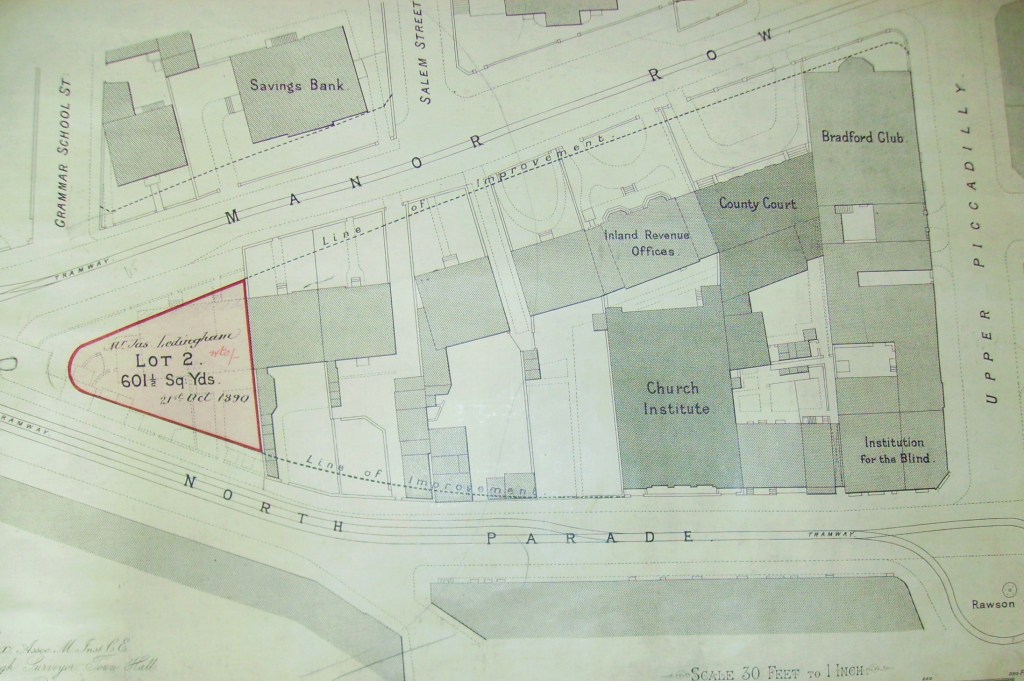
The Local Studies Library reserve collection has this sale plan which shows the junction of Manor Row and North Parade. It is worth studying because of the important buildings present in adjacent streets. The apex of the built area is marked Lot 2 and has a date, 21 October 1890, and a name James Ledingham.

The building that was eventually constructed on this site in 1894, the Yorkshire Penny Bank, will be familiar to everyone. The bank was designed by architect James Ledingham, is Grade II listed, and was constructed of sandstone ashlar. It just about survived a century but was shut in 1998 and now operates periodically as a public house.

An early plan of the site available to me is this detail from the town map of 1848. The future site of the bank is empty, and the actual junction of Manor Row and North Parade is labelled as ‘Pipers Grave’, although no structure is indicated in this position. I was puzzled by this name, which I should add can be spelled variously as ‘Piper’s Grave’ or ‘Piper Grave’. Older Bradford citizens clearly recognise the designation, indeed knowledge of its whereabouts seems to have been used as a test of a ‘true Bradfordian’. Until recently I, an immigrant from East Sussex, would have failed. There seems to be no accepted explanation for the origin of the name, nor even whether the piper was a musician (possibly a street entertainer) or a man who made clay pipes. Both would be perfectly possible professions in old Bradford.

The area is also covered by this detail from John Wood’s earlier 1832 Bradford map but there is no Piper’s Grave. It is a very useful map however and covers local landowners very fully.
The first mention of Piper Grave I can find in local newspapers is in the Bradford Observer of 1838. The public procession marking the coronation of Queen Victoria made a turn there. There are other mentions of the name in the 1830s, and in 1849 the Bradford Observer reports that there was space for three Hackney carriages in the open ground at Piper Grave. The 1852 6” OS map provides no additional information. The name must have been a puzzle even then since in 1855 the newspaper, quoting John James, suggests that the name may have been employed because it was the burial place of a piper who committed suicide. Such a one might not be buried in a churchyard, but to me the explanation sounds like pure guesswork. The newspaper itself describes it as ‘very apocryphal’.

History takes over in the next decade. The Bradford Observer of April 1860 informs its readers that a drinking fountain was to be erected at Pipers Grave. I can illustrate this with a photograph from the LSL collection. A report the following year stated that the fountain was in the process of erection, but a complaint was made that it was not aligned with Manningham Lane nor Manor Row. The report confirmed that it was a ‘Band of Hope’ fountain, and it had been place ‘upon a large stone’. Could the same ‘large stone’ have ever been mistaken for a gravestone I wonder?

At some date unknown to me the fountain must have interfered with traffic flow and have been moved to Peel Park. It has survived in the new location but it is no longer functional. In 1862 additional fire hydrants were affixed at Piper Grave and the last mention I have tracked down was in 1871 when the local street lines were under discussion by the Council. We know that the Penny Bank was constructed in the early 1890s but that is slightly too early for it to appear on the 1890 25” OS map. The site is not then labelled as Piper’s Grave in that map, nor is there a drinking fountain identified.
In the early 20th century there is an labelled feature identified in front of the newly built bank. Oral history recounts that there were public toilets on this spot in the post-War period, which are now long vanished. In fact, the urinal first appears labelled in the 1915 25” OS map, but the name Pipers Grave doesn’t bother the map-makers after 1848; the rest, as they say, is silence.
 Bradford and District Libraries Map Collections
Fascinating research and article, thank you. Intriguing mystery. Undertake immediate excavation to locate the ‘large stone’…
LikeLike