
This plan of the Bradford end of Manningham is dated 1846 and was originally created by the well-known surveyor JB Ingle. I assume the names are those who originally purchased plots when the land was sold off. Regular readers of this series will not be surprised to learn that the original vendor appears to be Rev. Godfrey Wright, as this detail from his earlier property map confirms (see the plot at 12 o’clock).

Ink annotations indicated that the Manningham map was employed in 1855 as evidence in an action in Chancery: John Child vs. James Douglas.

Appended are the signatures of John Thompson (and elsewhere James Duckit) who I assume are lawyers involved in the action. Witnesses providing evidence included Thomas Dixon and Richard Gration Child. Who are the plaintiff and defendant?
Richard Gration Child (1823-1865) is easy to identify because of his unique name. He was a schoolmaster teaching (according to the 1851 census return): English, Natural Philosophy, Fine Arts and Mathematics. Both his father and brother were called John Child, and both were also local schoolmasters. Either could be the plaintiff. Richard married Elizabeth Child in Skipton in 1850. They lived at Houghton Place and then (in the 1851 census) Drewton Street. The only plausible defendant called ‘James Douglas’ lived in Drewton Street in 1851 where he is a neighbouring general practitioner.
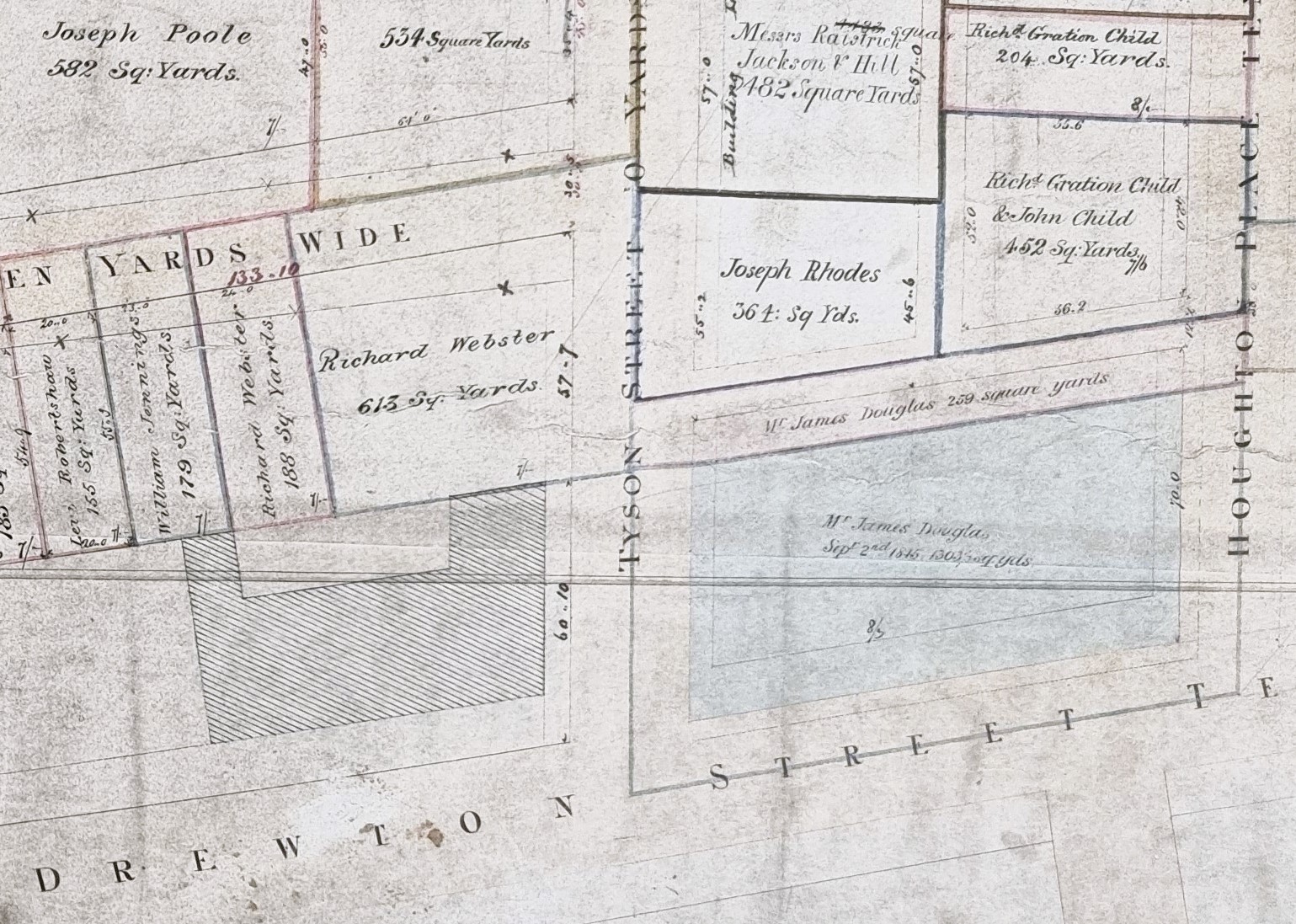
The properties of both men are marked on the map. I cannot find any further legal details of the action, but since a property map is included as evidence it can hardly have been a disagreement over fees for professional services.

Other areas on the map remind us that the nineteenth century was an age of faith. I initially assumed that the chapel in Roberts Street was the Zoar Baptist Chapel, constructed in 1846. But this was actually in the ‘next street up’ – Darfield Street. There was a nearby Wesleyan Reform chapel, but this was on the opposite side of Westgate. At the top of the map with a frontage on Lumb Lane is land belonging to the Scotch Presbyterian Church but the ‘Scotch Kirk’ itself was at the junction of Simes Street and Infirmary, just off this map to the south. So, the Roberts Street/Infirmary Street chapel must be a General Baptist chapel whose dates were 1850-1914. Along Westgate is a building belonging to the ‘new’ Baptist Church, associated with a date of 1844. At present this attribution still puzzles me.
 Bradford and District Libraries Map Collections