
I have been working with the huge collection of Local Studies Library maps for years, but I have been very slow to make some obvious connections. Those maps in the best condition are mounted and available to the public. The same areas or events may be covered by maps and plans in far poorer condition, which are in the Reserve Collection and not easily available.
In this instance the first image is a detail from a sale plan from 1837 (BRA 1837 PLA): the noted lawyer Samuel Hailstone (1768–1851) is selling a large estate in Bradford. It is clearly his own property, and he is not simply acting as an agent. The land stretches from Wakefield Road to Bowling Lane (now Manchester Road). Can you tell where we are? The second and third images will help.

At the top right is Goodmansend and the Friends Meeting House; south-east of this would shortly be used for the construction of the Bridge Street Chapel of the Free Methodist Church.
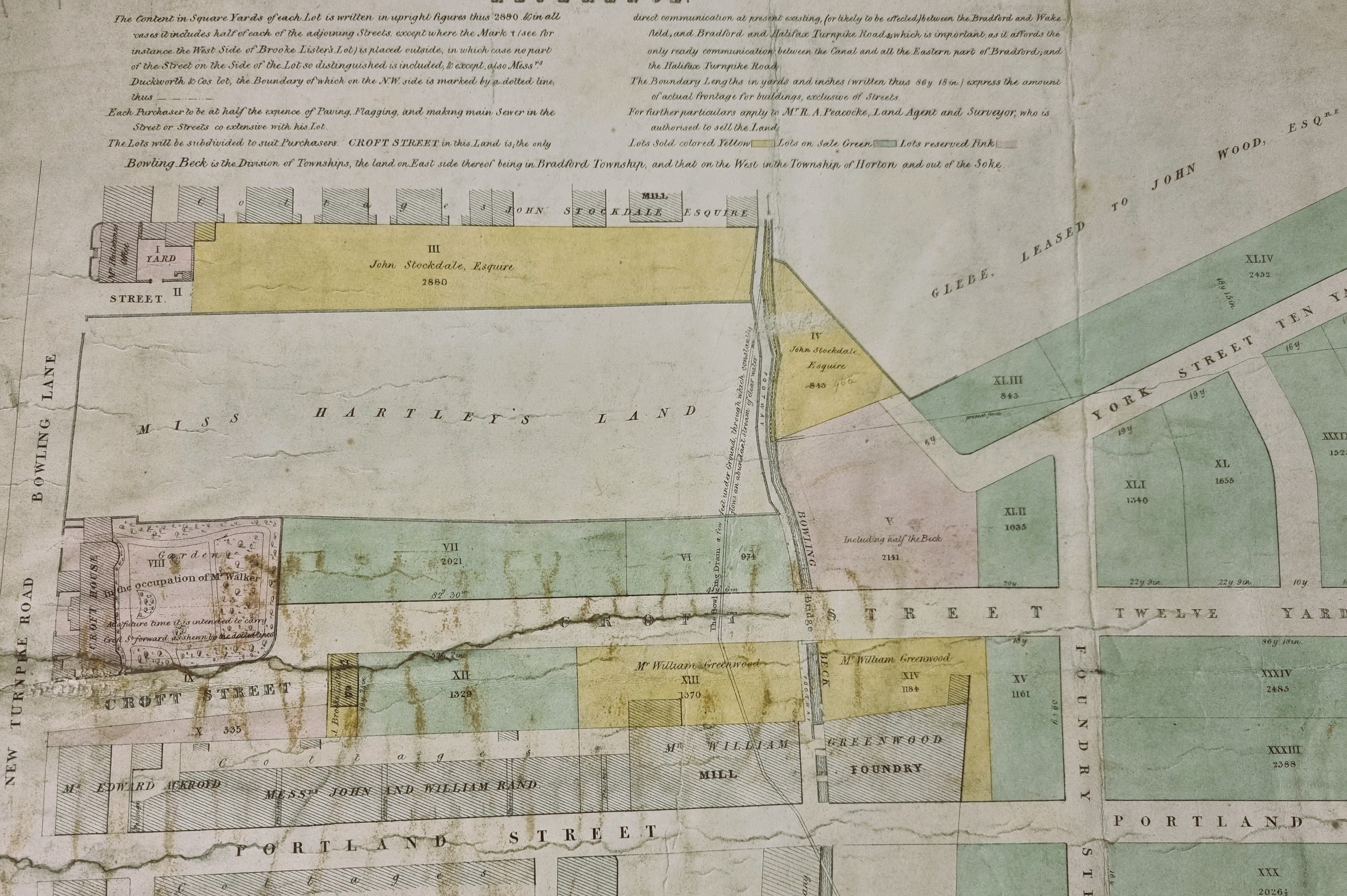
The street grid extends to the left where there is the Bowling Beck, a good deal of the land would ultimately be sacrificed to the Great Northern Railway Co. Croft Street took its name from Croft House, in Bowling Lane, which was where Samuel Hailstone lived in his early years. You can see Croft House at the middle left edge of the plan. Today Croft Street is now largely a railway bridge.
Samuel Hailstone (1768-1851) was a lawyer and a botanist. His brother John Hailstone MA FRS took holy orders and became a professor of geology at Cambridge. Samuel himself was born in Hoxton, London but his family soon moved to York. In time he became articled to John Hardy, a Bradford solicitor, and Hardy & Hailstone eventually became partners. I understand that Samuel and John Hardy were the moving spirits behind the 1803 Bradford Improvement Act. More than forty years before Bradford became a borough this act established commissioners with a variety of local government powers such as street cleaning, lighting, and water provision. Samuel continued to practise as a solicitor and was later in partnership with the Thomas Mason who became a director of the Bolling Iron Company and lived at Bolling Hall. Samuel Hailstone was the classic example of a wealthy and highly successful professional man. His politics were Liberal and, slightly unusually for non-conformist Bradford, he was an Anglican. He purchased the Bolton House estate although he never resided there. I get the impression that Yorkshire botany and geology were Samuel’s main interests. A collection of more than 2000 plant specimens was passed to the Yorkshire Museum on his death.
But despite his studies Hailstone was active in issues affecting his chosen town. He helped found the Bradford Literary & Philosophical Society, also the Mechanics Institute. He served as a major in the Bradford Volunteer Infantry and was clerk to the Trustees of the Leeds and Halifax Turnpike Road and other committees and organisations. In 1808, quite late in life, Samuel married Ann Jones the daughter of a Bradford surgeon, and the couple had several children. Samuel died at Horton Hall, Bradford in 1851.
The Hailstones were a very high achieving family. One son, Samuel jnr., was also a noted amateur naturalist and a collector of crustacea. He pre-deceased his father in 1841. There were two surviving sons, Rev John Hailstone (1810-1871), the vicar of Bottisham, Cambridgeshire, and Edward Hailstone FSA (1818-1890). Edward took over the Bradford legal practice but is famous for a huge assembly of books and documents relating to Yorkshire history, especially those of the Sharp family who were the previous owners of Horton Hall. This was the project of his retirement when he lived at Walton Hall, near Wakefield. At his death the collection was left to the archives of York Minster where it can still be consulted today.

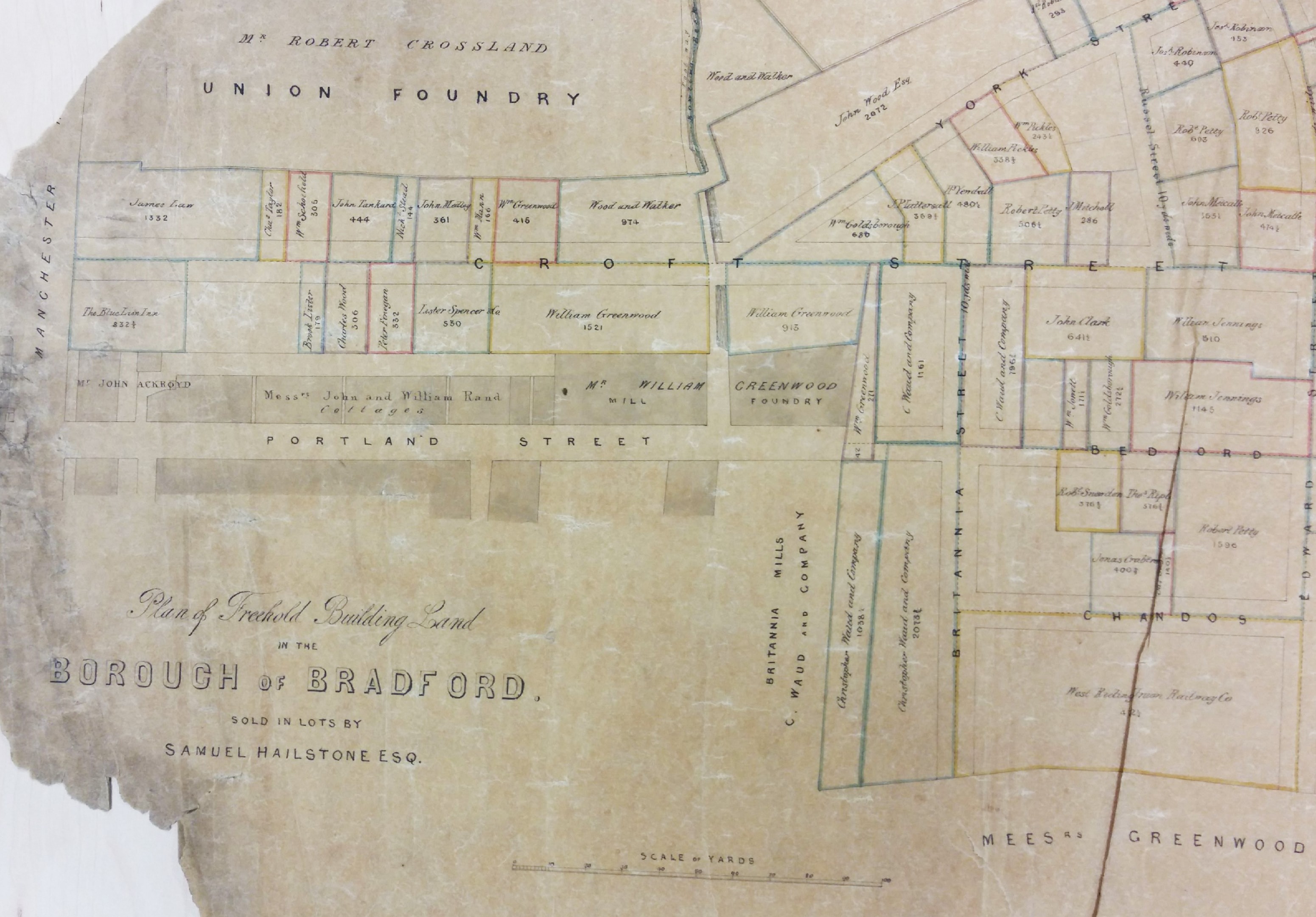
The first map is in the permanent collection and the staff could fetch it up for you, if you wished to study it. In the reserve collection are two poorer quality maps containing information about the eventual lot purchasers. They have deteriorated badly, although I have done my best with the two photographs. I assume they were intended for use only as long as it took the sale to be conducted. If you start again at the Friends Meeting House you will see that the Wesleyan Association have purchased some adjacent land with the two denominations being bisected by Croft Street. Elsewhere some quite familiar names, like Christopher Waud, have appeared.
The final map in this post is a capture from the 1848 Bradford Town Plan. Although it is on a different orientation it does show how things turned out a decade later.

 Bradford and District Libraries Map Collections
“Buy land! – they’re not making it anymore.” – Mark Twain
LikeLike
“Buy land! – they’re not making it anymore.” – Mark Twain
LikeLike