
I have mentioned the Goad maps before. The Local Studies Library has two books of city plans surveyed by Chas. E Goad, 53 New Broad Street, London EC. The books are dated 1886 and 1929, and presumably once formed part of regular series. The plans cover central Bradford listing every business and civic building. Internal evidence shows that the plans were available to ‘a limited number of subscribers’ and they would certainly have been very helpful to the Council, fire brigades, insurance companies, and developers. Charles Goad (1848-1910) was a cartographer and civil engineer. He became well-known for these insurance surveys of towns in Canada and the UK. The company he founded continued for some years after his death.
The map detail is taken from the 1886 survey of Bradford which must have been an early English example. Roughly at its centre is the Star Music Hall and the Princes Theatre. I don’t know a great deal about historic Bradford theatres. The Princes was in Little Horton Lane, opposite the Alhambra. It was built, over the Star Theatre and Music Hall, in 1876 I believe. The Star had opened the year before. The Star’s finest hour must surely have come in 1890 when operator Henry Pullen allowed the striking Manningham Mills workers to hold meetings. Indirectly then it had a role in the formation of the Independent Labour Party.
The Princes was also associated with noted theatre impresario Henry Pullen, and then (in the early twentieth century) with the ‘king’ of Bradford theatres Francis Laidler. The theatre had been named after the then Prince of Wales, later Edward VII. The Princes had stalls, dress circle and gallery. It was lit by gas, which may explain why it burned down after a couple of years and had to be rebuilt. When I discussed the theatre on social media several people could recall visits in the 1950s (two for one on a Monday night).

The LSL collections enable us to go back and forward in time from 1886. The theatre occupied approximately the same land on which a St John’s Church had previously been located. I don’t know a great deal about this church. William Scruton in his Pen & Pencil Portraits of Bradford says it was erected in 1839. There was seemingly an unhappy dispute between the incumbent, Rev CJ Pearson, and the Vicar of Bradford (and former whaling captain) Dr William Scoresby. The bishop of Ripon had to arbitrate. The old building was before long demolished, and a replacement church was built in Horton Lane. By the time of the Ryburn map of 1871 the churchyard seems to have been developed, but the church building itself was still standing, unused.
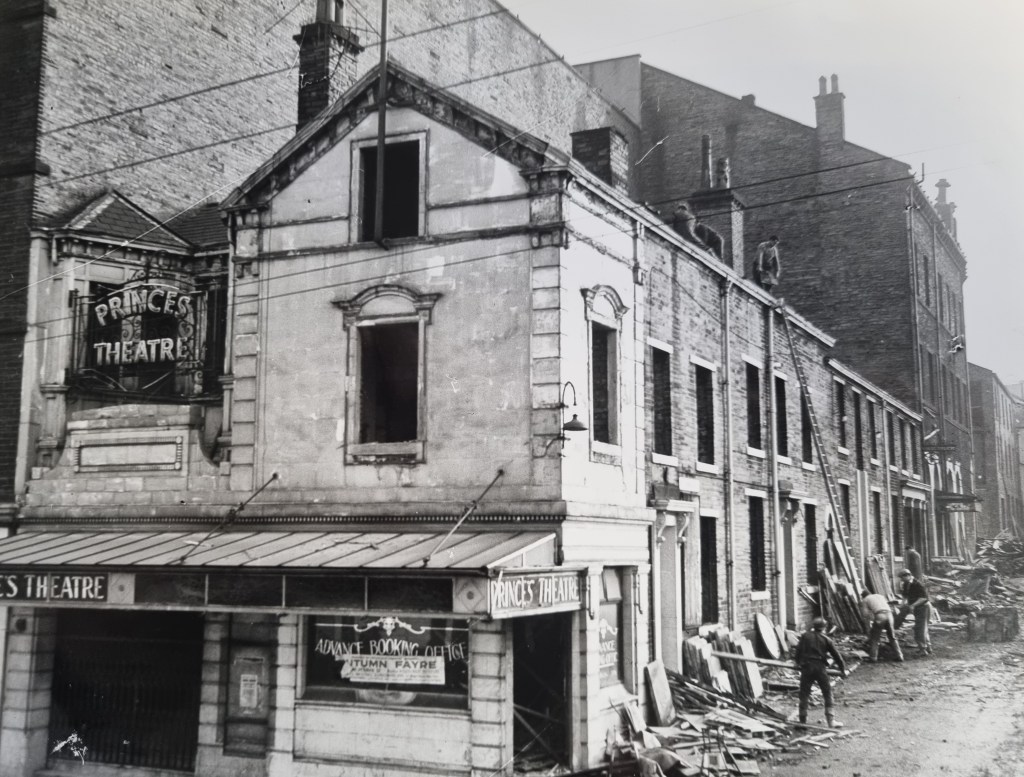
Moving forward the Princes Theatre was to close in 1961. This photo shows it at the time of its demolition in 1963, as part of a road-widening scheme. I assume its approximate position was the ornamental garden in front of the Media Museum.
I am very grateful to Jo Ives, Margaret Gray and Phil Baxter, who provided me with a great deal of information about this long-lost institution.
 Bradford and District Libraries Map Collections
The auditoria and stages of the Prince’s theatre and Star Music Hall were on land that is now under the grassy bank, pavement, and carriageway in front of the statue of J B Priestley. The last show at the Palace theatre (as the Star music hall had been renamed) was on Saturday 28 May 1938. The premises, which were below ground level, were deemed unsafe. It was a controversial decision by the local authority. The auditorium was left unused for entertainment purposes.
Information about Bradford’s theatres can be found at:
http://www.arthurlloyd.co.uk/BradfordTheatresIndex.htm
I contributed a page of text and images about the Colosseum music hall on Westgate (the website still mistakenly calls it Coliseum). Incidentally, my research and subsequent article reveals that the Francis Laidler 1914 Alhambra is the third such venue with that name in Bradford.
http://www.arthurlloyd.co.uk/BradfordTheatres/ColiseumBradford.htm
LikeLike