In connection with an earlier example, I explained that what I find particularly difficult in map interpretation is that there was once an ‘old Bradford’, say pre-1840, but most of this was demolished in the creation of late-Victorian Bradford. Late-Victorian Bradford was, in its turn, knocked down in the 1960s and later, to create modern Bradford. I was recently given a book of pictures entitled Old Bradford Views: from the Cudworth Collection. This was published in 1897 as part of the celebration of the golden jubilee of Bradford’s being created a borough in 1847. These images reflect the pre-1840 Bradford and consist of drawings, paintings and photographs. The author wisely points out that some of the illustrations are in fact drawings of drawings, and are not always totally faithful to the original subjects. But they are the best guide that I have, and I hope after much more than a century that I am not infringing anybody’s copyright by reproducing them to illustrate maps and plans.
So, as an example, I am taking the long-forgotten Christ Church. Historian John James explains that Bradford was widely regarded, in the early nineteenth century, as having a dearth of established church accommodation. As the century opened the Anglicans had only the parish church of St Peter, later Bradford Cathedral. The first attempt to address this lack was the erection of Christ Church. This was built in 1815 at the cost of £5400. James describes the building as being ‘pure Carpenters’ Gothic’ in style, but I understood that this description really applied to a later movement within the United States to employ Gothic forms in domestic architecture. Whatever James intended to convey the building resembled perpendicular Gothic and possessed a square turret, the architect being J. Taylor of Leeds. A picture is available in William Cudworth’s book.

Christ Church, Darley Street then was built as a chapel of ease for the Parish Church. It was close to a Bradford market, which in press reports is called ‘Christ Church market’. It seems it was necessary to enlarge and repair the building in 1826 and 1838, but interestingly no further church building took place in Bradford for 23 years. Christ Church had 1,300 sittings, of which 400 were made free when the church was created. I assume that other regular worshippers rented their pews. The patron of the church was the Vicar of Bradford, and William Morgan BD, previously his curate, was presented with the living when the church was consecrated. Remarkably he remained in post until 1851. Rev. Morgan obtained his place in literary history by being a friend of Patrick Bronte.
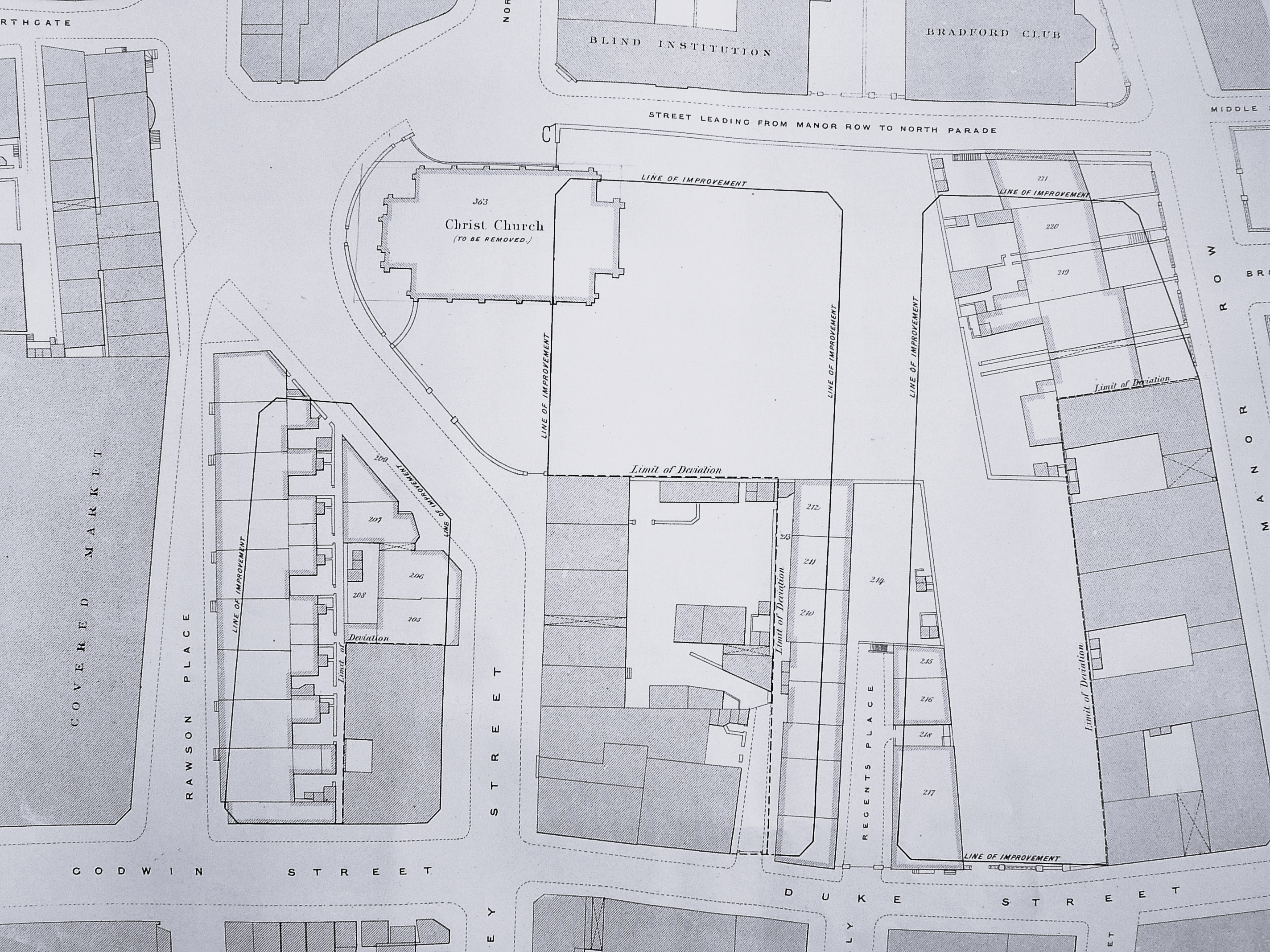
The first map shows the church in position at the end of Darley Street, and also indicates that the church building was to be removed as part of a Council road widening and creation scheme. The building was demolished in 1878-79, which consequently dates the map. Above the church location on the map note the Blind Institution and the Bradford Club. The new road in front of them is modern Upper Piccadilly. The church building was once immediately south-west of the junction of Darley Street and Upper Piccadilly. Rawson Square exists at its former site today.
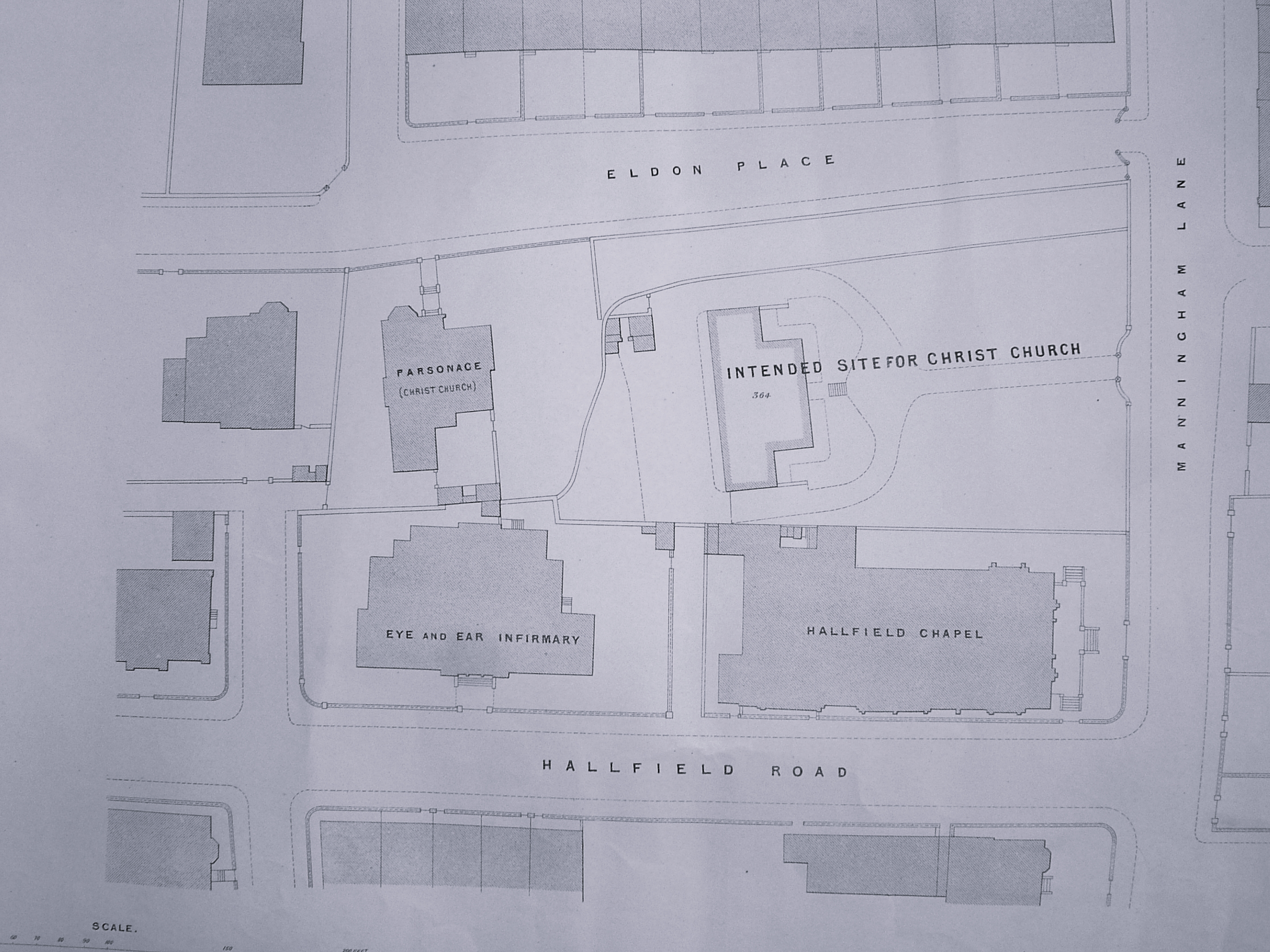
Christ Church was moved to nearby Eldon Place with the Council providing £10,000 compensation. The second map shows the intended site for the church and a pre-existing parsonage. It was close to the Eye & Ear Hospital and the Hallfield Chapel. I understand that the rebuilt Christ Church survived until the 1940s.
 Bradford and District Libraries Map Collections
wonder what chapel lane got when they demolished that one in 1867. In 1868 edward swaine opened congregational chapel but not sure who paid for it.
LikeLike