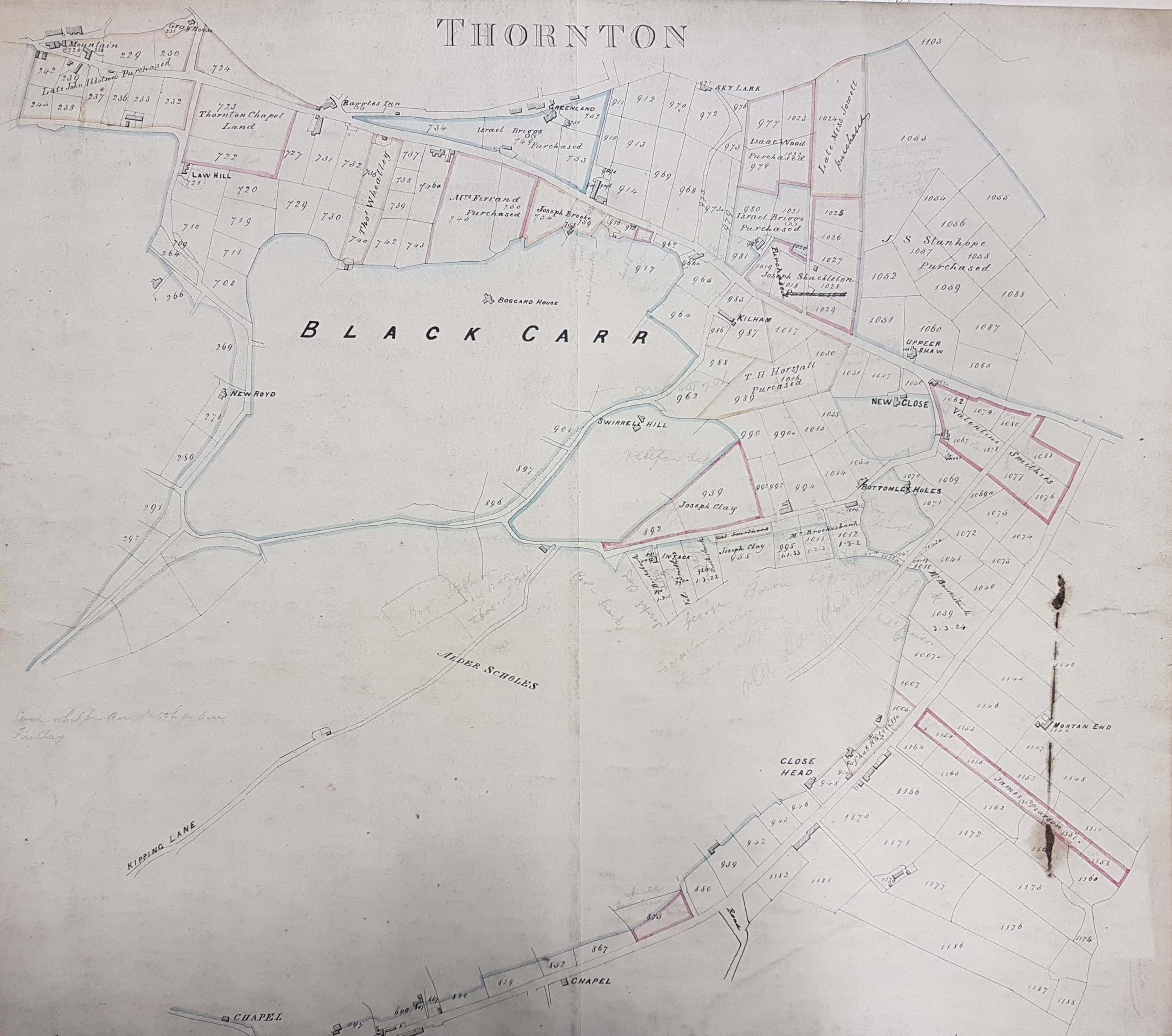
1.21 THO c.1850 PLA BHM 664 B10
Land ownership map Black Carr, South Thornton & Queensbury
Paper Scale: unk Size: 50 * 50cm Condition: Good, besides surface dirt
I treasure maps like this which portray an historical part of Bradford, and feature details such as land boundaries, land-owners, and property names. Better still it was clearly once a working map which has numerous pencil annotations. With all these positive features it seems churlish to complain about the lack of date, scale, or direction indicator. I don’t know the surroundings of Thornton very well and must admit I struggled to identify the people and places marked. Many readers must know the area far better than me and I should be most grateful if you would read my deductions carefully and point out any errors that you find. First of all the top of the map is south. Secondly, what I think of as Thornton township is not included at all. Finally, although our map must be roughly contemporary with the first Ordnance Survey map of the area (1852), the places selected for inclusion, and their spellings, do differ considerably. In what follows I’ve put the OS spellings in brackets.
Swirrell (Squirrel) House and Boggard (Boggart) House are easy enough, and Black Carr is clearly identified. The roadway near to Swirrell House is Deep Lane but it is not named here. It is easy to follow this to Kilham (Keelham) where it joins the Queensbury – Thornton road: you can follow this road further to Raggalds Inn and Mountain. The hamlet of Greenland, at the very top, is not named on the OS map. The roadway that passes it is called Mucky Lane in the OS but is unnamed here. Returning to Deep Lane and following it in the opposite direction it joins Malt Kiln Lane, which again is not named. You can see a roadway named Kipping Lane which passes Alder Scholes (Alderscholes) and would, if continued, naturally join the Bradford & Thornton Trust Turnpike at Kipping. If Thornton itself had been drawn it would have been in the very bottom left corner: later this corner would be ‘cut off’ by the magnificent curve of the Thornton Viaduct.
Past New Close two roadways meet the road from Queensbury. The first, rather sketchily indicated, will be the Turnpike itself. The second was evidently of far more interest to the map maker and must be Close Head Lane leading to Hill Top, although neither are named. On the OS map Close Head is drawn but not named, although several buildings here are encompassed with the title Close Head Row. Following Close Head Lane towards the direction of the unincluded Thornton it is clear that the OS map identifies more properties than our map, which may indicate that it was surveyed later. On the other hand it doesn’t include either of the chapels that our map marks.

When I first found this map in the reserve collection Jean K Brown (Thornton Historical Society) kindly told me that her knowledge of the land-owners places a limit of 1855 as the latest possible date for the map. Some names are also familiar to me. One field evidently belonged to the ‘Late Miss Jowett’. A area in the right centre is annotated in pencil with the name George Baron Esq. Baron succeeded Miss Sarah Jowett (who died in 1840) as owner of the Clockhouse Estate, Frizinghall, so I think that the inferred date is probably correct. Of the other land-owners I thought that Valentine Smithies was likely to be the easiest to research because of his apparently unique name. A man of this name is recorded in the 1881 census when he was a 36 year old farmer in Headley, Thornton. But this gives a date of birth c1845, so he’s an implausible land-owner in our map. In 1841 there is also a Valentine Smethers or Smithies, a 60 year old cattle dealer in Bottomley Holes, Thornton. He sounds more probable and has a 11 year old son of the same name. I would welcome comments from proper family historians.

The pencil annotations are difficult to read. Some, as we have seen with George Baron, are presumably land owners. Others must be describing mineral resources. Near Swirrell Hall are the words ‘Halifax Bed’. This could be either of the deepest two seams in the Coal Measures, the Hard Bed and the Soft Bed. Above Alder Scholes is a comment (pictured) that includes the word ‘coal’ and to the left of it an annotation includes both ‘coal’ and ‘fireclay’. A valuable stratum of fireclay was the seat-earth of the Hard Bed. It was used for firebricks and furnace linings. I should be interested in knowing the earliest date that it was exploited in the local area and the map suggests that it is recognised here by the late 1840s.
 Bradford and District Libraries Map Collections
Very interesting as my ancestors were living here around 1860’s the Cravens and Heys . Is it possible to copy a version of the map and compare to 1851 census ?
LikeLike
Unfortunately unless your family members were significant land-owners their actual names are not likely to feature on a map. Comparing a Thornton map with the 1851 census seems a good plan. It would also be sensible to look at the first Ordnance Survey map of the area. There is a copy in the LSL but such maps are now available free at the National Library of Scotland Website. Other possible source of information, forgive me if you know all this, would be the Trade Directories and Electoral Registers for Thornton which the LSL also has.
LikeLike