2.06 BRA c1865 AND BHM 1709 B27
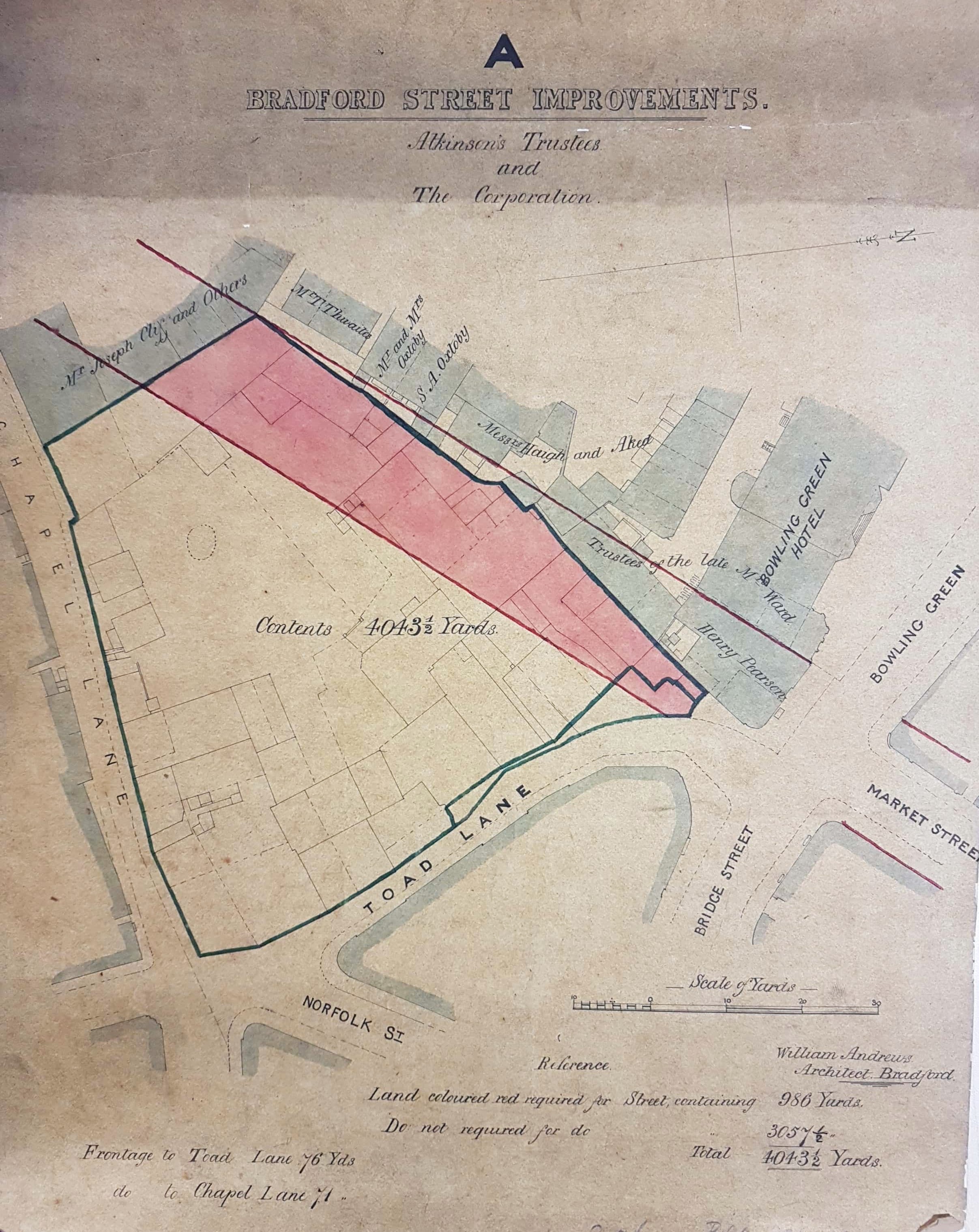
Central street improvements: Atkinsons Trustees & the Corporation
Paper Scale: 10 yards: 1 inch 38 * 32 cm Condition: good
The title I have given this plan is, strictly speaking, an anachronism since Bradford became a city only in 1897, decades after it was published. Bradford had been given the status of a borough in 1847 and in the 170 years since the city centre has changed almost beyond recognition. New buildings have been erected and old ones demolished. The Bradford Beck has progressively vanished underground into culverts. New roads have been created (Sunbridge Road being an example), while others have been re-positioned, lengthened, or have disappeared entirely. Change has been a continuous process but it was accelerated in the 1960s when there was a wholesale city centre redevelopment associated with the name of SG Wardley, then the City surveyor and engineer.
The contemporary street arrangement may be clearer in a second plan. According to historian Horace Hird the street names themselves were allotted by Bradford’s board of commissioners in the early years of the nineteenth century.

In interpreting the original, undated, plan I should start by pointing out that west is at the top. What is being planned is evidently an extension to Market Street (previously New Street) in front of the space soon to be occupied by a not yet built city hall. Purchase of land for the city hall was made in 1869 and the building itself, designed by Lockwood & Mawson, was opened in 1873. The date of the plan can be made more precise still since the Bradford Observer, October 28 1868, reported the proceedings of the Street & Draining Committee which includes the Market Street extension as, ‘in progress’. Allowing a few years for the legal necessities and the awarding of contracts I have estimated 1865 as its likely date.
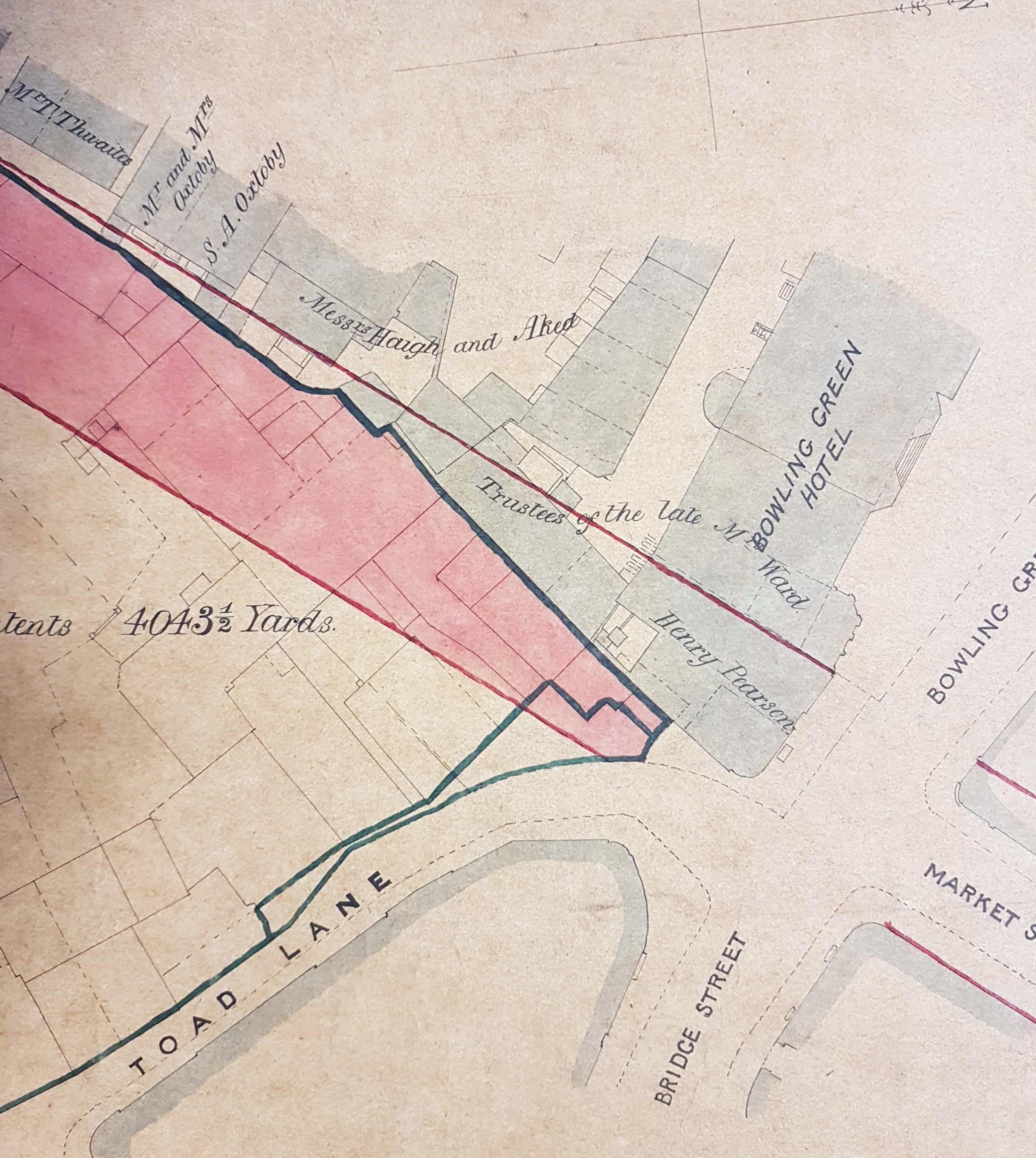
I have selected this map because of the named land-owners it records. The Bowling Green Hotel, was located at the end of Bridge Street: William Cudworth mentions that in the 1830s its owner was a Mrs Susannah Ward, widow of Joseph Ward who died in 1826. Joseph Ward is certainly at the Bowling Green in Baines’s 1823 History, Directory & Gazetteer. Cudworth tells an interesting story: by his account Susannah Ward bought land adjoining Duckworth Lane and built Field House (in 1835-36), which in my day was the home of Bradford Royal Infirmary’s medical library and post-graduate medical centre. William Scruton pushes the Bowling Green’s existence still further back into the seventeenth century. He regarded it as ‘the best inn of the town’. It was later used by the Royal Mail and coaches for Manchester left from the open space in front of the inn, which presumably was once actually a bowling green. The Inn came to be employed for political meetings. Be that as it may the owners at the time of the plan were trustees for the late Mrs Ward, presumably Susannah who died in 1842. The 1850 Bradford Directory places Joseph Baxter there. After him Susannah Ward’s son in law, John Lupton, returned as owner.
I can establish some information about the other land-owners mentioned. Henry Pearson was an ironmonger of 102 Bridge Street who, according to his advertisements in the local press, re-plated tea and coffee services ‘for Clergymen, Gentry and other Bradford Families’. ‘Haigh & Aked’ are James Aked and James Thistleton Haigh (1810-1878). I can definitely identify Haigh because of his unique name. He is in the 1871 Halifax census returns as a retired woolstapler. Despite his unusual surname I can’t unambiguously identify James Aked, although the surname is found in Halifax, Bradford and Keighley. ‘T Thwaites’ is Thomas Thwaites 12 Tyrrel Street, Plumber & Glazier, and ‘Mr Joseph Cliff and others’ are J & J Cliff – engineers and iron-founders of Tyrrel Street. So far I’ve drawn a complete blank on SA Oxtoby, and Mr & Mrs Oxtoby next door.
This section of Market Street no longer exists but it would have crossed in front of the City Hall and across the middle of the Bradford City Park.
 Bradford and District Libraries Map Collections
Sept 1866 (Bradford Observer)
“Toad Lane was once a pleasant spot, with its quiet hall, and the orchard stretching back over the site of Cliffs foundry. If we had chatted under the apple trees with Parson Atkinson’s predecessors … we might have felt some regret.”
LikeLike