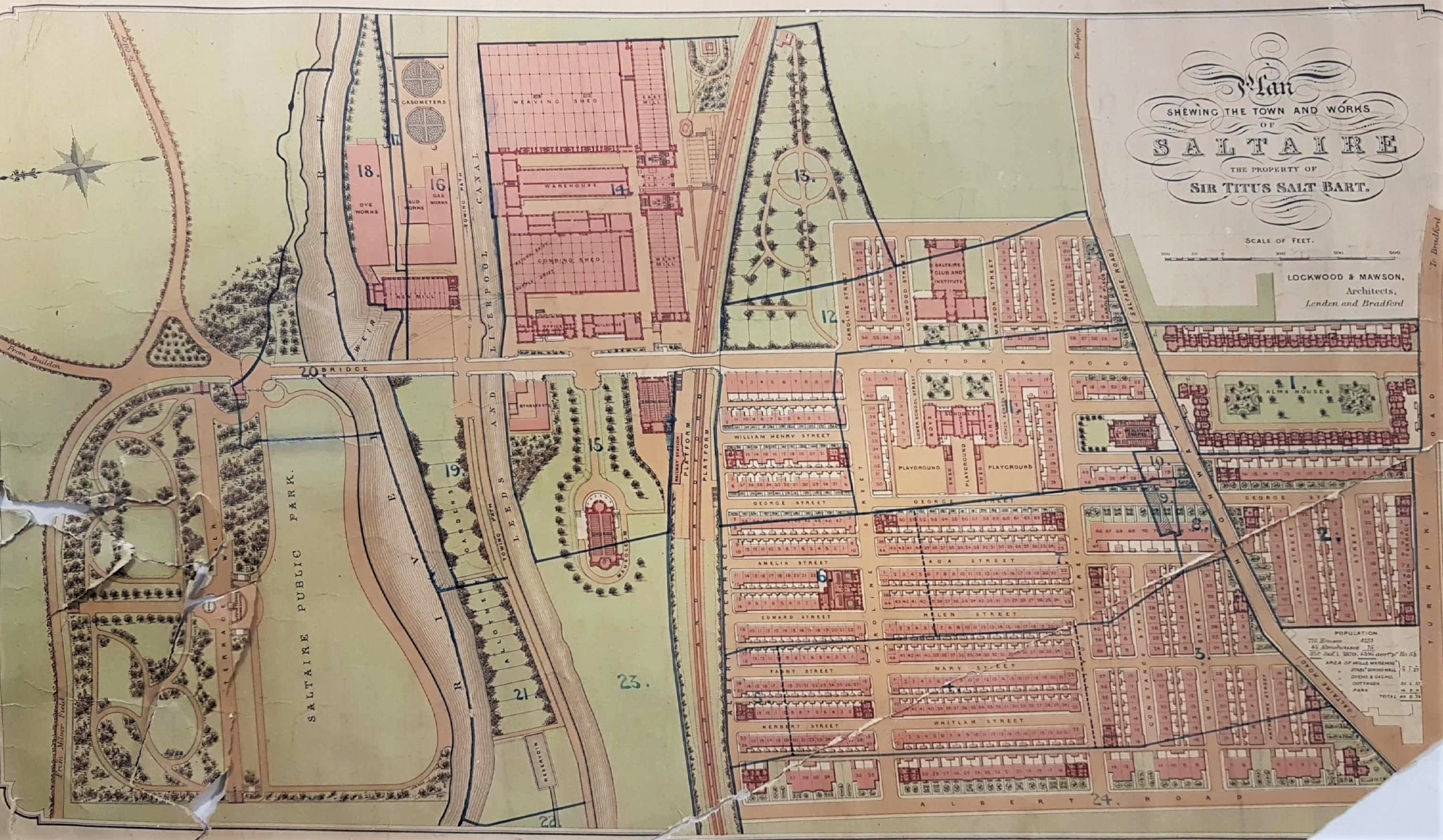
This example exemplifies what fate can befall a paper plan. I have located five fragments but several are still missing. Despite its very poor condition the plan is of interest because of hand-written annotations at top which seem to indicate the original owners of the land on which portions of Saltaire were subsequently built. The blue lines which have been added to the printed plan are a good match for the field boundaries to be found on the first OS map of the area which was published in 1852, but surveyed in the late 1840. In the past a date of ‘pre-1871’ was applied to the plan, but the Local Studies Library public collection of maps has two photocopies of an intact example of the same plan (index: SAL 1881 MAW). These are identified as the property of Shipley Urban District Council but lack the annotations, and the damage.
For any readers who don’t know the area I should explain that Saltaire is immediately west of Shipley, adjacent to the canal, railway line, and river Aire and since 1974 has formed part of Bradford MDC. Saltaire is a combination of a textile mill, model village, library, hospital, allotments, Victoria Hall and a Grade I listed Congregational church. All were created in the years 1851-53 by Sir Titus Salt, probably the most noted of Bradford’s textile magnates. He served as Mayor of Bradford, an MP, and famously introduced the weaving of alpaca wool. Saltaire was a very major constructional project and was a very enlightened piece of planning for a workforce, although it was not the first time this had been attempted. In Bradford it certainly pre-dated Sir Henry Ripley’s Ripleyville of which little now remains. Sir Titus died in 1876. His creation is now a UNESCO World Heritage Site, but is also a very active community which has a Village Society and holds a celebrated annual Festival. The mill finally closed in the 1980s but was purchased by the late Jonathan Silver who created an art gallery, shops, business premises and restaurants within the building. Saltaire should be on every visitor to Yorkshire’s places to see.
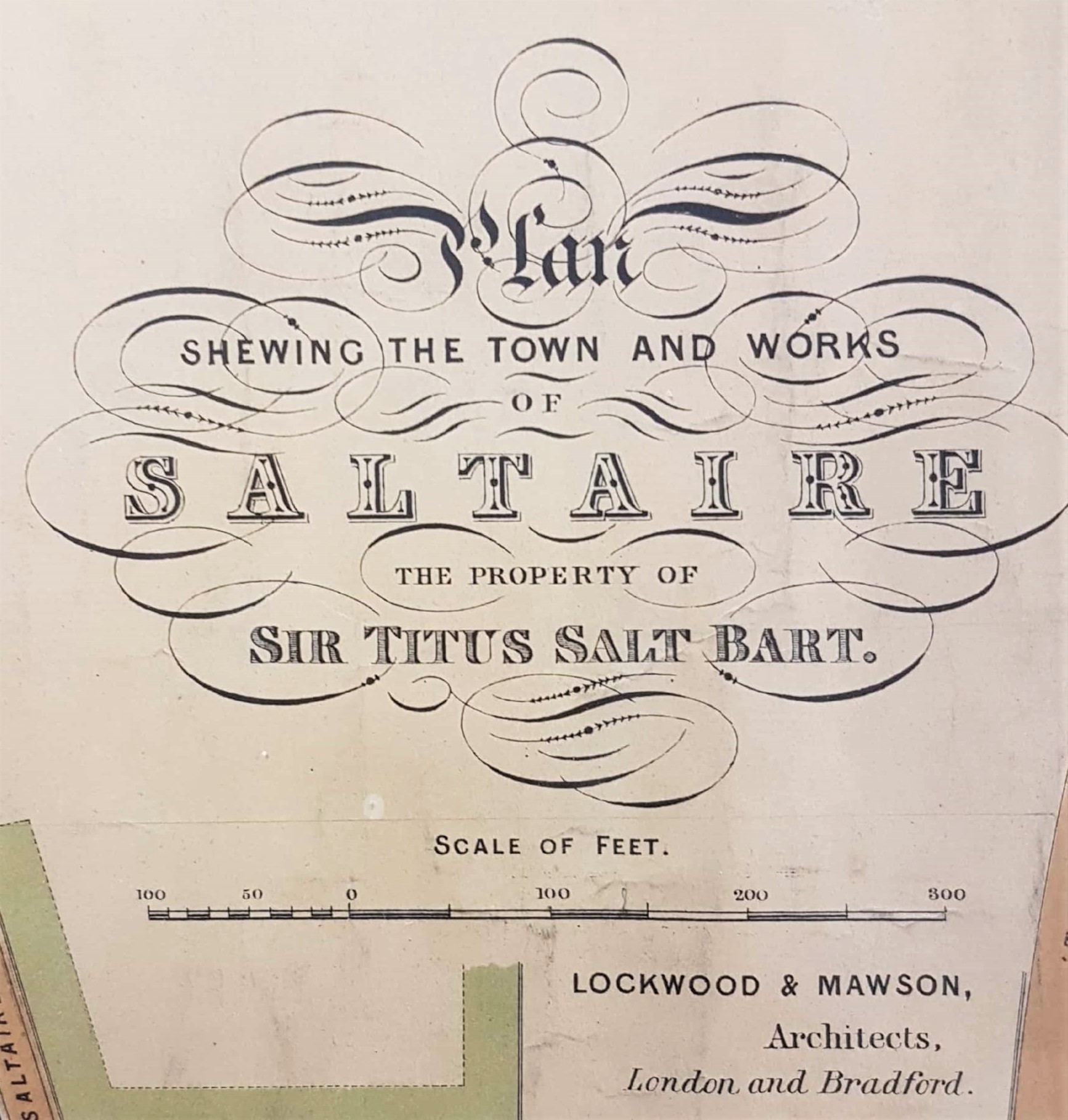
The original plan was created by Lockwood & Mawson a famous pair of Bradford architects who designed Salts Mill in collaboration with the mill engineer Sir William Fairburn. Shortly after this map was created Henry Francis Lockwood moved to London but his partner William Mawson stayed in Bradford, ultimately being buried at Undercliffe cemetery. The plan gives the population of Saltaire as 4356 in 1870 and this fact was presumably used to date it at some time in the past. I appreciate there is a decade difference between the two versions of the map the LSL possesses.
Subsequently there have not been huge changes to the layout of Saltaire. The street plan is essentially unchanged, the streets themselves being named after Sir Titus’s children. Caroline Street has been greatly extended and there has been a good deal of development east of Saltaire Club & Institute (Victoria Hall). The school opposite the hall is now part of Shipley College. The gas works and gas holders have long gone. There is a subterranean aspect to Saltaire which I have never been lucky enough to see. I gather an underground passage connects the mill with the building that was once a dining hall. The plan’s contribution to this aspect is the marking of the intake and return water-supply drifts from the River Aire adjacent to the weir which clearly supply Salts Mill.
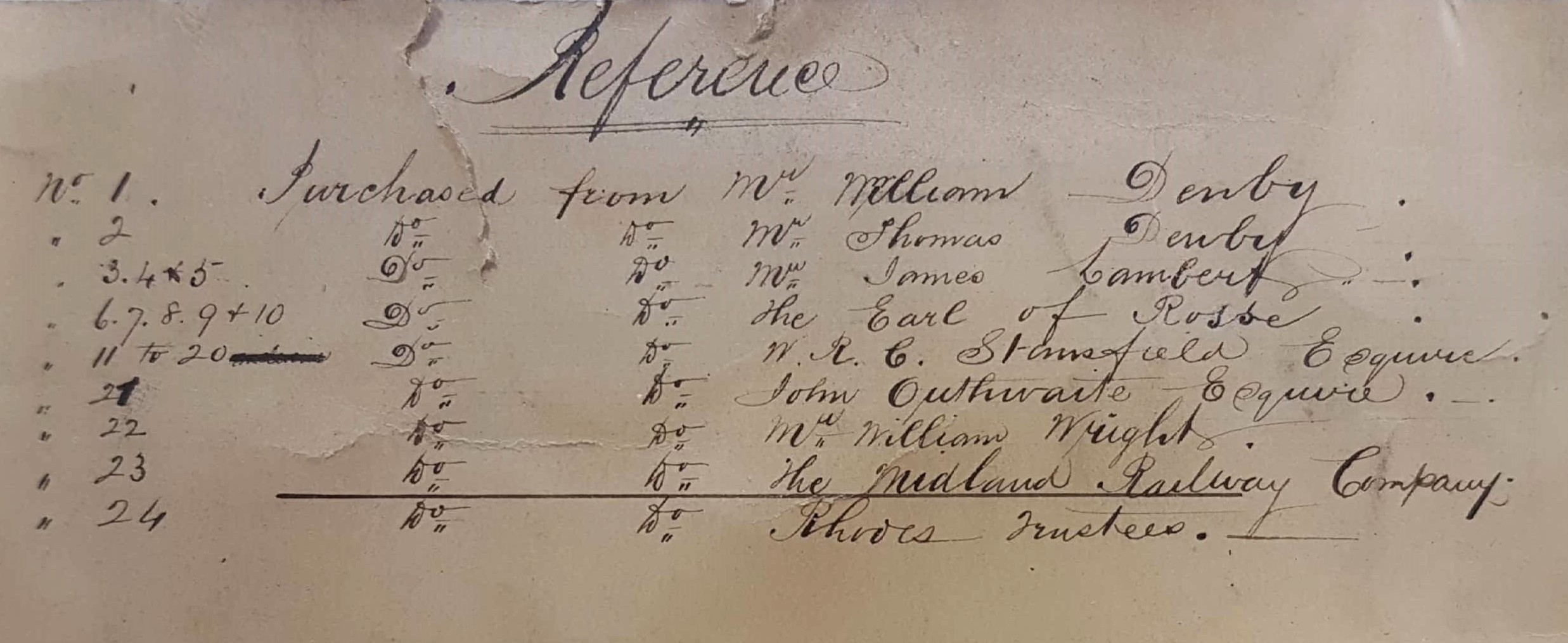
There are some very familiar names in list of landowners. Areas 6-10 were purchased from the Earl of Rosse, the largest local landowner and Lord of the Manors of Heaton & Shipley. I’m not sure why the Midland Railway Company ever needed as large an area of land as 23, but evidently they parted with it. Dr John Outhwaite (21) was a respected Bradford physician and friend of the Brontes: he had died in 1868. William Denby and Sons (1 & 2) were textile manufacturers in Baildon.
 Bradford and District Libraries Map Collections
The reference to ‘pre-1871’ is correct. The corner plot at the ‘Saltaire Roundabout’ end of Gordon Terrace was purchased in two lots in 1871 and 1874
LikeLike