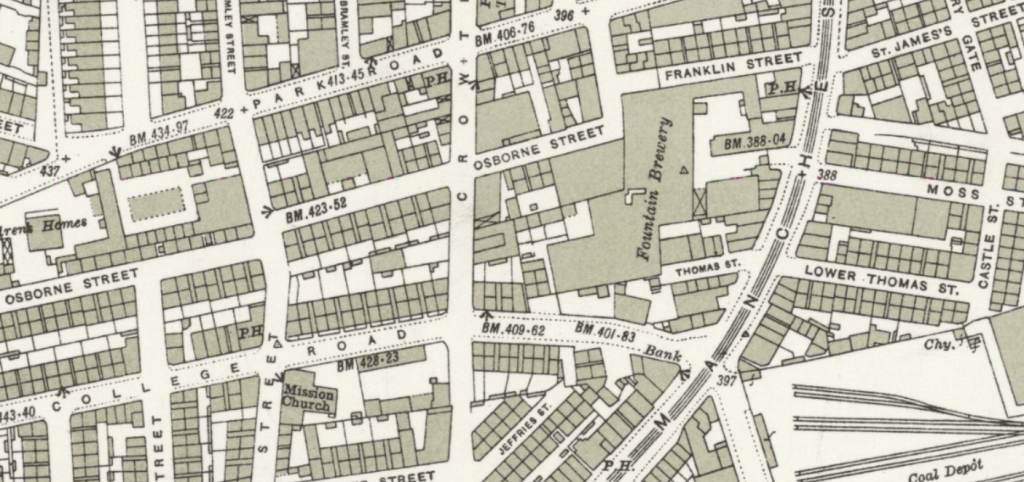
There was a substantial brewing industry in nineteenth century Bradford. To assess its full extent would need a lengthy period communing with Trade Directories and newspapers, but it would be a worthwhile project. Here I have concentrated on bigger concerns, but I imagine several of the larger inns brewed for themselves. The raw material for beer was malted barley. In 1828 there were 14 ‘maltsters’, 6 coopers and about 100 pubs in Bradford. Barley was grown locally, but there was no source for hops nearer than Kent, so these would need to be imported. The Fountain Brewery in Manchester Road can be seen in the first map detail (OS, 1890). It had been created by Joseph Pullen in 1840. Twenty years later it was bought by James Hammond, and it was under the Hammond name it was to become the most famous Bradford brewery.
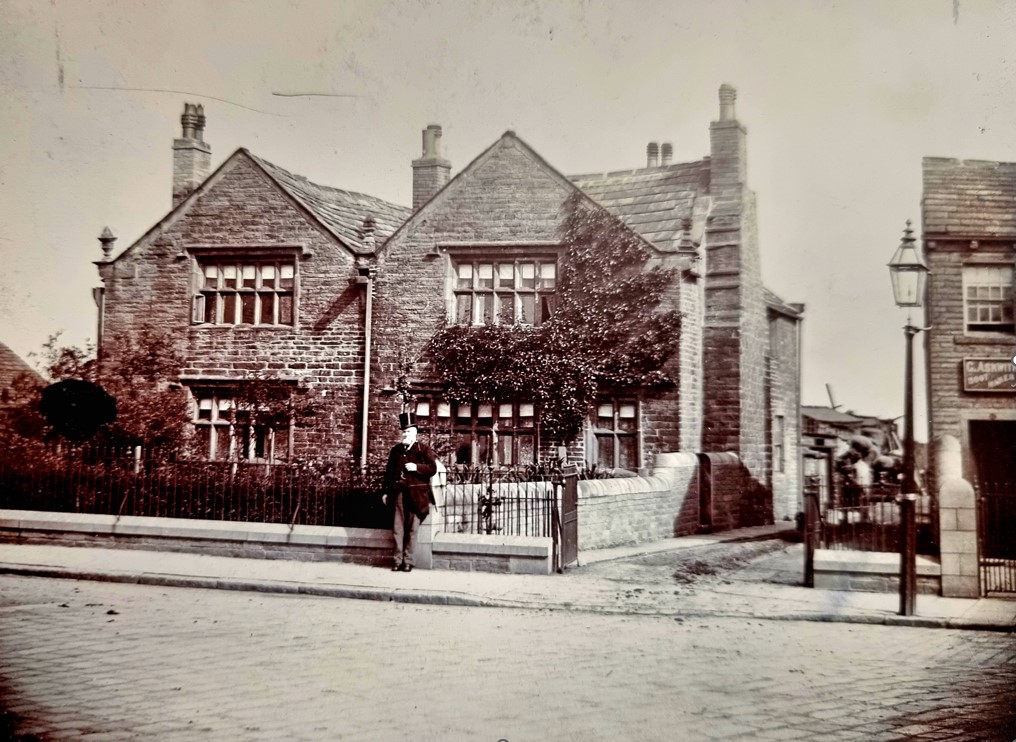
I believe the Local Studies Library has an image of Ezra Waugh Hammond (1836-1894). There is a very well-dressed gentleman who is standing in front of what, I assume, is his property. Next door, in the photograph, is a cobbler’s called G. Askwith. That is a big help for in the 1881 and 1891 censuses George Askwith, boot maker, lived at 25 & 27 Horton Green. In the 1891 census at ‘102 Horton Hall’ lived Ezra Waugh Hammond 55, retired brewer, with his two daughters and five servants to look after them.
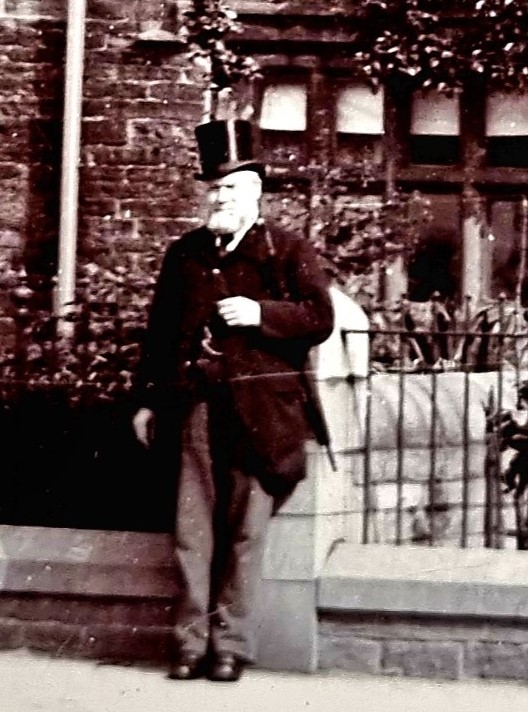
I assume Alderman EW Hammond is the man pictured in the blow-up. He died three years later and was buried at Scholemoor. He left more than £200,000 which was a huge sum for the 1890s. I’ve seen pictures of Ezra Hammond in his mayoral robes which would have been dated to 1890-91. I think it is the same man. Ezra’s father had been James Hammond, landlord of the borough’s Market Tavern, who bought out Mr Pullen. It looks as if his son may have been the main beneficiary. The company grew by acquisitions and mergers. I believe it ended up as part of Bass Carrington. The brewery was demolished in 1955, having been unused for some years.
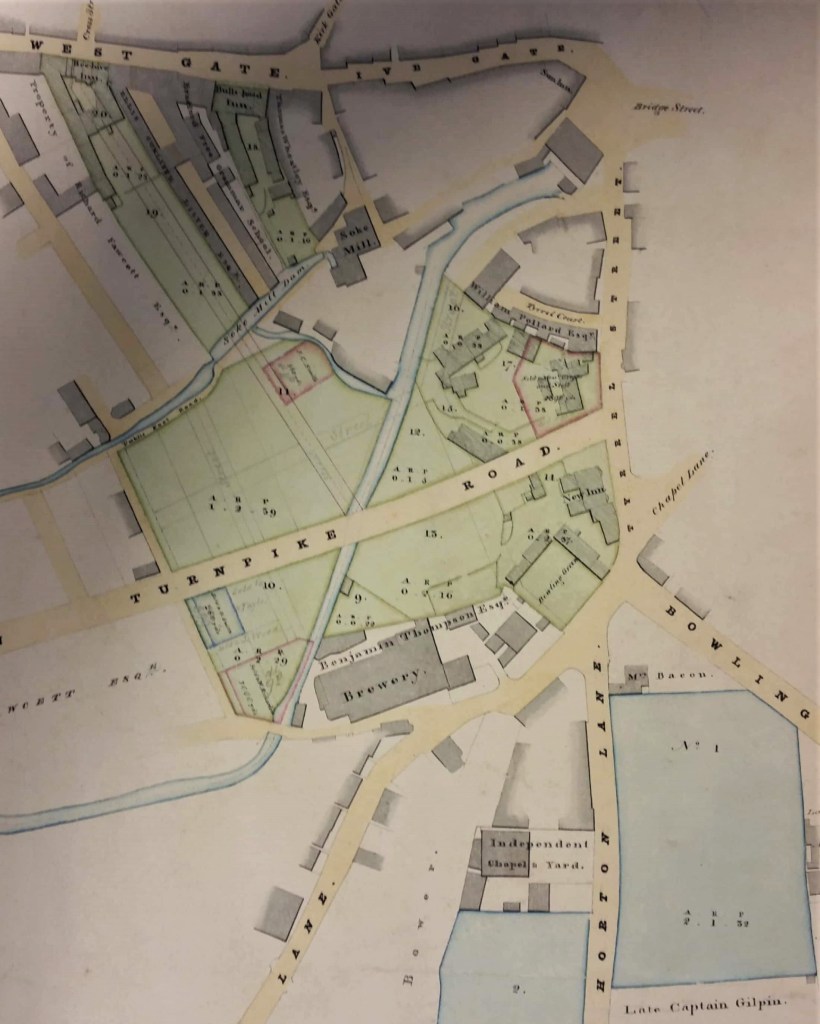
A contemporary of the Fountain Brewery in the 1851 Trade Directory is William Whitaker’s ‘Old Brewery’ in Great Horton Road, but it was older than this. John Whitaker acquired the brewery in 1763. In 1861 it built an entrance to the brewery yard off Thornton Road. There was an association between William Whitaker and a Benjamin Thompson (brewer); the brewery is given Thompson’s name the above image which is a detail from Rev. Godfrey Wright’s property map. Brewing at Whitaker’s ‘Old Brewery’ ceased in 1928 although the company continued as an owner of public houses. The site was sold off for the construction of the New Victoria cinema, later the Odeon.
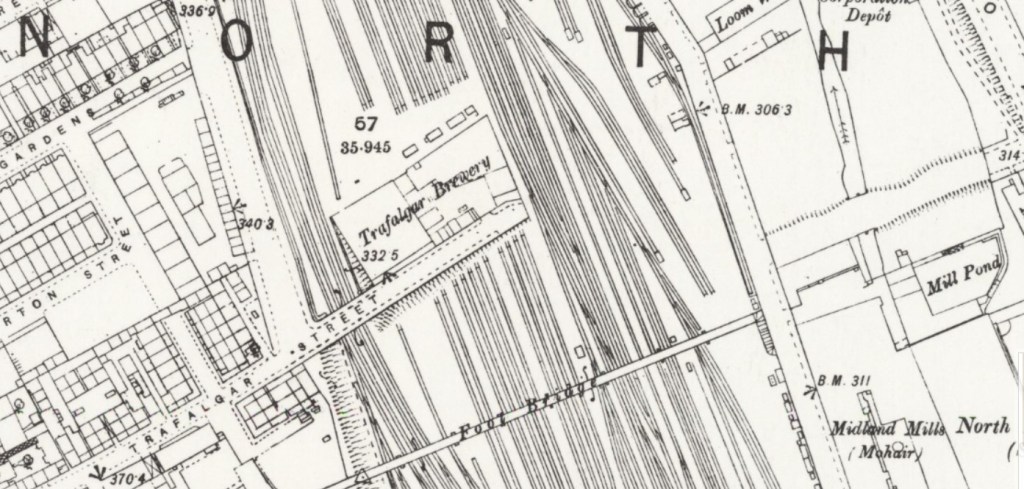
This second detail from the 25” OS of 1890 shows the Trafalgar Steam Brewery in Trafalgar Street. It had been founded in the 1853 and was associated with the name of Cllr. Charles Waller. The company regularly advertised its porter, mild, and bitter beers in the pages of local newspapers and own about 90 pubs across the city. I understand it was sold to the Midland Railway Company during the Great War, but the building survived until the 1950s. But I’m really not sure what they did with the steam.
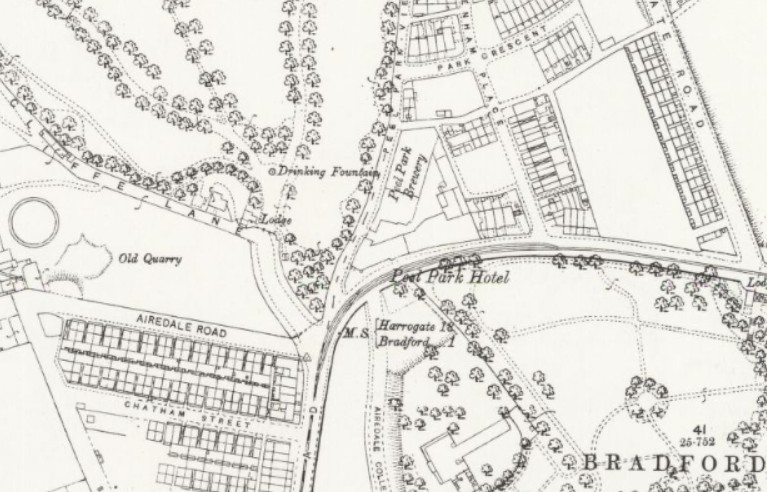
Daniel Riddiough was born in Colne, Lancs. By 1872 he is described in directories and newspapers as a brewer of Otley Road offering beer-houses to let. This must indicate that he owned what was called the Peel Park Brewery, Otley Road also built in 1853. Apparently, he sold this concern in 1872 and then bought it back after the new owners went bankrupt in 1882. It appears that in 1891 he finally sold out his brewery and 17 pubs to Hammonds Bradford Brewery Co Ltd.
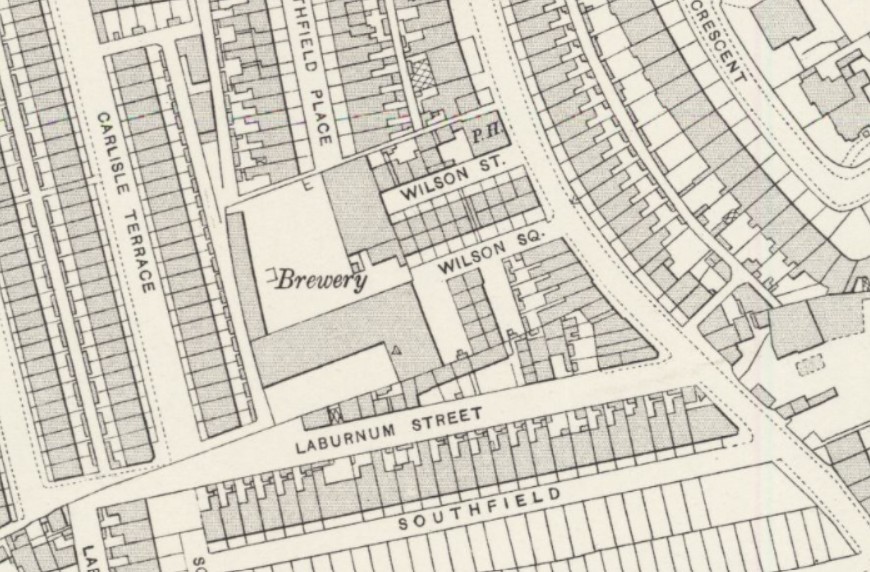
A Springhead Brewery had been established around 1837 by Job Wood and is in the 1845 directory. In the 1850s Clement Taylor & Son, Springhead Brewery, Back Regent Street, White Abbey is mentioned. The business was evidently transferred to the Northbrook Brewery, Wilson Square, Lumb Lane. This was acquired in 1898 by Joseph Hey. Joseph Hey and Co Ltd continued to run successfully after the Second World War but ceased to be an independent company in 1966 when its shareholding was sold to Samuel Webster & Sons Ltd, of Halifax. These were all large breweries but there were many more of a smaller size.
Since I first published this article I have, not for the first time, been corrected by local historian and photographer Kieran Wilkinson. On the subject of the gentleman in the top hat he writes:
‘I’m pretty sure that it is William Moulson pictured rather than Ezra Hammond. Moulson was mayor a couple of years before Hammond. The house that the gentleman is standing outside is 29 and 30 Little Horton Green. The 1891 directory shows (a) that 29 and 30 Little Horton Green is next to George Askwith’s property and (b) that William Moulson was living at 29 and 30 Little Horton Green. If you look at the entry on the Undercliffe Cemetery website it looks like the same chap who is in the photo. Ezra Hammond would have been living a bit further down the road at Horton Hall.’
William Moulson (1825-1904) was aa stonemason and builder. I believe he and his brother Miles were the ‘sons’ in the contracting firm of John Moulson & Sons. His own sons Angus, Rufus and Archibald all worked in brick-making, stone provision, or contracting. In its time the company won some very important contracts in Bradford: the erection of Britannia Mills in Manchester Road for Messrs. Christopher Wand & Co., and much of the works at Saltaire and its Congregational Church. Their worst moment must have been the building of the block of mill property in Springmill Street for Sir Henry William Ripley. After twenty years, in 1882, the chimney, which had been designed by Andrews & Delauncy in 1862 and built at a cost of £942.5s.10d, fell with considerable loss of life.
 Bradford and District Libraries Map Collections