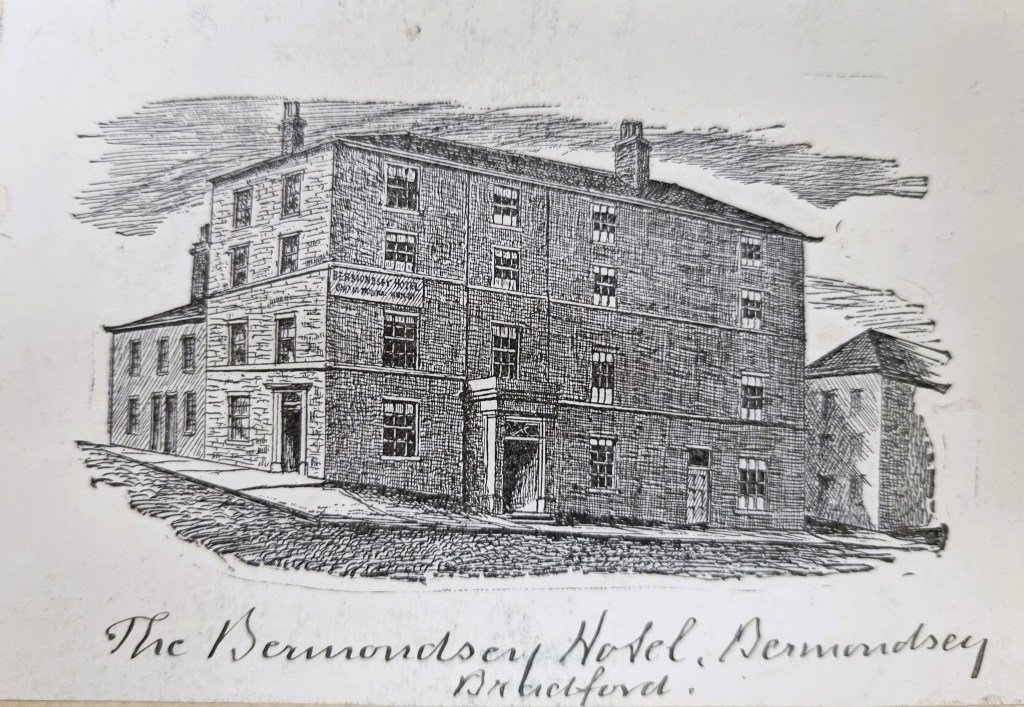
An image from the Local Studies Library triggered an examination of a series of maps. Illustrated is the Bermondsey Hotel in the collection of William Scruton. Scruton was one of a number of authors, past and present, to interest themselves in the possibility of a medieval castle in Bradford, sometimes called ‘the Black Castle’. I must say at once that I don’t believe myself that the city centre was ever host to such a building, but what did Scruton say?
Writing at the end of the 19th century he claims that Henry, Earl of Lincoln (the last de Lacy to own the manor of Bradford) had a hall or manor house mentioned in 1311. This sounds plausible although no location is given. He also writes ‘it is pretty certain that Bradford could boast of a castle’ which (he speculates) the de Lacy family used a stopping place. He places it ‘near where the Bermondsey Hotel recently stood’. He gives no evidence either for the existence of a castle nor its location, but this comment did at least alert me to the presence of the Bermondsey Hotel which had previously escaped my notice.
In the 1850 Ibbetson’s Directory a Mary Dunn gives her address as Bermondsey Hotel, Lister Street; she was quite famous – or perhaps notorious. Lister Street ran parallel to Cheapside between it and the new railway station. Following my mentioning of the question on social medial local historian Hector Hill explained that Mary ran the hotel at the height of the 1840s pub singing-room boom, and Paul Whitaker told me that its name was changed to the London Hotel in the 1850s. Both pieces of evidence of considerable value and I am most grateful to their providers.
Before looking at maps of the area I wondered if the Bradford Observer had any contributions to make. In 1839 an Isaac Walmsley ‘respectfully informs the public’ that he has entered into the premises. In 1843 the incumbent and curate of Christ Church informed the justices responsible for licencing, that the Bermondsey Hotel (which they place in Cannon Street) was one of a small group of premises which formed the sources of local ‘immorality, prostitution and drunkenness’. Mrs Dunn was then in charge and she was duly told off at the brewster sessions. When the licences were renewed the following year, she was among a group accused of keeping ‘disorderly houses’.
In 1845 ‘a lad’ paid money to go into the concert room of the hotel but was struck with a pint pot by a waiter! The musical sessions at the hotel were evidently popular; in 1848 (according to ‘Viator’) a crowd of 500 ragged and disorderly boys were watching the entertainment. The then manager, the noted theatre organiser Henry Pullen, replied to the newspaper, making a spirited defence of his concerts. Things may have quietened down since by 1853 the Oddfellows are having a dinner at the Bermondsey Hotel and a Mr J Nunn is in charge. This still seems to be the case in 1858 when the name ‘London Hotel, Bermondsey’ is first used. John Nunn and his wife Anette were comedians on West York theatrical circuit, as well as operating the hotel, but had become insolvent debtors. So, the Bermondsey Hotel had a decade of life under that title, and may I suppose have provided the name for the district.

What about the maps? In the 1802 Bradford map the whole area consists of fields, and there are no features suggesting a ruined castle! The figure above represents the next oldest map I can find after that time. It is undated but the red lines must represent the projected railway track from Shipley which finally arrived in 1846. The map illustrates that a row of terraced housing will need demolition to accommodate the station, and also how close the station will be to an old quarry site. The Bermondsey Hotel must be present although it is not named.
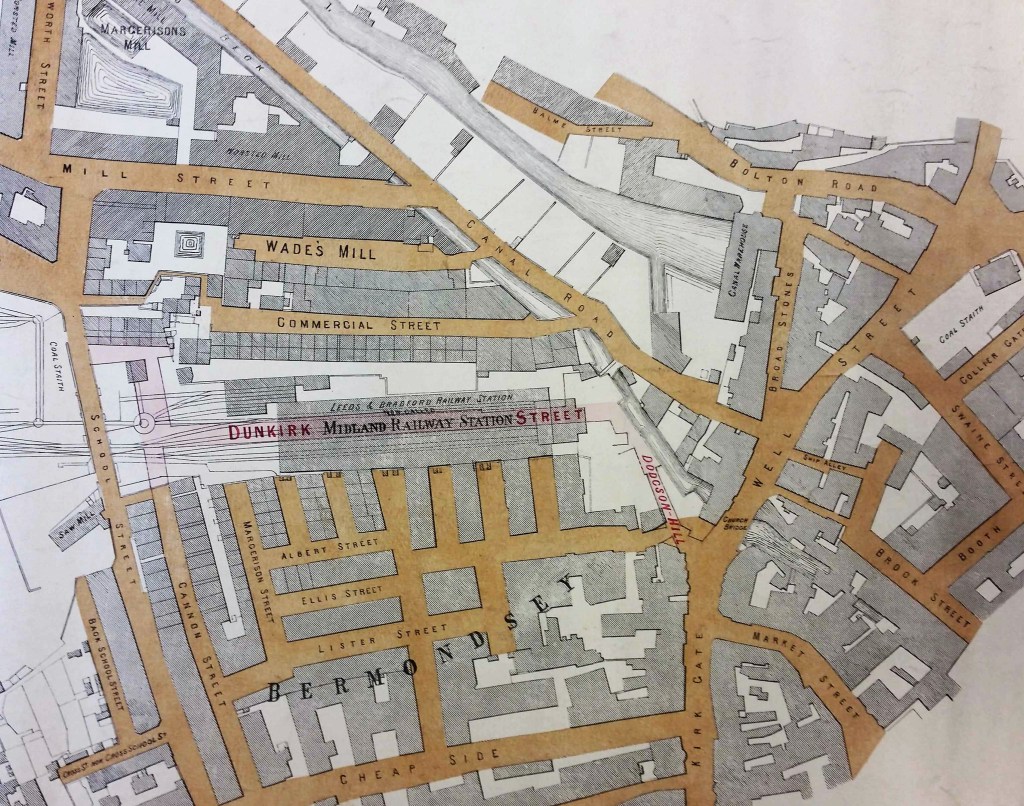
I have employed this plan on several occasions before. Dunkirk Street has been demolished and the Leeds & Bradford Railway station is now built. Lister Street and Cannon Street are labelled, also Margerison Street.

This small detail from the 1850 Town Plan enables us to identify the location of the Bermondsey Hotel exactly.

The Local Studies Library has several copies of this plan which was seemingly surveyed to elucidate some point in an action between the Margerison Trustees and the Midland Railway Company. The hotel is now named the London Hotel. I’m not sure which Margerison needed trustees. Research in local newspapers suggests that Samuel Margerison was a mill owner (Margerison & Sutcliffe) whose address, given in the Bradford Observer, was Manor Row. His rent agent was a John Lister Margerison, and he is certainly active in Bermondsey where the firm had a warehouse.

I shall conclude with this plan of the area since it is definitely dated as 1863. There have of course been many further changes since that time.
 Bradford and District Libraries Map Collections