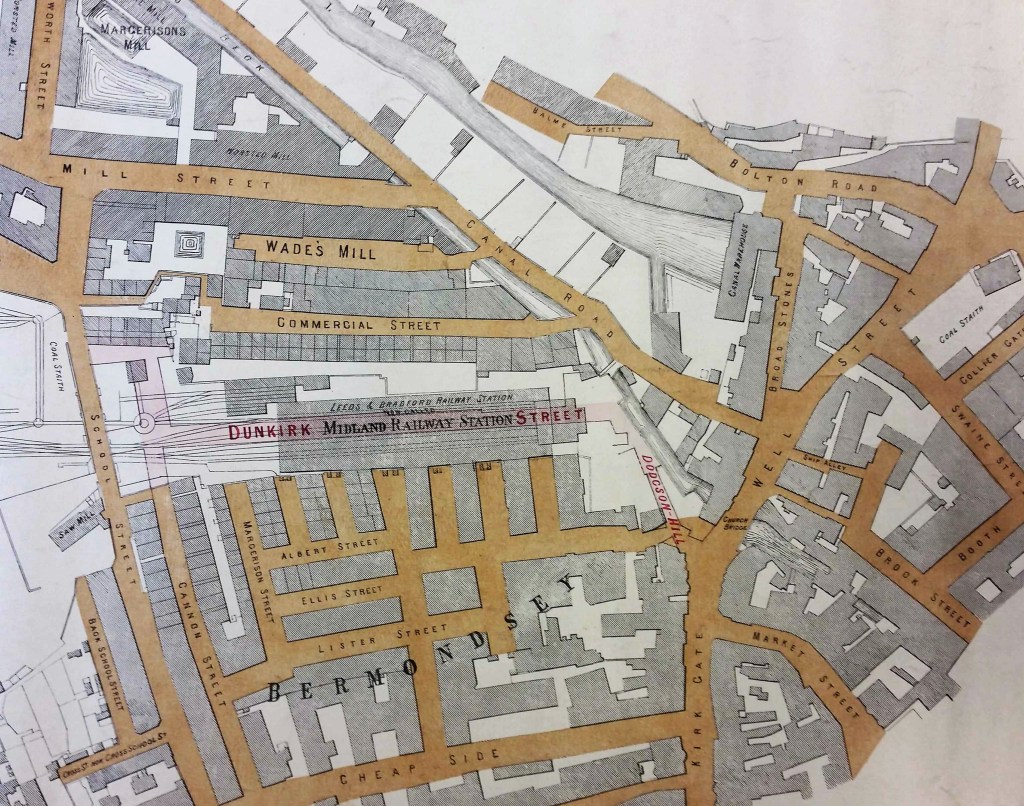
The possibility of railway communication with Bradford was being widely discussed in the local press in the late 1830s. The Leeds & Bradford Railway was finally formed in 1843 and it opened a station in 1846 when the line first became operational. The route from Leeds via Shipley was initially a single track, but this was later doubled. The first train, a goods train, was hauled by the engine Stephenson which was watched by a huge crowd as it was detached and moved onto the old quarry site near School Street (Bradford Observer, March 19 1846).
This early map (used in Regina v Midland Railway) suggests that houses on Commercial Street and Dunkirk Street in Bermondsey, were demolished to create space for the terminus. The loss of the housing provoked an emotional response in the Bradford Observer: ‘its human habitations…with their love and hate, and fear and hope, and joy and sorrow, and crime and madness….are being laid bare to the public gaze’ (March 5 1846). More prosaically an inquiry was set up to fix levels of compensation for those affected by the demolition.
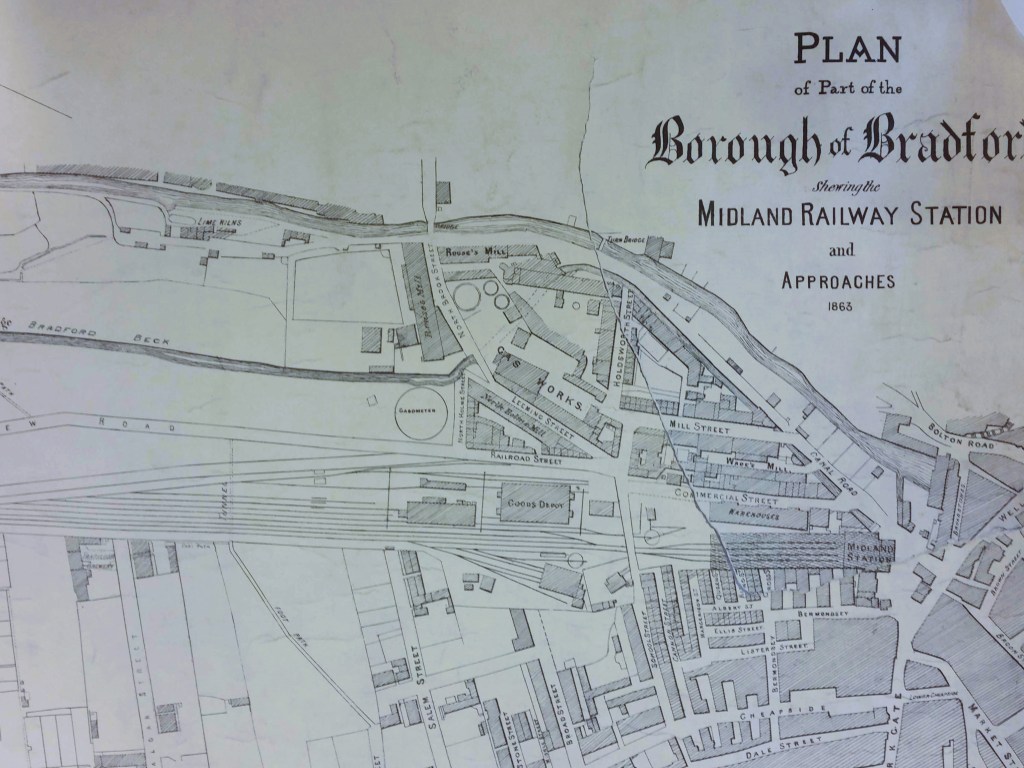
When I previously posted the first map I made two mistakes. The map carries the date 1849 but Kieran Wilkinson pointed out that the case involved took place in 1864, around the time of this second map. Litigation was brought by the Corporation over whether Commercial Street remained a public highway after the Midland Station had been built, or not. The Midland Railway Company maintained that it was their private property, but the Corporation claimed that it was a public highway, and won. I also assumed that the terminus itself was once called ‘Dunkirk Street Station’, but now I cannot confirm this name was ever used officially. Does any reader know?
Subsequently the terminus was extended and moved on several occasions. The name Midland Station was employed after the Midland Railway Co. took over the line in 1851. The station was known as Bradford Market Street by 1890 and was of course finally renamed Bradford Forster Square. Further extensive demolition of housing must have occurred, but I have not investigated this.

A straight line from Halifax to Bradford via Low Moor was built by the Lancashire and Yorkshire Railway into Drake Street station (1850). This terminus was later called Exchange Station. L&Y subsequently became part of the Great Northern Railway. This sale plan of 1850 must illustrate these recent events since it shows that a ‘passenger station’ could be accessed by steps from Drake Street. This sale plan records several other interesting features. On Hall Ings is the Bradford Courthouse built in 1834 on land owned by Rev. Godfrey Wright. At the corner of Bridge Street and Hall Ings St George’s Hall was to be built. The map shows some pre-existing buildings that were clearly demolished to clear a space. Rev. Wright got £5000 for this site I believe. An early minister of Sion Chapel (Baptist) was Benjamin Godwin (father of John – mayor and Arthur – first Lord Mayor). He was an abolitionist, and helped found the Bradford Observer and Mechanics Institute.

The Bradford map of 1850 includes two railway stations and at least one puzzle. To the north of the Borough the set of parallel lines marks the existing line from Shipley into an unnamed station. In the south single lines must mark projected lines from Halifax to Bradford, with a loop giving direct access to Leeds for Halifax trains. The puzzle is that the projected Halifax-Bradford line goes further north than the reality. Was this implying that the two stations would, one day, be linked? If so height differences would have prevented such a direct approach. It is universally agreed that the main problem with Bradford’s rail services is that no link line was ever constructed to join the two main stations, Even today there is no ‘through traffic’ through the city, which remains a prisoner of railway history.
Some years after this Borough map a more direct route from Leeds to Bradford was constructed (1854) terminating at Adolphus Street Station, south of Leeds Road. Passengers had quite a long walk west into the town centre so this route was never really popular. Trains from Halifax often wanted to bypass Bradford and in the same year the GNR Laisterdyke – Bowling Junction line opened for Leeds – Halifax direct trains. In 1867 Drake Street was enlarged to become a shared L&Y/GNR station called Bradford Exchange, and a further loop line was opened to allow GNR trains from Leeds direct access into Bradford Exchange, which is still in use today. Adolphus Street Station became ‘goods only’ at this time. Much later Exchange Station evolved into the Bradford Interchange.
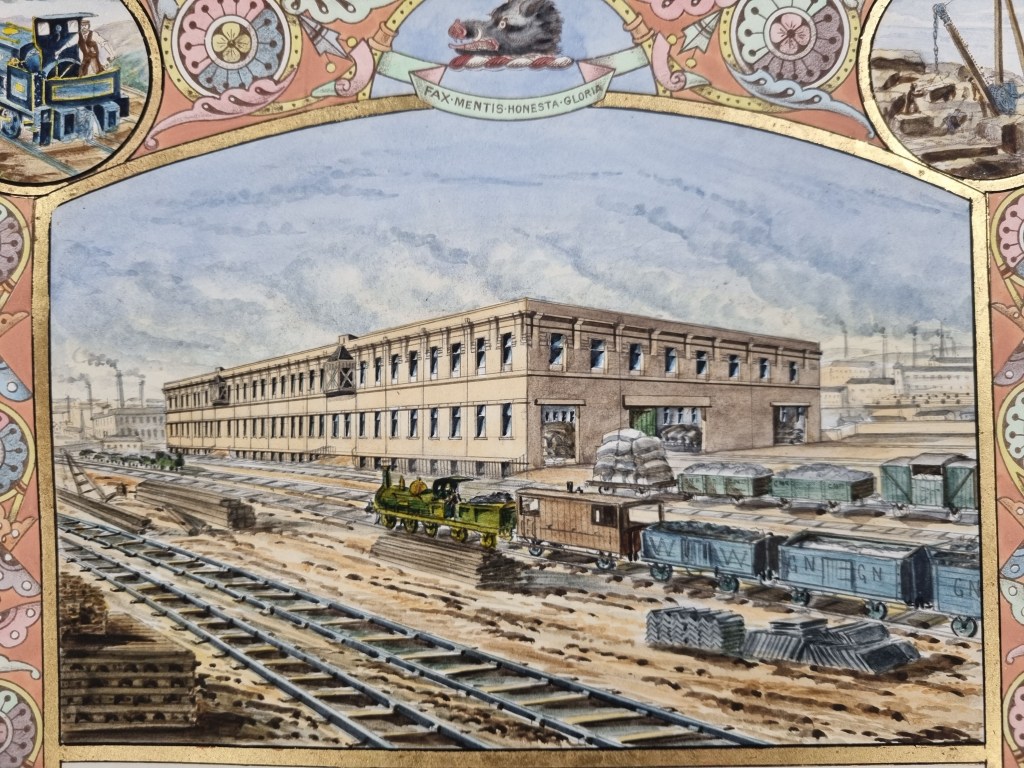
I don’t have a photograph of those early trains and railway engines. To represent them I have used this illustration which was included in a presentation book given to contractor Isaac Woodwiss on completion of Bradford’s last railway line: the Bradford, Halifax, Thornton and Keighley Railway, in 1884.
 Bradford and District Libraries Map Collections