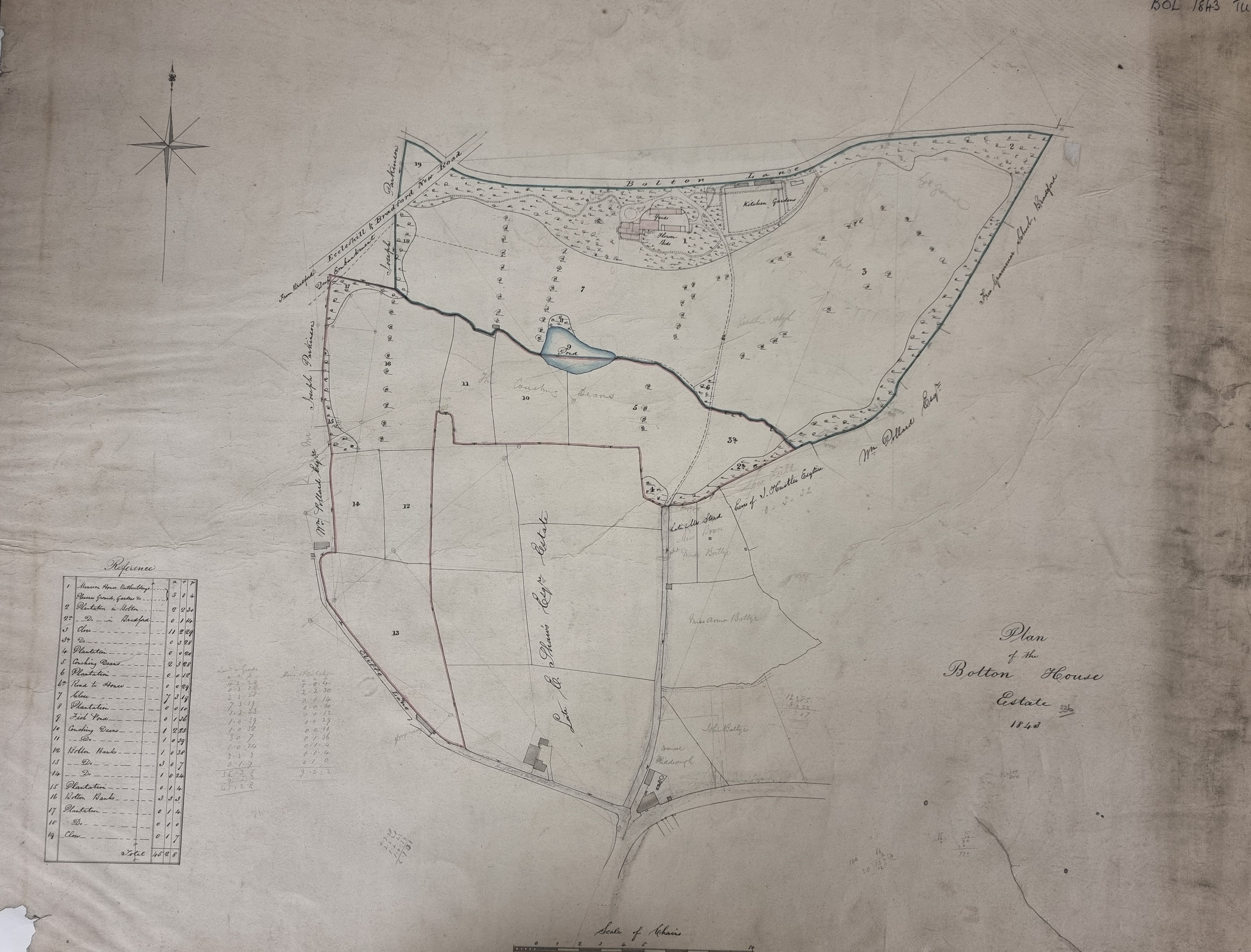
This detailed plan (BOL 1843 TUX) has a definite date, 1843. I assume that the inked portion is the original but names, and even calculations, have been added in pencil. This suggests that what we have is a working map and it was perhaps used by an agent or surveyor. The names of neighbouring landowners are included. Whether their property ever formed part of a larger Bolton estate is not clear. Similarly, when the estate was sold, I don’t know if this occurred piecemeal or on a single occasion.
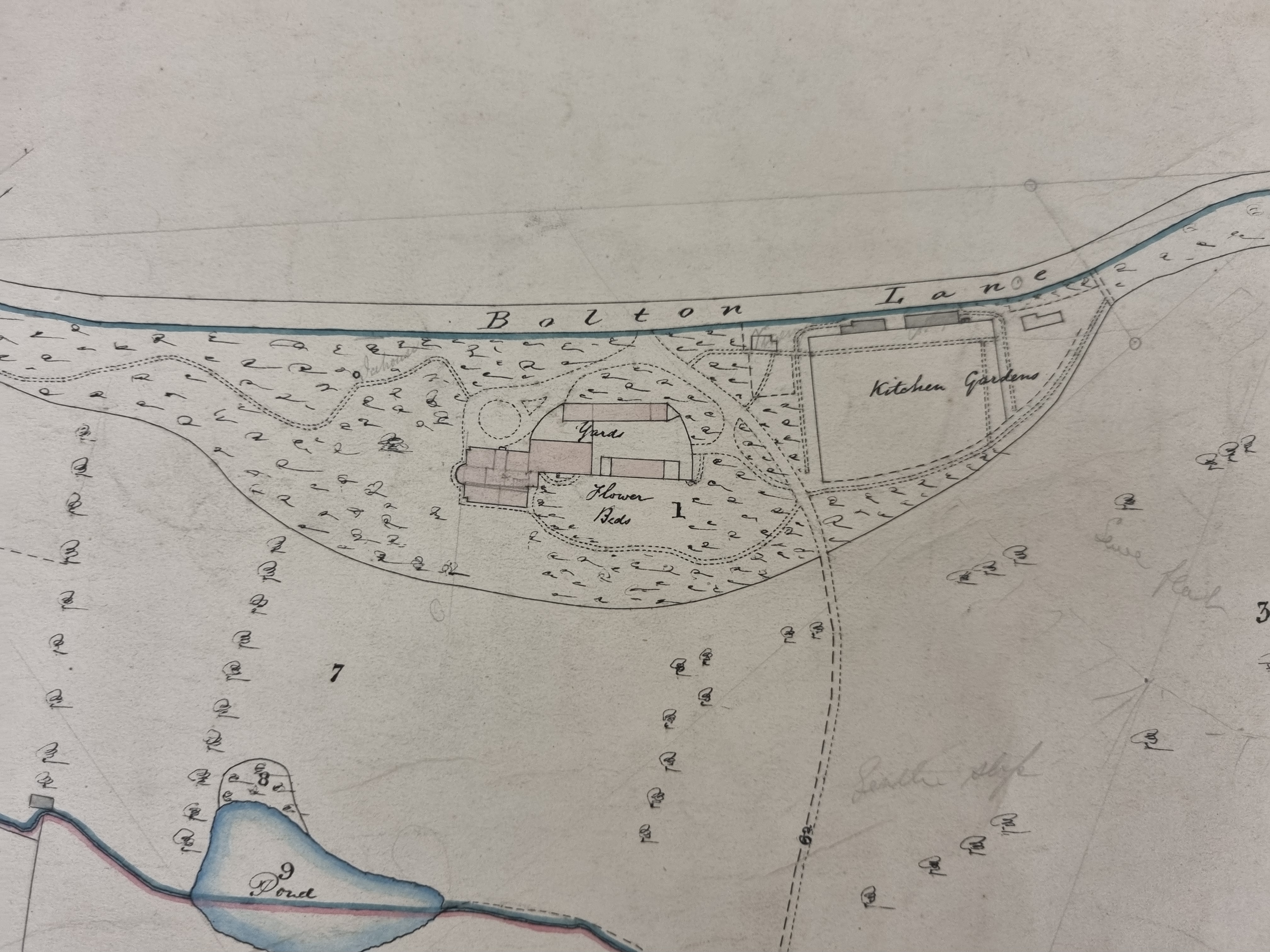
The portion of the plan which I find most interesting is this detailed survey of Bolton House. It looks very comfortable with its yards, flower beds and kitchen garden. It is easy to locate the area concerned since within 5 years or so the surveying for the first Ordnance Survey map in the area would have commenced, and few changes would be anticipated. Later in the century the clearly marked Bolton Lane would change its name to Lister Lane, which it retains today. On the extreme right of the plan a portion of land marked as owned by Bradford Grammar School is revealed by the OS map to be a sandstone quarry. This is no surprise: Bolton is famous for its quarries.
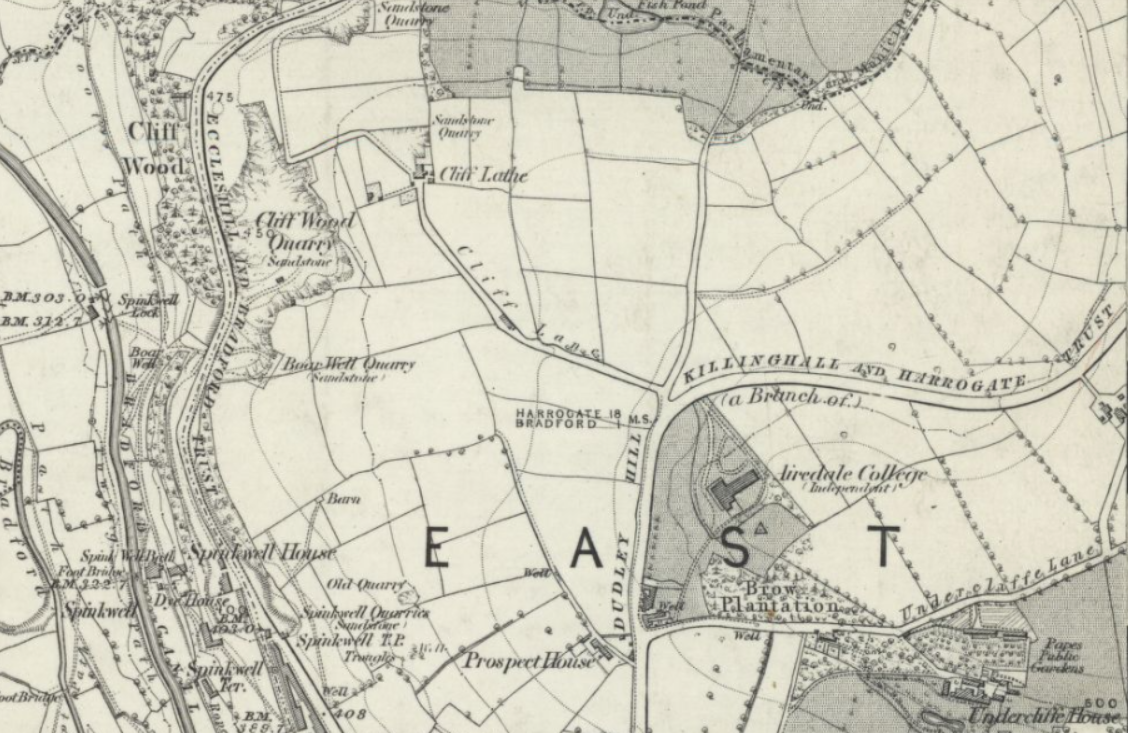
South of the house the OS map confirms the presence of a fishpond, and typically identifies the estate area with a grey tint. The dark line that ‘cuts off’ the southern third of the estate is revealed to be a Parliamentary Boundary. If you go to the very bottom of the original plan, you can see that a larger road curving to the right gives off roads heading north, which I assume are Airedale Road and Cliffe Road. There is a triangular area adjacent to these roads and you may be able to make out the pencilled name of Daniel Riddiough.
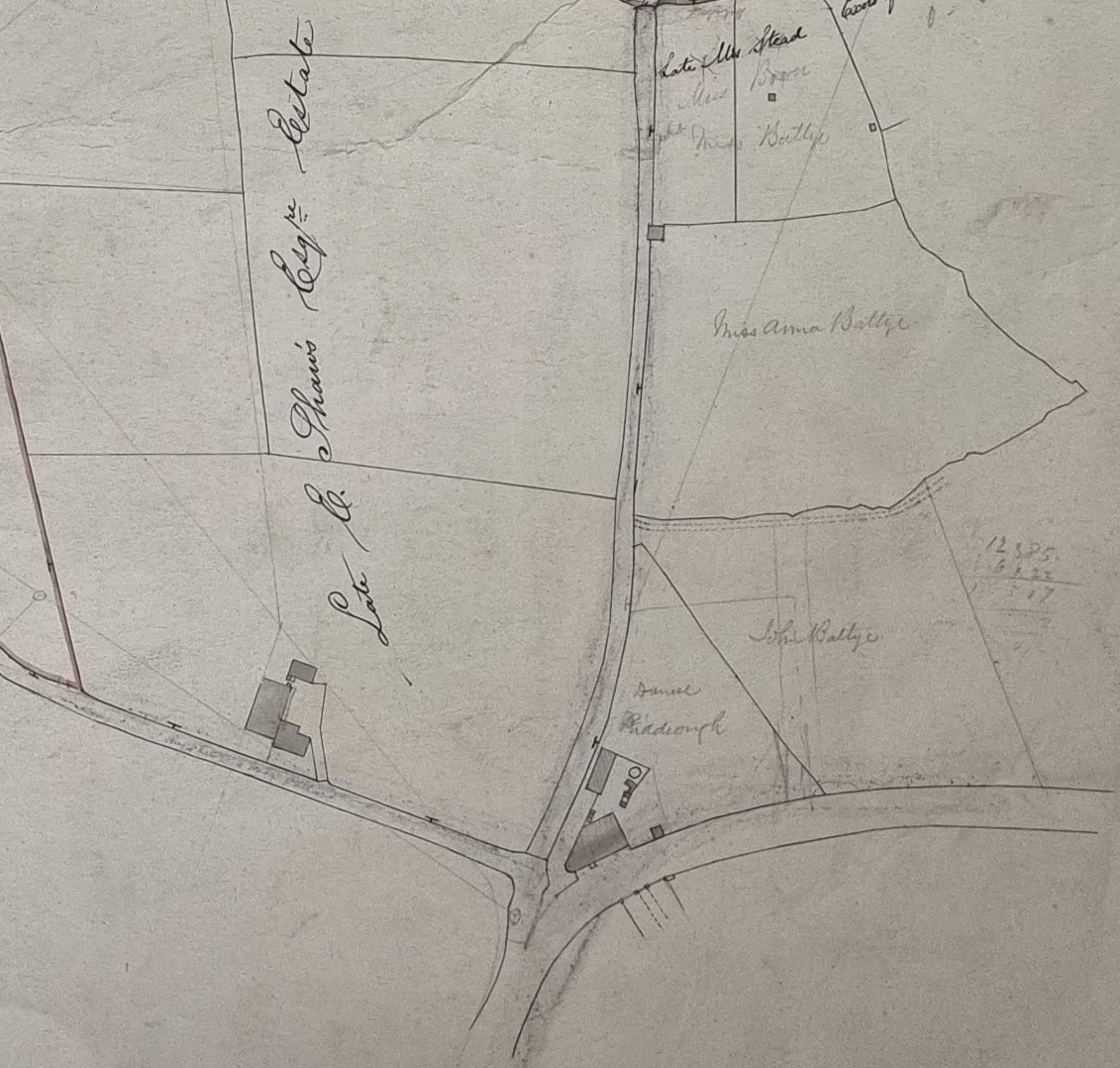
Riddiough was a brick-maker and quarry owner located in the Otley Rd/Killinghall Road area. The brick mark [D.R] must be his. But unless I am very much mistaken stone quarrying seems to be the least of his accomplishments. Daniel Riddiough was born in Colne, Lancs. His name first appears (as Daniel Riddiough, Undercliffe) in the Leeds Mercury of 28 August 1852 applying for a licence at the Brewster sessions. By 1872 he is described in the same publication as a brewer of Otley Road offering beer-houses to let. In the triangular area he was to construct Peel Park Brewery in 1853. Apparently, he sold this concern in 1872, and then bought it back after the new owners went bankrupt in 1882. North of Daniel Riddiough the landowners appear to be John and Miss Anna Battye. Despite their relatively uncommon names they have defied my limited family history skills.
The real excitement of this map is what was to happen between the first and second OS map (published in 1890). Bolton House remains but the rest of the area has evolved into Peel Park. Peel Park is Grade II* listed, 56 acres in extent, and was named after Prime Minister Sir Robert Peel (1788-1850) after his death. It was opened to the public in 1853. Peel Park is significant since it was such an early example of a public park. Joseph Paxton’s design at Birkenhead is generally accepted as the first in England, being opened in 1847. The group that financed Bradford’s first park initially retained control and weren’t, for financial reasons, able to present it to the Borough of Bradford until 1863. As a further development across Otley Road from ‘the Riddiough triangle’ you would find yourself walking into Undercliffe Cemetery; but that development takes us well outside our original plan.
So, who owned Bolton Estate in 1843? Samuel Hailstone (1768-1851) was that rare combination, a lawyer and a botanist. He was the classic example of a wealthy and highly successful professional man. His politics were Liberal and, slightly unusually for non-conformist Bradford, he was an Anglican. He is recorded as having purchased the Bolton House estate although he never resided there. There was also a John Hustler ‘of Bolton House’ (1797-1861) who I think was a wool merchant in partnership with Benjamin Seebohm. He was also involved in the Orrell coal business. He (Cudworth reports) purchased Bolton House and he was certainly described as ‘formerly of Bolton House’ when he died in Falmouth in 1861.
 Bradford and District Libraries Map Collections