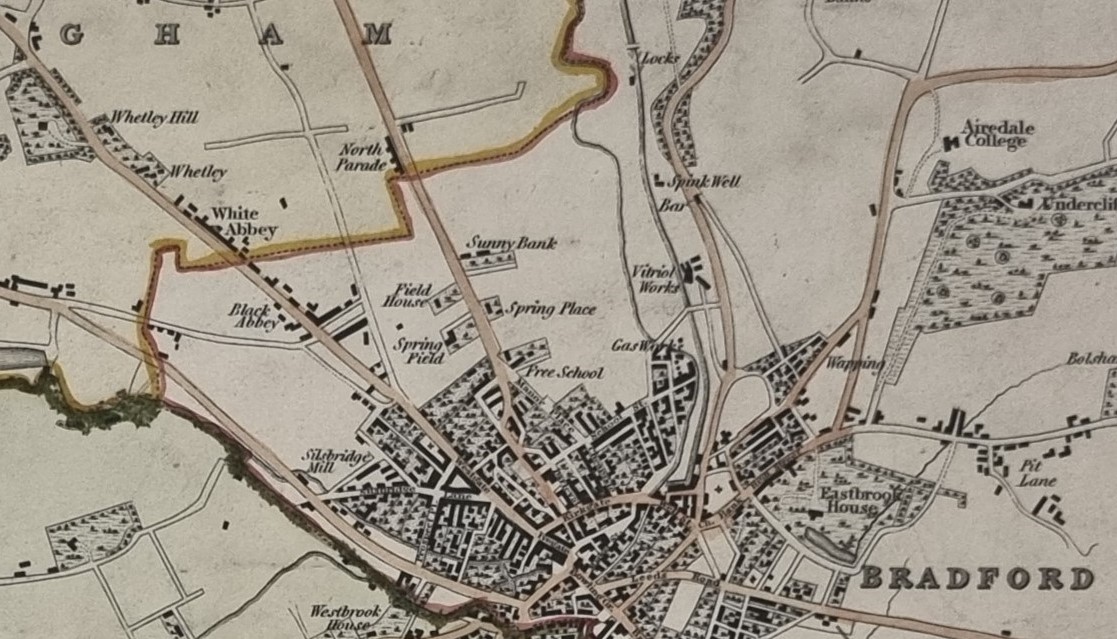
The name ‘White Abbey’ has always been puzzling since there is no evidence whatever of a medieval city centre abbey or priory. It is an area of Manningham bordered, approximately, by White Abbey Road, Lumb Lane and Carlisle Road. In fact, the name seems to be relatively modern, but older is its homologue – Black Abbey, which today is used to describe the region of Brick Lane. In the first map detail, from the Bradford plan of 1836, you can see Whetley Hill at 10pm: following the road down to Westgate passes both White Abbey and Black Abbey.
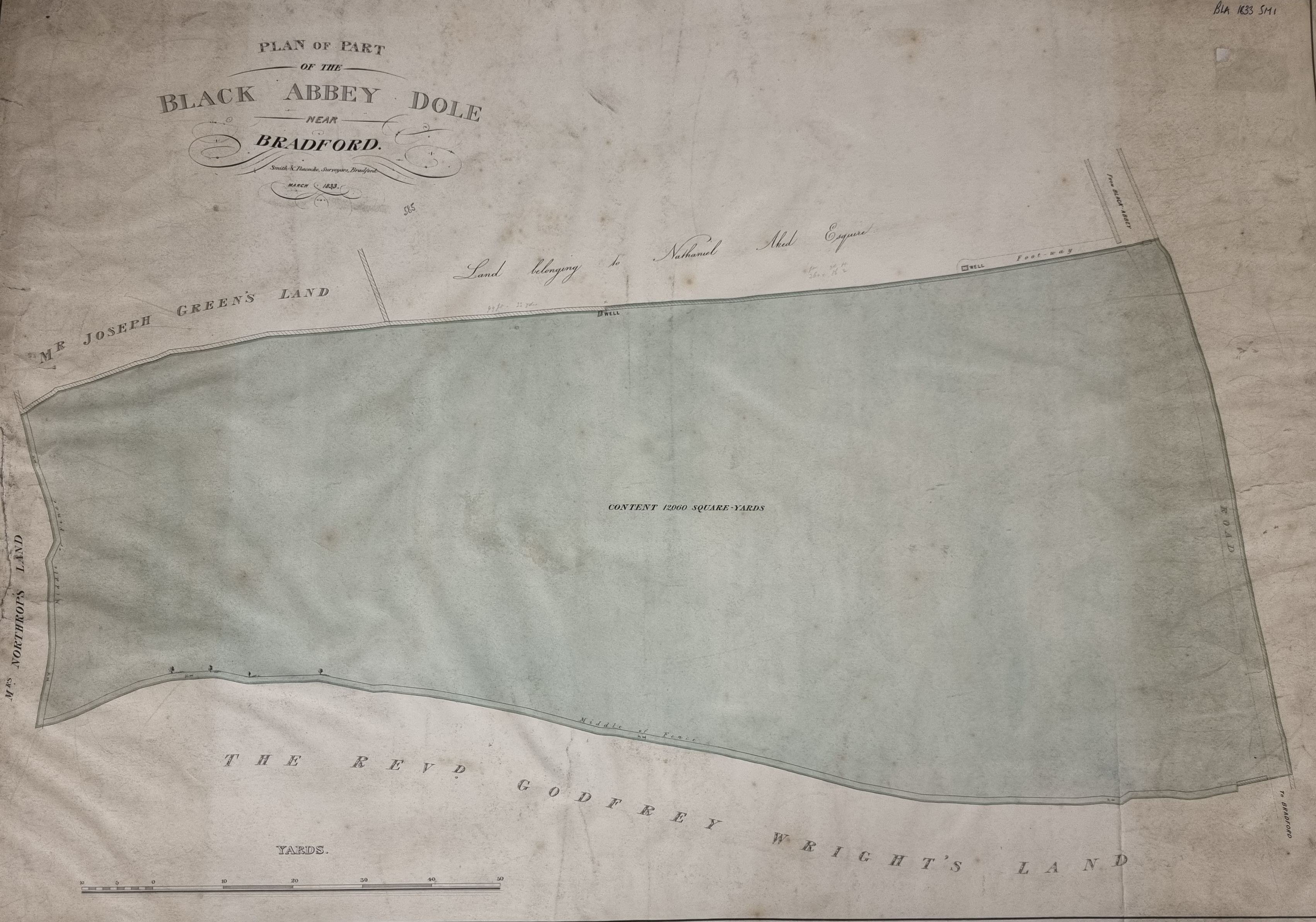
The second map is in the Local Studies Library collection and is an 1833 plan of land belonging to a charity called the ‘Black Abbey Dole’. South of this is the property of Bradford’s biggest contemporary landlord, Rev Godfrey Wright. The road to the right must be White Abbey Road. Can historical sources help us interpret what is going on?

John James, writing in the 1840s (The History & Topography of Bradford), records that as long ago as 1686 one William Field conveyed four closes of land in an area already called Black Abbey to Thomas Ledyard and James Durham. The idea was evidently that the rents and profits and the land would be used for the maintenance of the poor in the town of Bradford. The heirs of William Field having become extinct various trustees were appointed to fulfil his intentions. The charity continued to distribute money to the deserving poor, and in the early nineteenth century areas of land were leased for building development. I assume that this brought in more income than agriculture or quarrying. The charity was known as the Black Abbey Dole or Field’s Charity.
William Cudworth does not really provide any new information but follows James. He notes that at the beginning of the nineteenth century one Tommy Clays lived in Black Abbey and was famous for his garden, containing ranunculas. This is the buttercup genus which I assume must have had cultivated varieties.
I’m afraid that demonstrating that Black Abbey was being used as a descriptive name in the mid-seventeenth century, and was famous for flowers 150 years later, doesn’t really bring us much nearer to the name’s origin.
 Bradford and District Libraries Map Collections