
I was surprised to learn that as recently as 150 years ago heavy industry, such as stone quarrying, coal mining, and iron smithing were to be found within the central area of Bradford. This detailed map is from the collection of the Local Studies Library. On the reverse side is the catalogue stamp of Bolling Hall Museum which is where it must have entered the city’s collection. To the best of my knowledge those maps were transferred to the Library Service in the 1960s. Unusually the map has a date (1865) and the ‘Dix’ in the catalogue designation means that the surveyors were the well-known partnership of either Dixon & Hart or Dixon & Hindle. As early as the 1850s one Thomas Dixon is listed in trade directories as a land surveyor of Bridge Street, and later Rawson Place. I assume Hart and Hindle were his partners at various times. There is an annotation ‘copied from a notice to treat plan’ and the signature of Thomas Dixon. This suggests that some sort of legal process is being undertaken.
So, where are we? At the bottom of the map is Chapel Lane, named after the Unitarian Chapel, which in two constructions, was here until the late 1960s. On the opposite side of the road there were in fact two foundries, the Old Foundry and the Union Foundry. The size and shape of the site surveyed suggests that this is the Old Foundry, with access being a private road to Tyrrell Street. This would place the site where the Mirror Pool is today.
The map details indicate what work the foundry undertakes. The raw material was likely available from Bowling and Low Moor Iron Works, although the foundry may also have worked with brass. It presumably remelted cast iron billets and made mouldings which were cleaned up in the Dressing Shop. It could undertake smiths work, but I’m not sure what went on in the two Fitting Shops. In common with many industrial concerns it would need a steam boiler, chimney, engines to provide power, a warehouse, an office (counting house) and some means of weighing materials entering or leaving the works.
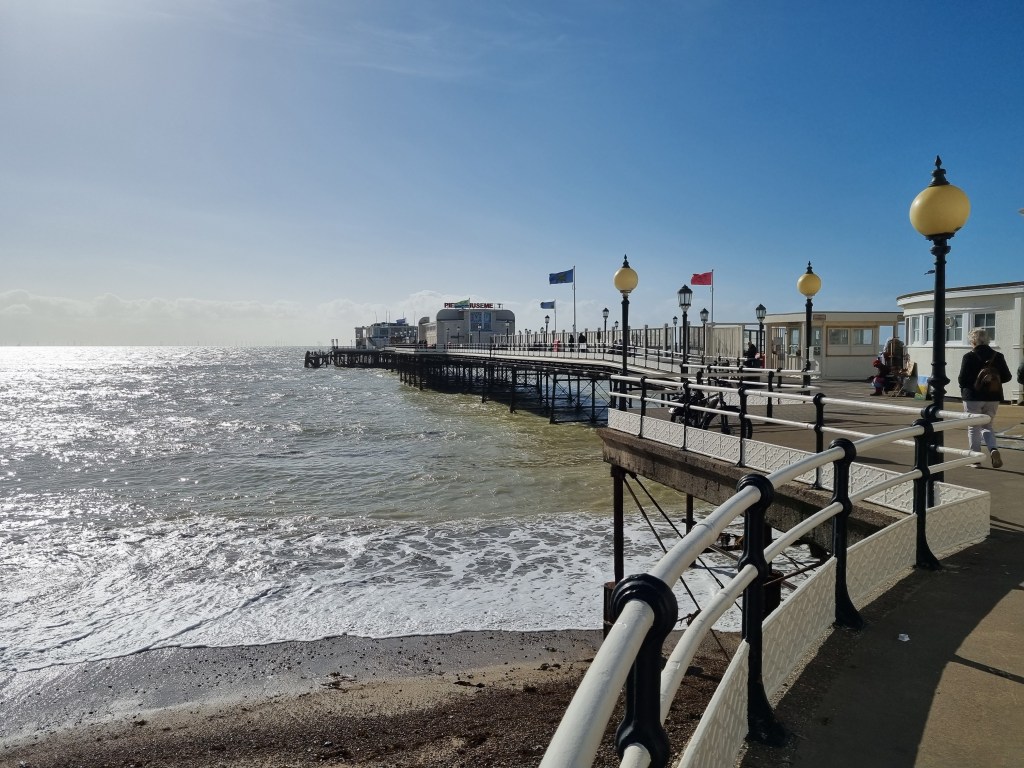
Because we have a definite date it is not too difficult to reconstruct a little of the history of the works in the 1860s. The site had been compulsorily purchased by Bradford Corporation to allow for street improvements. There was the usual debate about fair compensation and Thomas and James Mawson shared £1400 for their one quarter share of the property. For some years the occupier and operator had been Joseph Cliff (J & J Cliff); was he also a part owner? Evidently, he was able to undertake large projects since in 1861 the Bradford Observer reported that Joseph Cliff had been entrusted with ‘making and erecting’ a wrought and cast-iron pier for Worthing in Sussex which had been designed by Robert Rawlinson and opened in 1862. I stood on Worthing Pier in 2022, and never guessed.
There is a famous Joseph Cliff who was a firebrick maker from Wortley, Leeds. I know that he had coal mining and iron interests, but I don’t know for certain that he was the same man.
 Bradford and District Libraries Map Collections
To the best of my knowledge those maps were transferred to the Library Service in the 1960s.
1957 and 1959 gargrave PLANNING maps RE GARGRAVE RIVER PLACE CAN YOU GET HOLD OF ANY OF THESE? HM LAND REG SAY NOT RETAINED BUT THEY MUST BE SOMEWHERE Linda Drew
LikeLike
Bradford is in West Yorkshire. Gargrave is in North Yorkshire so the place to try would be the county archives in Northallerton. But they may not be anywhere; many maps and documents are destroyed or lurk forgotten in solicitors strong rooms. Sorry.
LikeLike
how do you know chapel there until late 1960’s? I really need to make a visit to archives and library
LikeLike
Several of the congregation of the present Unitarian church remember worshipping at its predecessor.
LikeLike