X38 NOR c.1843 PLA
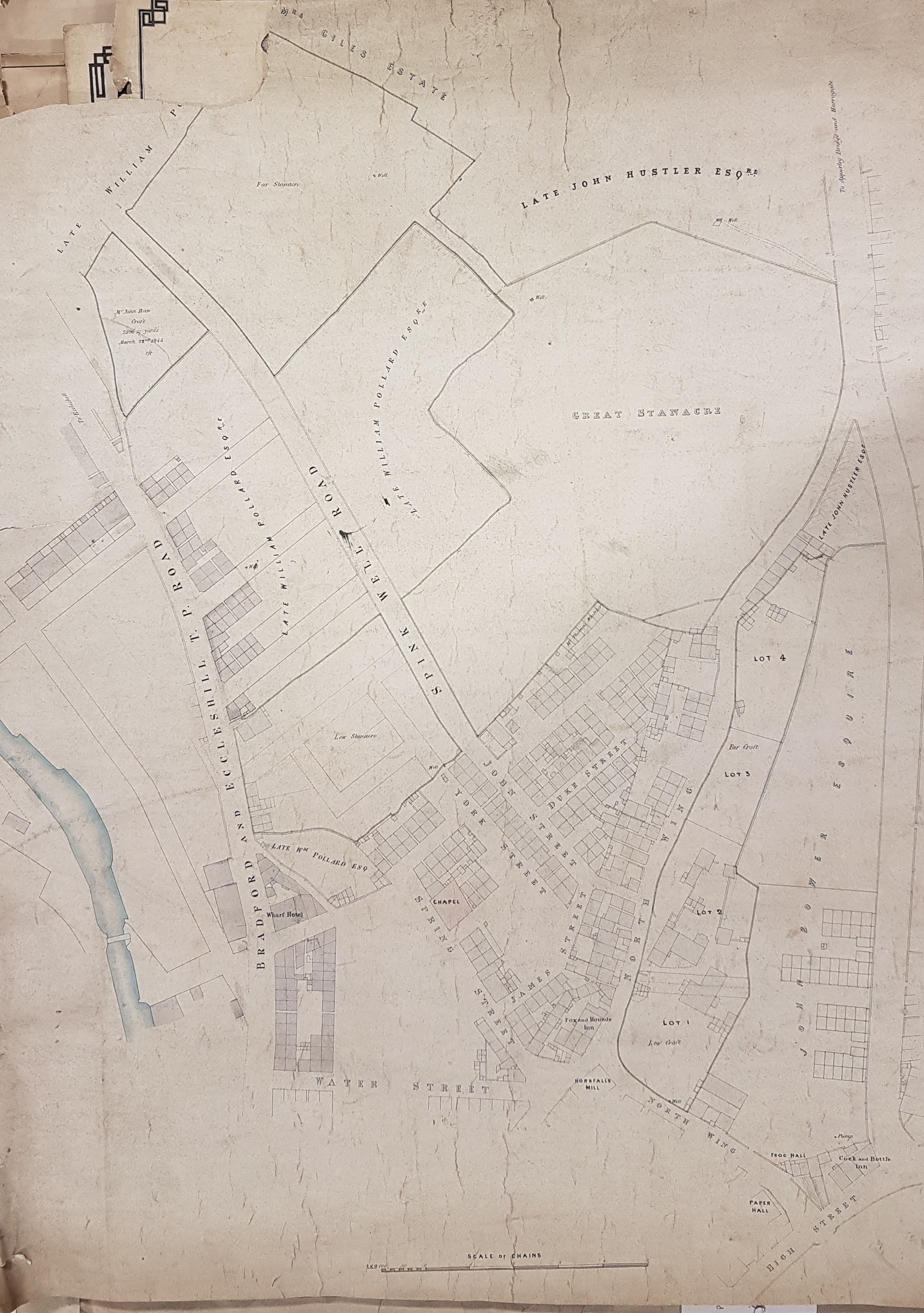
Title: Plan of the area around North Wing, Bradford (c.1842-43)
Size: 23” * 29” Material: Paper
Scale: 1” to 1 chain Condition: good
This is an undated, but detailed, sale plan of the area around North Wing. Several sale lots are marked. I have put this map online before, but now have a completely new feature of interest.
To orient yourself Horsfall’s Mill is marked, as is Paper Hall and the Fox & Hounds Inn. A good place to begin is the fragment of Paper Hall at the bottom right of the plan. This seventeenth century construction, one of the city’s oldest domestic buildings, is still extant although its surroundings have changed out of all recognition. North Wing then opened off ‘High Street’ which is the modern Barkerend Road. The Fox & Hounds Inn was believed to have been built in the early nineteenth century and was, I understand, demolished during the creation of the Shipley Airedale Road. Horsfall’s Mill was of great significance in Bradford’s textile history. John Garnett Horsfall introduced steam power looms to the city. The consequent riot at his mill in North Wing (in 1826) led to several deaths when special constables fired on the protesters. It is possible to date the map by considering the names of the landowners. Assuming all the identifications are made correctly, 1842-43 seems a reasonable date for it.
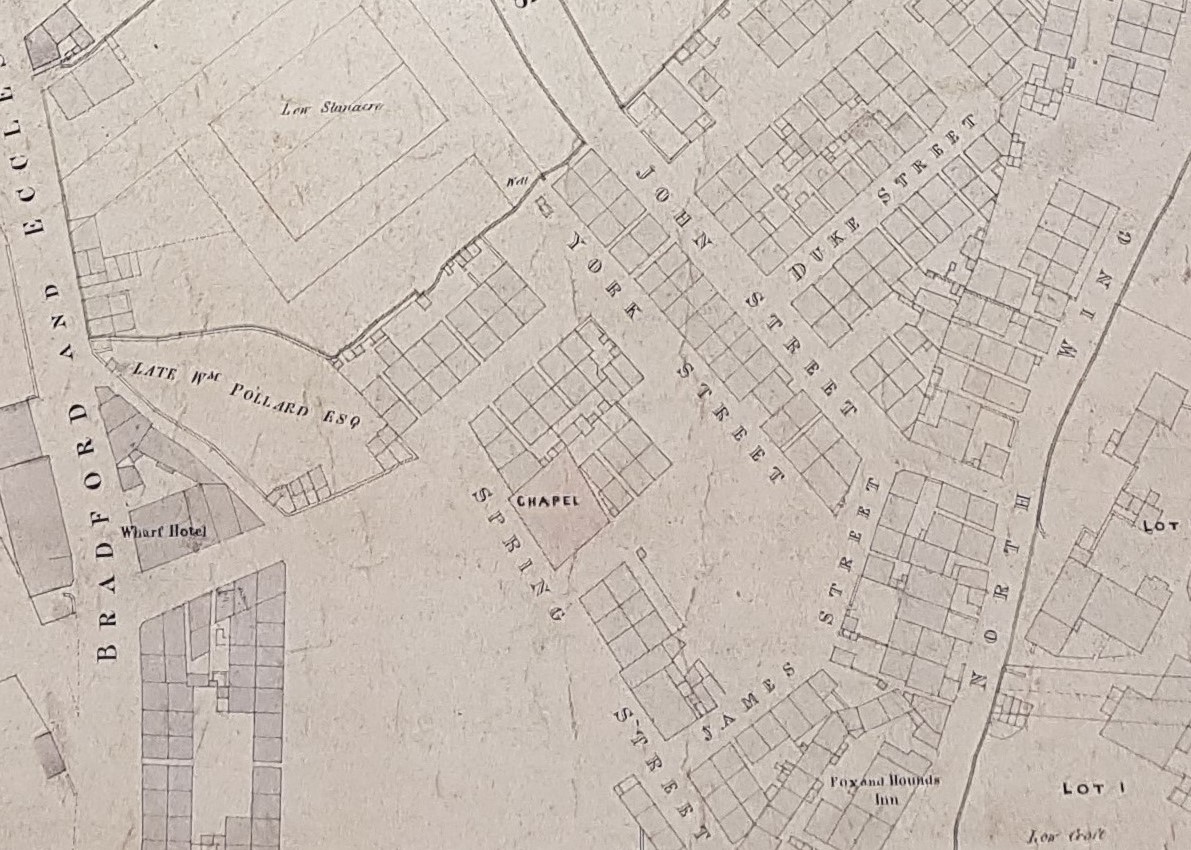
This detail shows the new feature that I wish to discuss, that is the chapel at the centre of the plan. I am trying to draw up a complete record of all Bradford’s Victorian places of worship based on material curated by the LSL. This is a typical example: an unnamed chapel in an undated map with no information concerning the denomination that worshipped here. Very fortunately the same building is named in the 1846 Town Plan, of which this next figure is a detail.

Although there is some variation of street naming there is no doubt in my mind that we are looking at the Philadelphia Chapel in both maps. It is not marked in the 1890 25” OS map and the road is then Sun Street. With an absolutely certain name we can look for other sources of information, like local newspapers.
The Bradford Observer August 28 1834 reported the opening of the ‘Gospel Pilgrim New Philadelphia Chapel’ (Spring Street, North Wing). No denomination is mentioned but sermons were preached by an Independent Minister from Leeds (RW Hamilton) and Rev Steadman of Horton Academy. If this academy is Horton College then that was a Baptist institution. Who were the Gospel Pilgrims? A little earlier the Bradford Observer draws a parallel with the Society of Friends (Quakers), since the Pilgrims had no paid ministers and both men and women could serve in this capacity as lay-preachers. From a tiny fragment of additional information from 20 years later it appears that this name was applied to a group of like-minded individuals rather than a regional or national denomination. In 1838 the newspaper records that they were renting a property in Horton.
Providence Chapel was long associated with the Primitive Methodist Church and within a few months of its opening the Bradford Observer reported that a Rev JR Stephens delivered a lecture there, and Primitive Methodist Chapel, Bowling Lane, on the relationship between church and state. I know that there are baptismal records in the West Yorkshire Archives under the heading of Bradford Gospel Pilgrim Chapel (Philadelphia Chapel), Spring Street, Bradford. I conclude that it was built by Gospel Pilgrims and also immediately rented by Primitive Methodists.
In 1845 its importance to working people was indicated when wool-combers held meetings there concerning some problem at Messrs. Rands. In 1846 the public were warned that Chartists planned to meet at open space near the chapel, but the association may have been purely geographical rather than representing any form of active encouragement.
In 1859 the Bradford Observer indicated that the chapel and neighbouring dwelling houses were being offered for sale by auction. I don’t know if a purchaser was found. Then it was advertised for let on 30 October 1862. Remarkably it was there described as ‘being occupied for many years by the Wesleyan Methodists of the Eastbrook Circuit’. A school room had been built by that time and the chapel had 800 sittings. The Wesleyans were the largest group within nineteenth century methodism and although there were no doctrinal differences with the Primitive Methodists (only organisational ones) they were distinctly different, so it would appear the management of Philadelphia Chapel had changed again.
‘A Churchman’ wrote to the newspaper advocating its continuance for the very poor but it was still being advertised to let in 1863. Then a year later, on a very dark day, a John Harrison became the tenant and converted it into a ‘singing and drinking saloon’. But the Bradford Observer 12 May 1864 reported that Harrison had been accused of fraud over the acquisition of some beer and had represented himself as the owner, rather than the leasee, of the property. Whether he got his just deserts I cannot say but by November 1864 the chapel and school are functioning again, although it is not clear under the supervision of which denomination. But by October 1865 it was clearly being used by the Primitive Methodists and the chapel was being described as being rescued from its ‘filthy and improper use’, which must mean the singing and dancing.
There is a very helpful website devoted to Primitive Methodism: Bradford: the growth of Primitive Methodism | A – G | My Primitive Methodists
The author quotes a description by the Rev. Ernest Lucas in the Handbook of the 111th Annual Primitive Methodist Conference held in Bradford in 1930. I will conclude with his words:
In Sun Street there was a building originally a Primitive Methodist chapel, disused through the transference of the cause to Tennyson Place, widely known as Philadelphia Chapel. “At this time two courageous young men, looking at the character of the neighbourhood, and struck with its need for Christian work on new lines, determined to undertake a fresh method of Christian service. Almost unsupported, they got permission to make what use they could of the place. They lived in dire poverty among the people, frequently suffering cold and hunger, but making the old chapel a bright and useful centre for people as poor and helpless as themselves. Here they organized soup kitchens in the winter, begged and distributed coals and necessaries among the needy people, and provided concerts in the chapel for them during the evenings. On Sundays they preached their simple Gospel, and often were themselves hunger-bitten when dealing the bread of life to the people. With scarcely any salary but just the wages of going on, these unnoted heroes carried forward their social evangelistic work for nearly two years. Living a life of austere simplicity and privation, they made the old chapel bright with memories of human service, and wrought as noble a piece of heroism as ever was recorded in the history of the city.”
I’d love to know who these unsung Bradford heroes were, if anybody can help.
 Bradford and District Libraries Map Collections