Once I move outside brickworks and coal mines, I cannot pretend to any specialised knowledge concerning the rich history of Bradford. I simply pick up ‘unconsidered trifles’. It may be surprising then that my latest enthusiasm, based on the material I am able to work with as a volunteer at Bradford Local Studies Library, is for Victorian places of worship. Outside my industrial archaeology comfort zone I am easily confused, and I may be here.
The Victorian period was an age of faith. I have listed over 325 nineteenth century chapels and churches in the Bradford area. My ambition is to have a name, denomination, contemporary image, and map detail for each place: but there are many difficulties to overcome before I achieve that.

An example of such a difficulty is exemplified by this picture from the LSL reserve collection. The rubric shows that it was a Methodist New Connection Chapel. The image background, with its fashionable ladies and well-dressed gentlemen, would seem to have been somewhat idealised! The obvious questions are which chapel is this, but also (since it is evidently not a photograph) was it ever actually built anywhere? I am not the first person to consider these issues: on the back of the image a predecessor of mine has written in pencil ‘Horton Road Chapel (Ebenezer – 1838) replaced by a newer building, became College of Art’. But is this all true?
It is quite correct that the famous Ebenezer Chapel was originally constructed in 1838 at the city end of Horton Lane. I believe that it is also established that a successor was eventually constructed in 1879, which was called Mannville Chapel, in Great Horton Lane. However, as a slight complication, Cudworth reports that Ebenezer Chapel was first rebuilt on its original site in 1861 for structural reasons, prior to being targeted by the Bradford Improvement Act of 1873. Studying maps confirms the date of construction of its definitive replacement by Mannville Chapel.

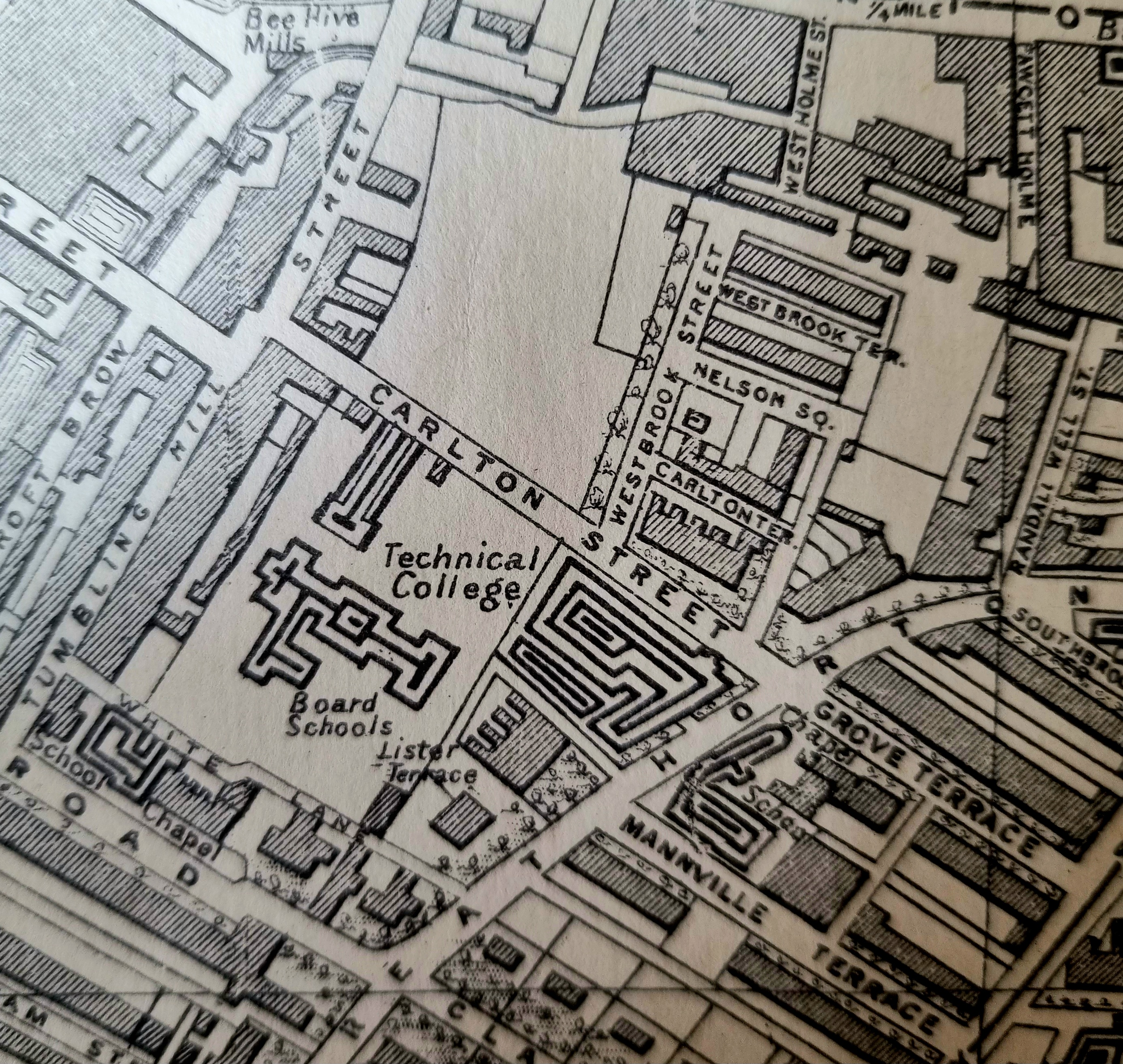
The first detail is from the 1871 Bradford map. Note the position of Grove Terrace and the presence of a house called Manville (sometimes spelled Mannville or even Mann Ville). Cudworth describes the building as belonging initially to the Mann family who, he says, were the first stuff merchants to come to Bradford. Their founding father was one Thomas Mann.
The next detail, from an 1887 map, shows the (unnamed) Mannville Chapel and associated school in place. That really should be that, except there is the little matter of builder and architect. The date of the construction of Mannville Chapel fits beautifully with the named builders, J & W Beanland. John and William Beanland were based at 13 Harris Street, but I have also seen a Horton Lane address for them. They were famous Bradford contractors responsible for the construction of Leeds Infirmary, the Bradford General Post Office, Swan Arcade, Saltaire Mill (partly) and the Wool Exchange. Their greatest achievement must have been the construction of Lister’s Pride, the Manningham Mills chimney.
On the first image you can also see the truncated name of Samuel Jackson (1830-1910). He was a noted Bradford architect and surveyor of the late nineteenth century. Jackson designed Shipley Baptist Church, Baildon Moravian Church, and Blenheim Terrace, Manningham. He came third in the Bradford Town Hall competition.
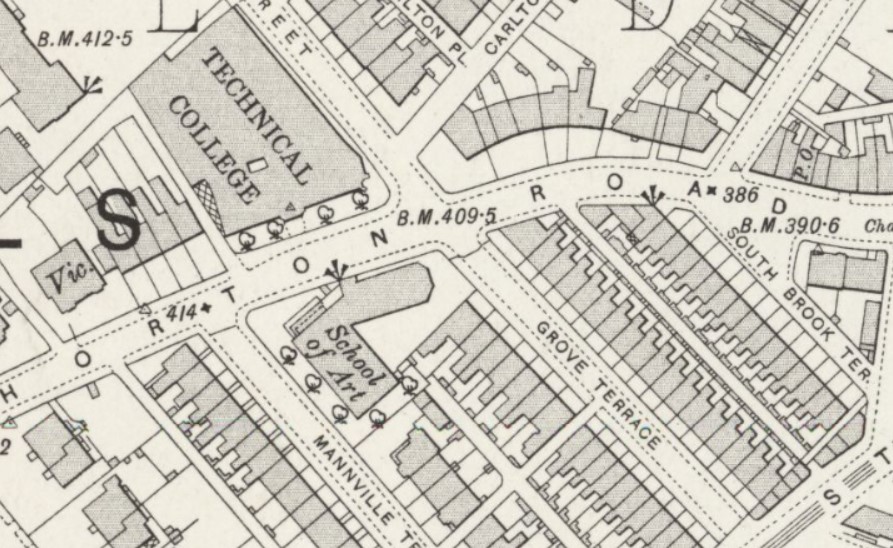
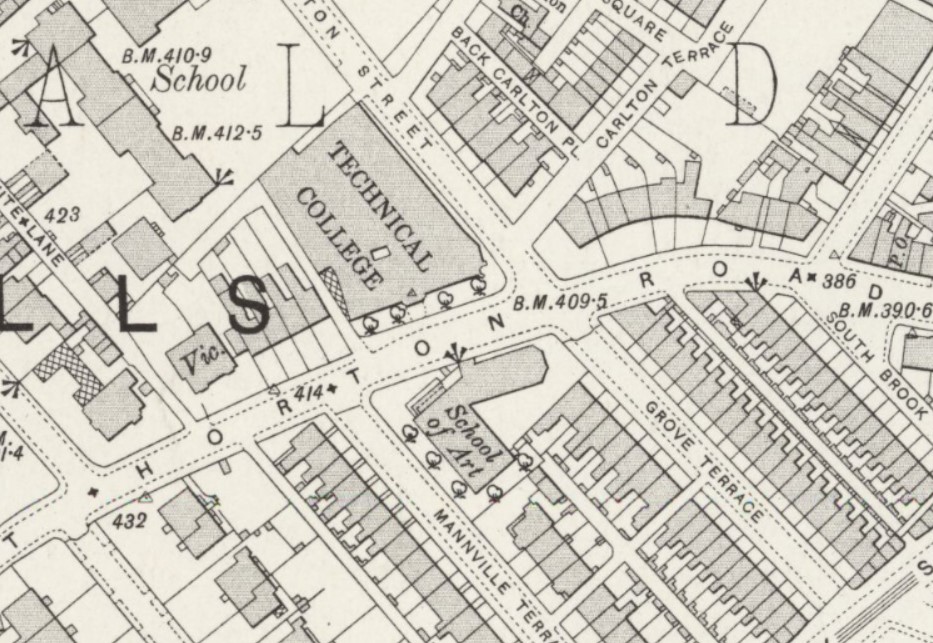
So, what is the problem? Firstly, a Methodist Church website states that Mannville chapel was built to the designs of Leeds architects Hill and Swann, not Samuel Jackson. Secondly, there is the comment by my predecessor ‘became College of Art’. This is true, and within 25 years as evidenced by this detail from the 25” OS map of 1905. The Bradford College building itself was opened by the then Prince of Wales (later Edward VII) in 1882.
Now, as far as I know, Bradford School of Art has now evolved into Bradford College’s Grove Library. I walk past the lovely sandstone ashlar building regularly and it really looks nothing like the picture I have used at the head of this article, although it certainly could well have been a large chapel of an alternative design.
So, can anyone identify the original chapel for me? It looks too ornate to be the 1838 chapel. There were other New Connection chapels in Bradford, but none appear on the lists of projects undertaken by the Beanlands or Jackson. Finally (as I suspect) could it have been purely an architect’s projection that was never actually constructed? I have top people working on this question at the moment, but I rather suspect poor Samuel Jackson missed out yet again.
 Bradford and District Libraries Map Collections