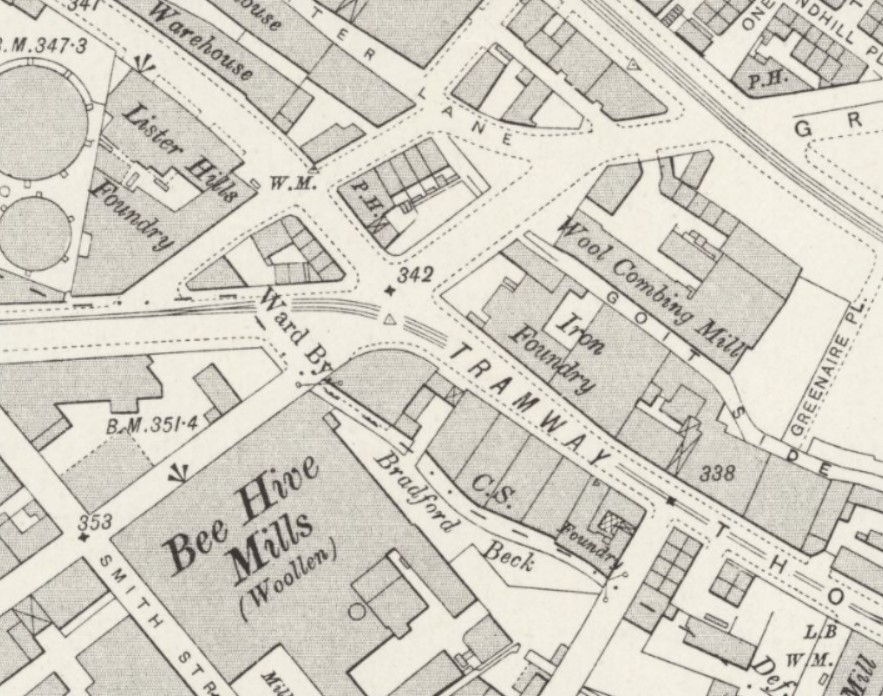
The majority of Bradford maps name the streets and major public buildings. You would also expect the naming of the larger mills and other substantial businesses. Public houses and hotels usually feature prominently. Places of worship are normally recorded although not necessarily the denomination. I have spent much time investigating the activities at a building simply named as ‘chap.’. Despite all this assistance you are always left with large numbers of cross-hatched blocks which sometimes conceal some very interesting items from city history.
This particular investigation started with an image in the Local Studies Library reserve collection.
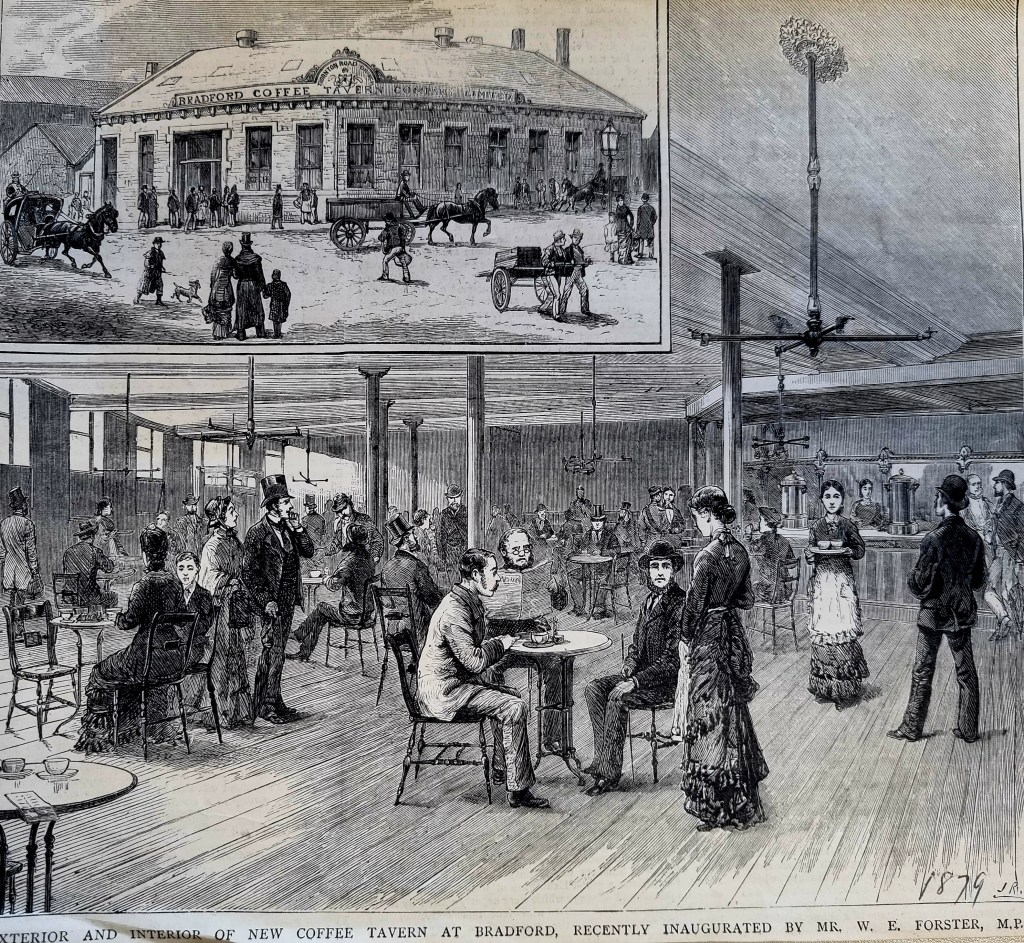
This image is described as the Bradford New Coffee Tavern. The style is that of the Illustrated London News. The rubric suggests that the tavern was inaugurated in 1879 by WE Forster MP. The inserted image states that it was ‘the Thornton Road branch’. This branch (which I subsequently learned was number 5) seemed to have had a corner location. Working up Thornton Road from the city end using the 25” 1890 Ordnance Survey Map the most plausible location was the unnamed building in the centre of the OS map detail (Fig 1): the one that resembles a slice of pie. This is at the junction of Listerhills Road and Longside Lane, and I was later able to confirm the position using Bradford trade directories.
Although the picture is dated 1879 an account of the opening was carried by the Leeds Mercury on 11 November 1878; which I believe was the year in which the Bradford Coffee Tavern Company was incorporated. The Chairman was then the Quaker philanthropist Frederick Priestman. Perusal of the 1891 GPO directory, and contemporary newspapers, suggests that eventually there were 30 or so other Coffee Taverns with a Central Office n in Westgate. There was also a bakery and an aerated water factory which, I assume, produced goods available for sale at individual taverns.
The reduction of the ‘terrible evil of drunkenness’ was an important part of the Company’s philosophy, but each branch was intended to be self-supporting. The consumption of alcohol was seen as a very major social evil in Victorian England. An exception to the naming propensity of old maps are the Goad Insurance maps. We have two books of these maps dated 1886 and 1929. They cover central Bradford listing every business and civic building. Internal evidence shows that the plans were available to ‘a limited number of subscribers’ and they would certainly have been very helpful to the Council, fire brigades, insurance companies, and developers. Charles Goad (1848-1910) was a noted cartographer and civil engineer. He became well-known for these insurance surveys of towns in Canada and the UK. The 1886 survey of Bradford must have been an early English example.
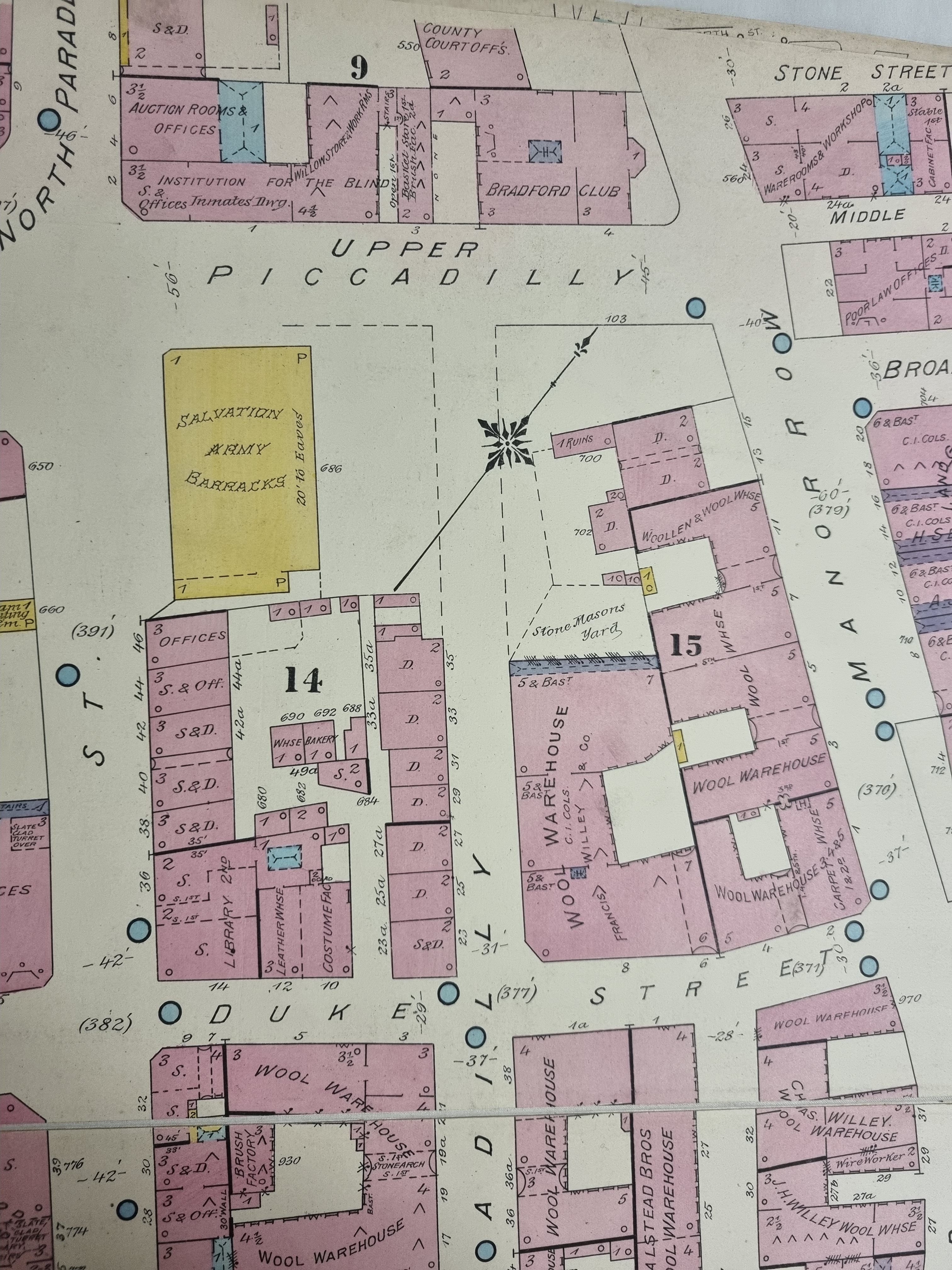
I have used a Goad map detail to locate a Salvation Army barracks or citadel: although the Army were famous as opponents of the ‘Demon Drink’ in fact temperance was commonly embraced by the non-conformist churches. The Coffee Taverns provided an opportunity for social interactions unaccompanied by alcoholic drink, a facility later offered by Lyons Corner Houses and now by branches of Costa and Starbucks.
It doesn’t appear that the enterprise survived many years of the new century, and the company was dissolved in the early twentieth century. It can’t have been an easy existence. Even a conservative estimate would put pubs outnumbering coffee taverns by 12: 1. At their most successful I can identify these branches:
Registered Office – Westgate (junction with Ivegate & Kirkgate)
1 61, Manchester Road
2 Corner Hammerton Street & Peel Street
3 Corner of Canal Street, Forster Square
4 Valley Mills, Valley Road
5 Corner Listerhills Road and Longside Lane
6 Bridge Street, Wakefield Road
7 Brunswick Place
8 Sunbridge Road
9 St George’s Hall, Bridge Street / Hall Ings
10 Carlisle Road, Manningham
11 Lilycroft, Heaton Road
12 St James Market
13 Laisterdyke (opposite Railway Station)
14 Bolton Road
15 Brownroyd (next Illingworth’s Mill)
16 Corner of College Road, Manchester Road
17 Bowling, Essex Street
18 Old Mechanics Institute, Leeds Road
19 Exchange Café, Albany Buildings, Market Street
20 Tyrrel Street, near Town Hall
21 Jowett Street, Thornton Road
22 Central Commercial Hotel, Westgate
23 Upper Croft
24 Otley Road, corner Cavalier Street
25 Bradford Café, corner Booth Street & Market Street
26 Great Horton (opposite end of Southfield Lane)
27 Laurel Street, Leeds Road
28 Albany Cafe, Market Street
29 Saltaire (adjoining railway station)
30 North Parade Dairy, Rawson Square
31 Barkerend Road (opposite Garnett’s Mill)
32 Lumb Lane, corner of Bowland Street
33 Valley Road, junction of School Street and Leeming Street
In addition, there is a Bakery Department, an Aerated Water Manufactory, a Meat Department and a Laundry Department, together with stores & stables at Wilton Street, Horton Lane.
I am not the only Local Studies enthusiast to find the Coffee Taverns of interest. I am grateful to local photographer and historian Kieran Wilkinson who has helped me with the list of taverns. He also tells me that the company was actually put into voluntary liquidation in July 1903. The assets of the company were sold off over the next couple of years and a final dividend was paid by the liquidators in 1907. In 1980 the East Bowling History Workshop published several ‘East Bowling Reflections’. In one article the group described life in the Wakefield Road district. In this the Coffee Tavern was described as a ‘place of delicious odours, noted for Meat & Potato Pie and Stew & Dumplings. The puzzle is that the article is headed ‘1910 onwards’. Possibly individual taverns maintained an existence after the company went into liquidation or perhaps the authors, thinking back 70+ years simply mistook the date.
Clearly there is room for more research and I should like to know why such a commendable institution failed at all. But having said that, where are the Lyons Teashops and Corner Houses of my youth?
See:
 Bradford and District Libraries Map Collections