
3.047 HOR 1847 WRI BHM 1173 B14
Linen backed paper Scale: unk
Size: 125*80 cm Condition: good
This map is a great personal favourite which I have used on several occasions. It is dated 1847 and having an exact date is a rare pleasure. Since it is annotated on the reverse ‘Revd G Wright’s land, Little Horton Lane, 1847’ we can be reasonably sure that its purpose was a land sale, although I can’t find the notification of such a sale in contemporary newspapers. Rev. Godfrey Charles Wright (1780-1862), of Hooton Pagnall, Doncaster, is an almost entirely forgotten figure but was once the major Bradford landowner. He possessed estates in what would later become the city centre, but also at Horton, Manningham, Baildon, Otley, and elsewhere.

Helpful to the local historian is the very detailed record provided of all the land occupiers. Working clockwise round the second detail we have: Bolton Lane Chapel, J&W Rand, the Methodist Chapel, Mrs Bacon and St John’s Church.
Horton Lane Chapel, Little Horton Lane, was an Independent Congregationalist church attended by Titus Salt, Robert Milligan and many others of the Bradford ‘great and good’. I know that John & William Rand founded their textile mill as early as 1803. It was the ‘New Connection’ Methodists who built the next chapel, one of several groups into which this body of non-conformists splintered in the nineteenth century. Of Mrs Bacon, William Scruton wrote ‘her house would be remembered by many, but even if that were not the case, the good deeds of the occupant would be recalled for she spent her life in acts of kindness’. What a memorial!
I don’t know a great deal about St John’s Church. William Scruton in his Pen & Pencil Portraits of Bradford says it was erected in 1839. There was seemingly an unhappy dispute between the incumbent, Rev. CJ Pearson, and the Vicar of Bradford (and former whaling captain) Dr William Scoresby. The bishop of Ripon had to arbitrate. The church and churchyard occupy a substantial area in this detail.

In the next figure you can see Manchester Road more clearly. Prominent among the smaller landowners are John & William Beanland, and Thackray & Holliday. John & William Beanland (Horton Lane, Bradford) were famous Bradford contractors responsible for the construction of Leeds Infirmary, Swan Arcade, Saltaire Mill (partly) and the Wool Exchange. Occasionally they offered bricks for sale in the Bradford Observer. Their greatest achievement must have been the construction of Lister’s Pride, the Manningham Mills chimney. John died in 1890 and is buried with his wife Isabella at Undercliffe. William Beanland is known to have died in 1887. But in the time I allow myself for research Messrs Thackray & Holliday have defeated me. Neither the 1850 Ibbetson Directory nor the Bradford Observer mention a partnership of this name. Perhaps two individuals simply came together to purchase this land.

To the left side of the next figure note an embryo Wilton Street. A Samuel Woodhead has purchase three plots making an entire street frontage: useful if you were a developer planning back to backs. But the only man of this name in the 1850 Directory is said to be ‘high bailiff of the county court’, living at Nutter’s Place, Northgate. At the top of the map notice ‘a ditch reserved for Rev. Godfrey Wright’. I assume this is a ‘ransom strip’ which would give Wright a financial interest if Rands Mill wished to extend into the mapped area.
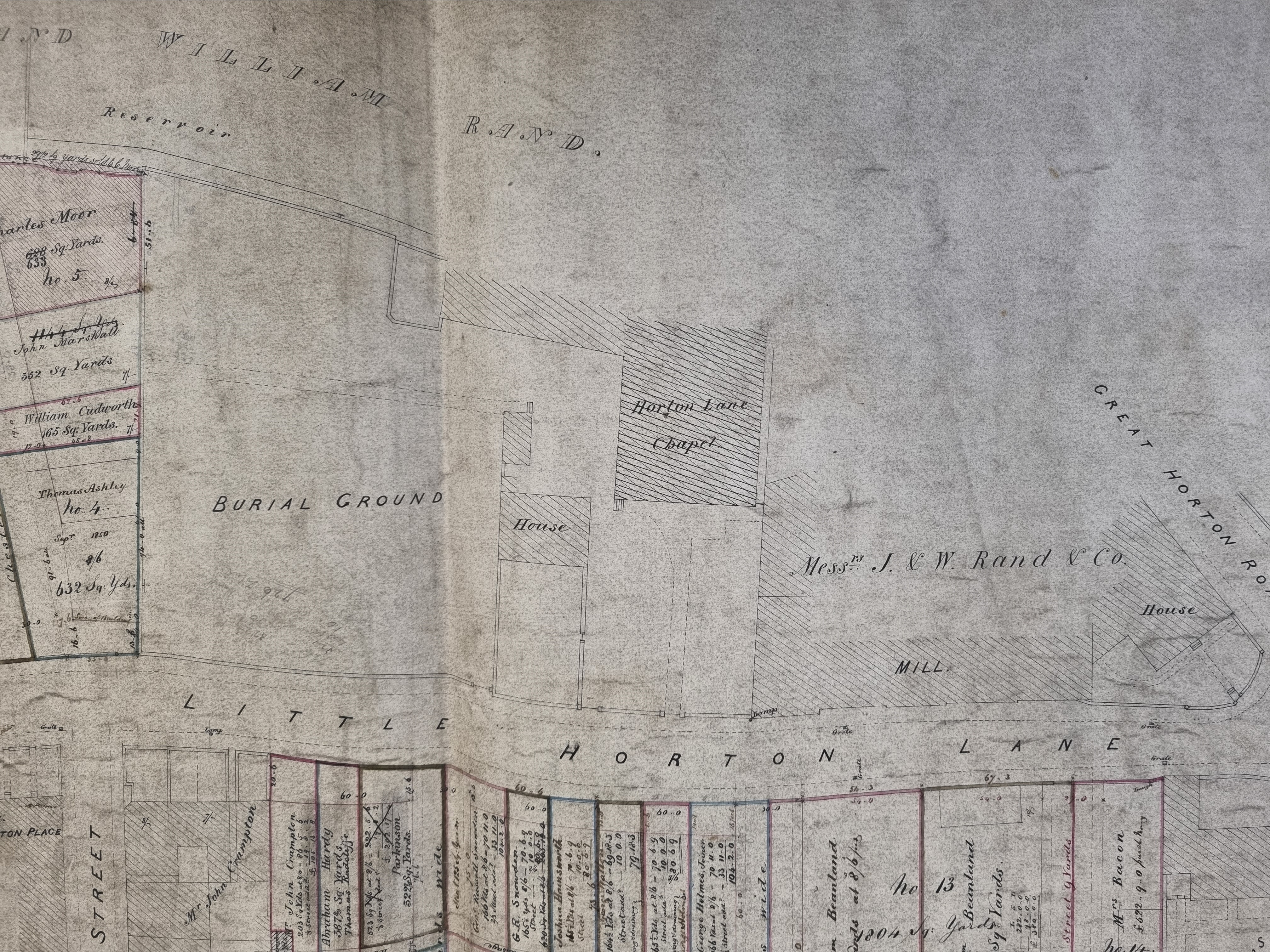
The far side of Little Horton Lane, occupied here by Rands Mill, now has the queen Victoria Statue placed on it. By the early twentieth century Morley Street has been constructed and the Central Swimming Baths are built over a Rands Mill reservoir. The Independent Chapel survived until the 1960s. Almost everything is now covered by 1960s roads and redevelopment. One of these buildings is the Bradford Central Library (now Margaret McMillan House) within the ground floor of which is located the Local Studies Library, in which this humble drudge struggles with these reserve maps.
We are fortunate to have drawings showing how some of this this area appeared at an earlier date. These are the New Connection chapel, and the junction between Rands Mill and Horton Lane Independent Chapel.


 Bradford and District Libraries Map Collections