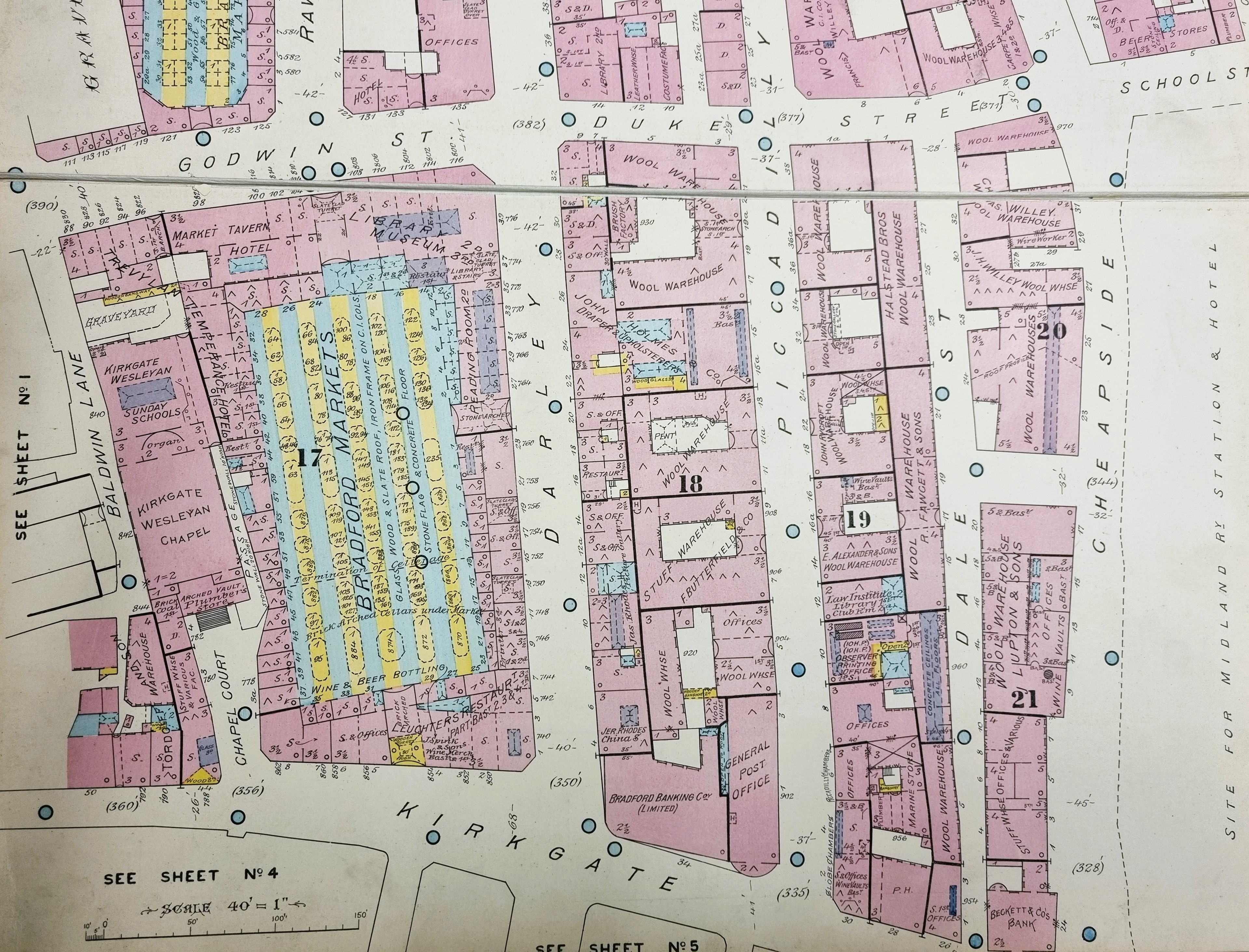
The reserve collection of Bradford Local Studies Libraries has many treasures, although I feel that at present there are many that I don’t fully understand. For example, there are at least two books of plans surveyed by Chas. E Goad, 53 New Broad Street, London EC. The books are dated 1886 and 1929, and presumably once formed part of regular series. How and when did these first form part of the collection?
The plans cover central Bradford listing every business and civic building. Internal evidence shows that the plans were available to ‘a limited number of subscribers’ and they would certainly have been very helpful to the Council, fire brigades, insurance companies, and developers. Minimal online research reveals that Charles Goad (1848-1910) was a noted cartographer and civil engineer. He became well-known for these insurance surveys of towns in Canada and the UK. The 1886 survey of Bradford must have been an early English example. The company he founded continued for some years after his death.
The plans would be very helpful to local and family historians since, in imagination, each property along a street can be recognised by size, shape, occupiers and neighbouring premises. As an example, the first figure shows Kirkgate, Piccadilly, Darley Street, and Godwin Street in 1929. The number of wool warehouses is not surprising but look at the details provided for Kirkgate Wesleyan Chapel with its steps, organ, graveyard and adjacent Temperance Hotel. In the same block is Leuchters Restaurant which was a very well-known place of resort in which The Barbarians Rugby Union side had been founded in 1890. At present I am more interested in the Godwin Street end of the block where the Bradford Library and Museum buildings are situated.
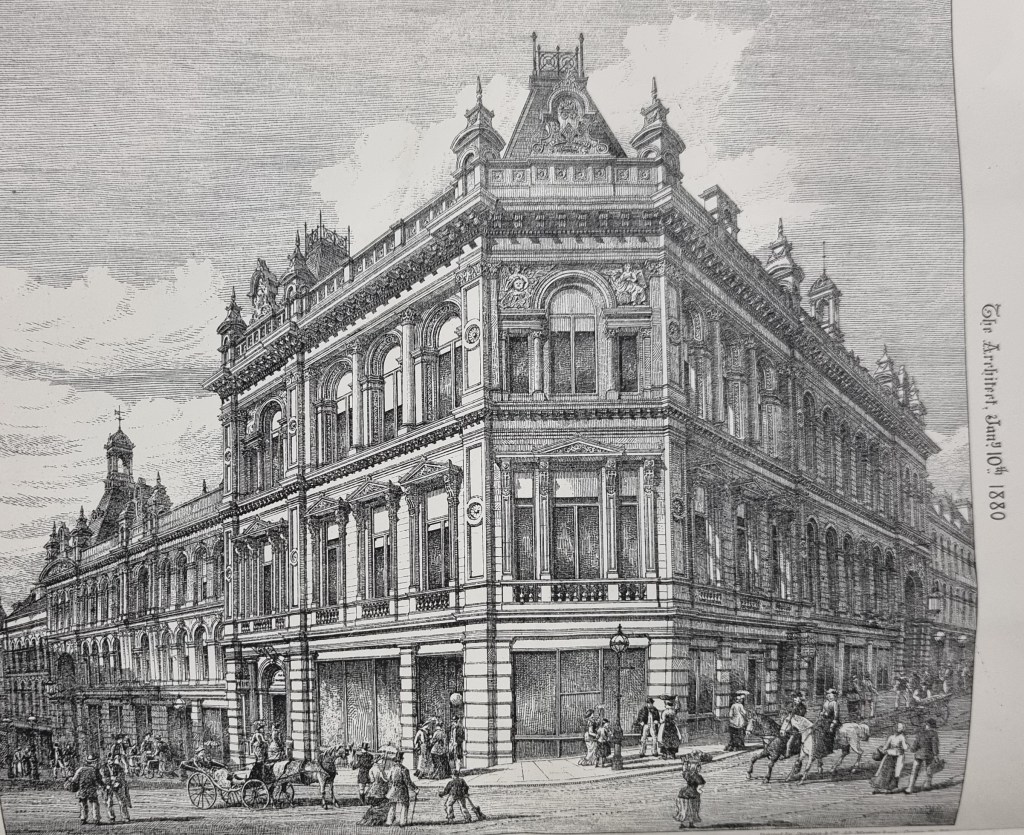
The value of these plans is greatly increased if they can be illuminated by photographs or drawings. The second figure shows the Library and Museum in 1880. The drawing comes from a journal called The Architect and offprints from this journal also form part of the LSL reserve collection. The logical time for such illustrations to appear was when a civic building was being planned, but an architects drawing may not of course have represented the completed building with complete accuracy.
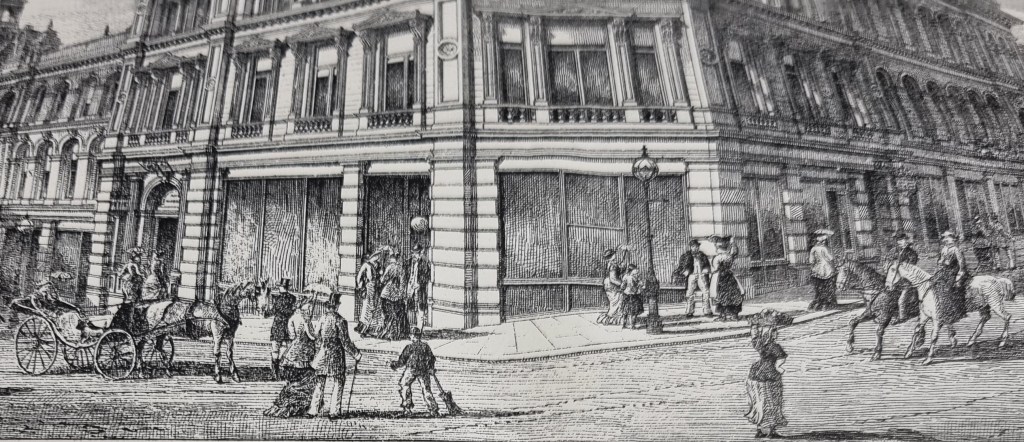
I’d love to know if this associated street scene was the result of the draughtsman’s lively imagination, or actually represented Bradford 140 years ago. Did smart folks ride horses through the town? Did street-sweepers carry besoms or women move about with baskets on their heads?
My colleague Bob Duckett is at present preparing a definitive history of Bradford Libraries. The service has just celebrated its 150th anniversary which indicates an origin around 1870. The building illustrated was run by a Free Library and Art Museum Committee. Some subsequent developments are recorded by Horace Hird in his account How A City Grows. The top floor museum also contained an Art Gallery and in 1897 had received over 300,000 visitors. Unsurprisingly, there was a significant space problem. In 1895 there was thought to be insufficient room to accommodate a magnificent gift, by Mr Jacob Moser, of educationalist James Hanson’s personal library of 12,000 volumes.
It appears that the Council were looking for a ‘munificent prince of industry’ to resolve this difficulty. The result was a gift of £40,000 from Lord Masham (Samuel Cunliffe Lister) to construct a new Cartwright Hall Art Gallery and Museum (Cartwright Memorial Hall) in the grounds of Lister Park. This was opened in 1904, although as so often happens there was a budget overrun!
Does the old Library building survive until the present day? I’m afraid not. The site is now a corner of the Arndale Centre (Kirkgate Shopping Centre) whose somewhat brutalist structure has been present since 1976, and is now itself destined for demolition.
 Bradford and District Libraries Map Collections