
Nineteenth century Bradford was notable for a group of textile magnates who possessed enormous wealth and political influence. Several were MPs. The development of the mill village of Saltaire (now a world heritage site) makes the name of Sir Titus Salt familiar even today. The existence of Lister Park and the Manningham Mills strike, which led directly to the formation of the Independent Labour Party, should ensure the immortality of Samuel Cunliffe Lister. Any student of Bradford history will soon encounter the names of Sir Isaac Holden, Robert Milligan, John Rand, and Henry Ripley.
The first plan shows the Bowling dyeworks; this very famous concern is always associated with the name Sir Henry William Ripley (1813-1882). I should explain to any readers outside Bradford that yarn was spun in a mill, and cloth was then woven in a weaving shed. Finally, the cloth would be dyed and finished. This next plan is a detail from the first Ordnance Survey map of Bradford (1852) which shows the general topography of the area, and the relationship of the Dye House to Bolling Hall.
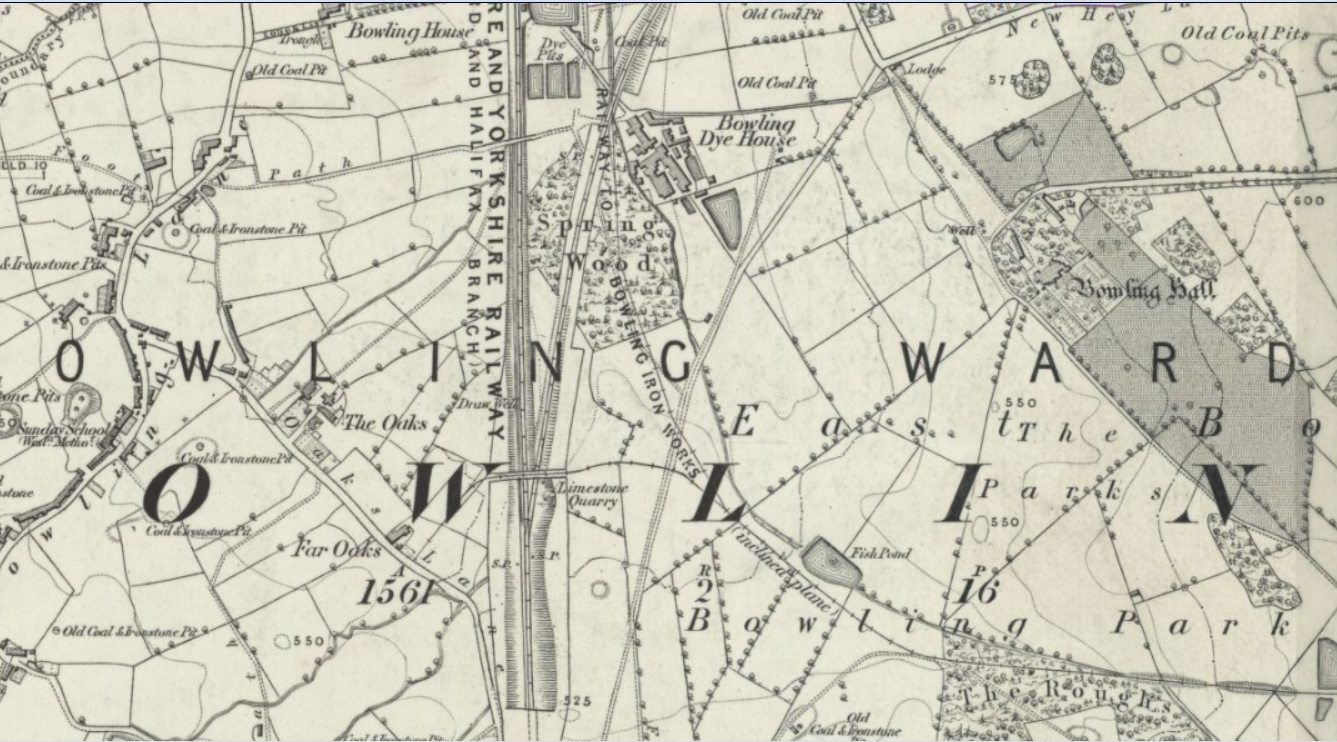
So, Sir Henry Ripley was the owner of this huge cloth dyeing concern and rates among the most famous of those Bradford business magnates. He was an MP both as a Liberal and an Independant. In the 1860s, Sir Henry began the construction of model housing for workers, which became known as Ripleyville. Ripleyville has a good claim to be Bradford’s own Saltaire and many still regret its subsequent demolition. The story of the dye works, and its development is dealt with very fully by James Parker (1904, Illustrated Rambles from Hipperholme to Tong) copies of whose work are on the shelves at the Local Studies Library. Maps of his home and his place of business are divided between the LSL and Bradford Industrial Museum, but I shall bring them together here.
The dye works had been established by his grandfather, George Ripley, in the early nineteenth century. Parker gives 1808 as the date. His father, Edward Ripley, was brought up as a dyer and construction of a new works began in 1820. I was interested to see that at that stage dyers specialised in particular colours. George was a woad dyer (blue) whereas a Joseph Crowther was employed to dye in black. Seemingly the dyeworks was initially supplied with steam by the Bowling Iron Company. Edward Ripley married Anne Murgatroyd and Henry Ripley was their only child. George Ripley died in 1834 and within a few years Henry was the leading man at the works, although the company kept his father’s name.
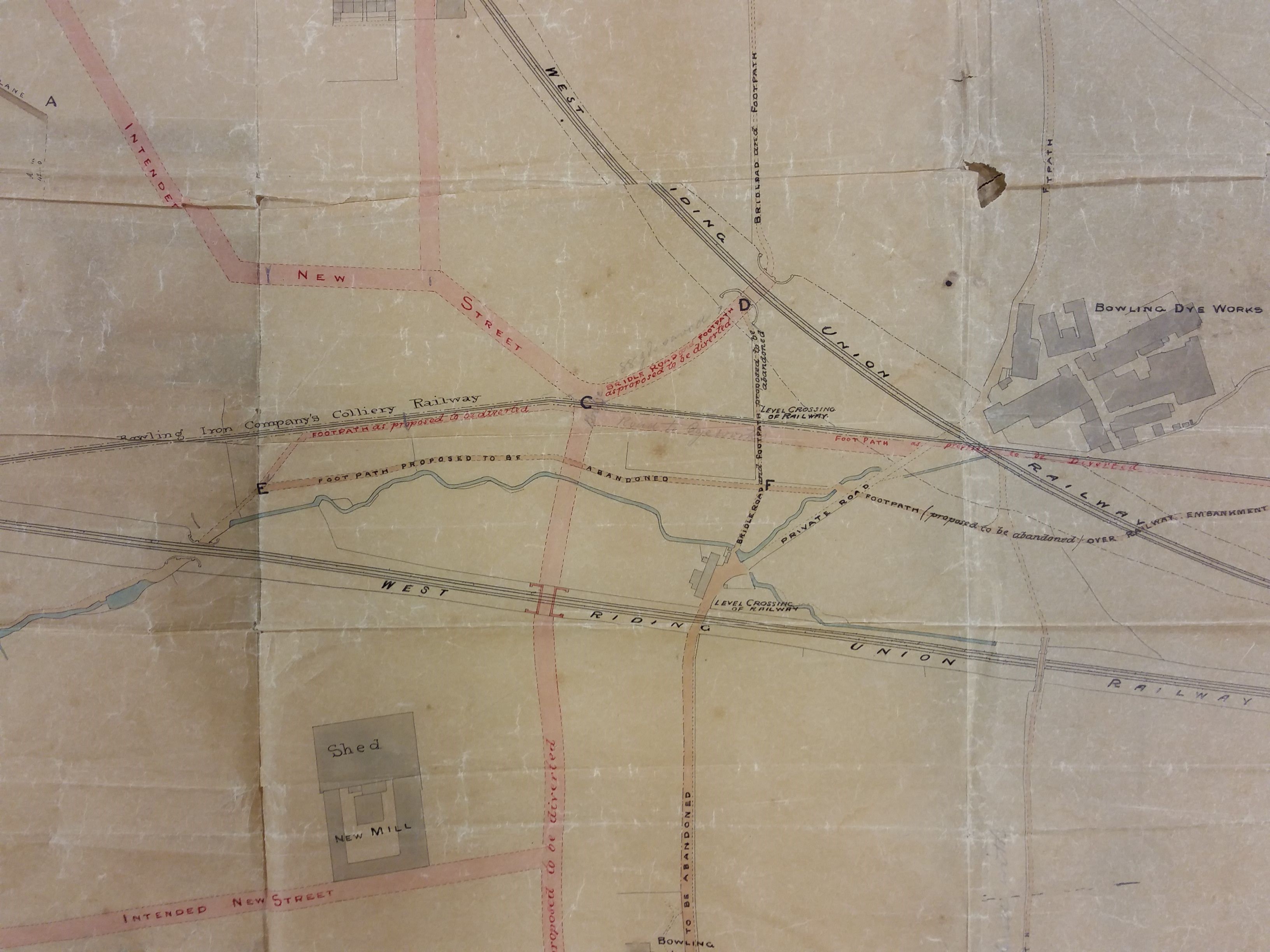
This map from the LSL Reserve collection must date from the late 1840s. You can see the railway line from Bowling Junction curving round the building on its way to Laisterdyke and Leeds. Immediately outside the curve of the railway line should be the large ponds constructed for the works. The ponds are present on the first OS map and the 1849 Bradford map. Have these simply been omitted, or is it possible they were not yet constructed? The Bradford Observer reports a large sale of land in this area, including that piece accommodating the Dye Works, in 1850. The vendor isn’t stated but might well be the Bowling Iron Company. Probably Ripley’s purchased land at this time to allow for the expansion of his business and the assurance of adequate soft water supplies, which included the reservoir. Victorian historian William Cudworth records a 100-acre purchase by the Ripley company and also states that a contractor called Samuel Pearson constructed reservoirs for Bowling Dye Works and Bowling Iron Works at a date ‘early in the fifties’. Samuel Pearson was a Cleckheaton brick-maker who founded a contracting dynasty with another important grandson. After being created a baronet Samuel Pearson’s own grandson, Weetman Pearson, became the first Viscount Cowdray in 1917.
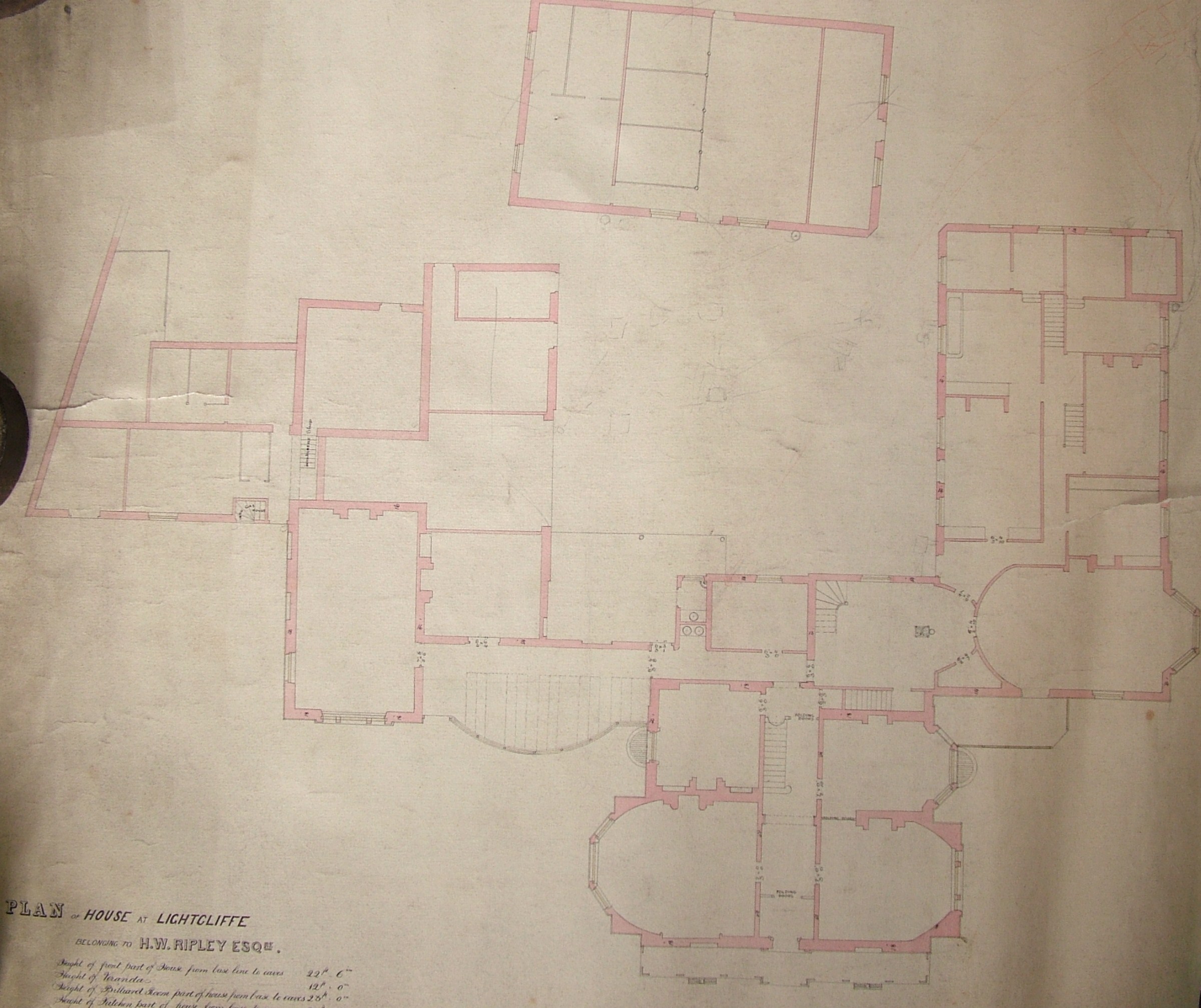
Henry Ripley was married in 1836 to Susan Milligan of Acacia, Rawdon. ‘Acacia’ is associated with the name of Robert Milligan MP, first mayor of Bradford; Susan, I believe, was his adopted daughter. In 1841 Edward and Henry Ripley bought Home or Holme House in Lightcliffe for £5000. The plan, part of the collection of Bradford Industrial Museum, shows the arrangement of a far from modest home. The purchase price included the Punch Bowl Inn and land at Bailiff Bridge. In ‘the year of revolutions’, 1848, the Bradford Observer reported that HW Ripley had erected a schoolroom in Bailiff Bridge. When the school was opened Rev J Glyde addressed a celebratory meeting on the subject of education. Jonathan Glyde was the minister of Horton Lane Chapel with an enviable record of concern for society’s less advantaged. The school was just erected in time to feature on the first OS map, but the house was eventually sold in 1873 together with the surrounding land (plan in BIM).

Parker states that Henry Ripley and his wife moved to Apperley Bridge, presumably back to his wife’s former childhood home which she would have owned since her father’s death in 1862. Subsequently Henry Ripley’s name is associated with the Grade II Listed Bedstone Court in Shropshire. This was built on an estate he had owned since the 1870s, although he may not have lived to see its completion. Sir Henry Ripley was created a baronet in 1880 and died two years later. His son took over control of the business. In 1890 the company became part of the Bradford Dyers Association.
 Bradford and District Libraries Map Collections