
4.018 BOW c1840 PLA BHM 1363 B19
Material: linen backed paper
Scale: 3 chains per inch Size: 38*28 cm
Condition: good
As usual this plan from the Local Studies Library reserve collection is undated, and no indication is given of its purpose. Fortunately, it is annotated on the back in pencil ‘Mr Paley’s Bowling Mill Estate’. This would be John Green Paley of Oatlands, Harrogate, to whom we shall return.
One clue to the date is the portion of land being managed by ‘John Sturges’s Executors’. John Sturges jnr. died in 1823. Based on the first Ordnance Survey map of the area, being prepared in the late 1840s, the railway track would cross from 7pm to 1am after 1846, so evidently our plan is older. The ‘tramroad’ is present on both maps and conveyed coal and ironstone to Bowling Ironworks.
Another difficulty is that Bowling and Horton were separate townships. St James Church is not drawn since it was over the border in Horton: its position would be immediately above ‘Mrs Newby’s Land’. St James Church was, I believe, constructed in 1838 which would have been helpful as dating evidence.
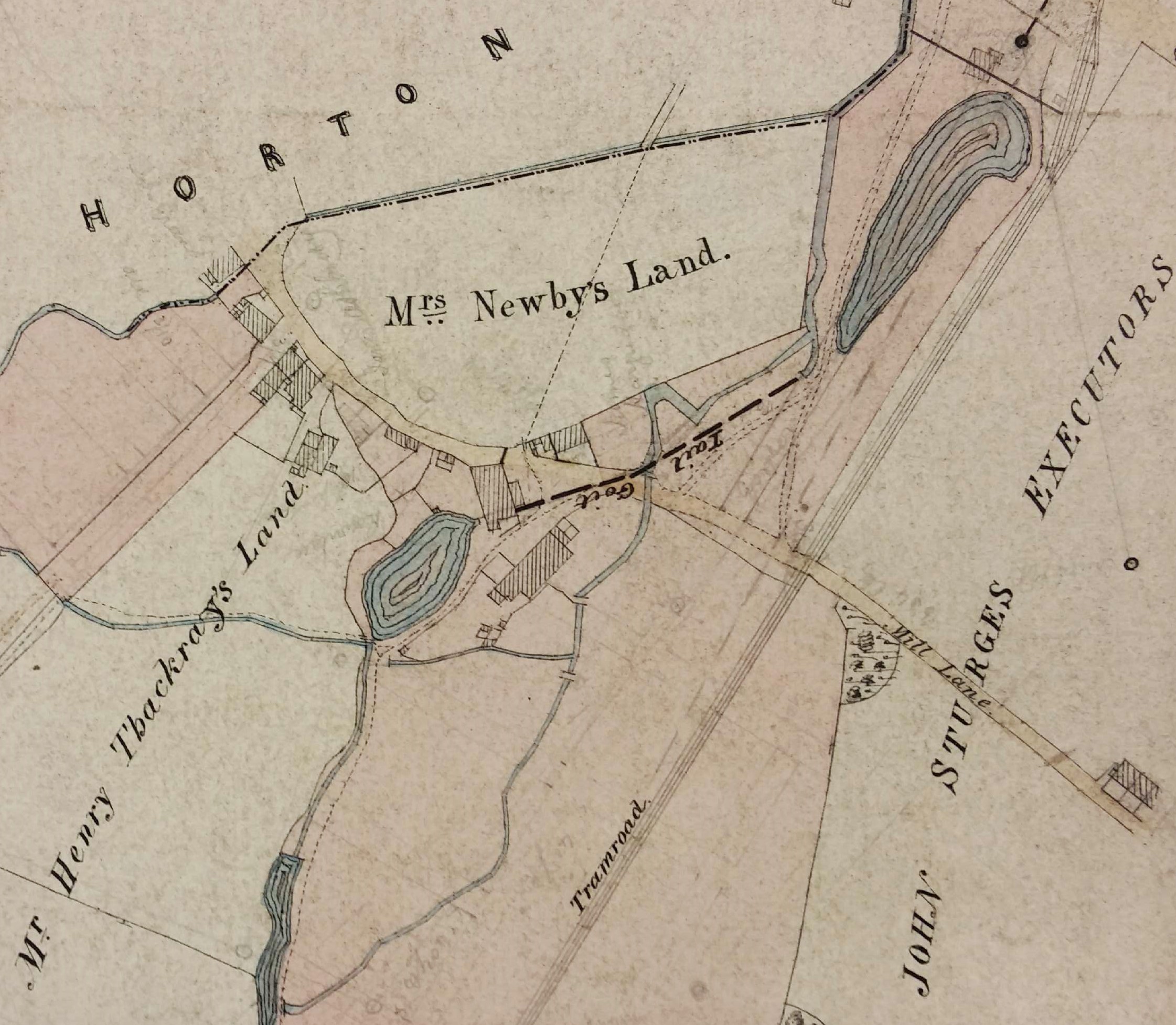
There are three small lakes or ponds drawn. There are a cluster of buildings present round the middle of these, one of which is Bowling Old Mill and another, I presume, is the miller’s house. The same cluster appear on the OS map but it is easier to identify the mill itself on our map since the water course that powers the wheel goes under one building and there is a clearly labelled ‘tail goit’ leading from it. Bowling Old Mill was identified as a corn mill at the time of the first OS. The Low (or Law) Beck joined the Bowling Beck above the mill. After their junction the result, called Bowling Mill Beck I believe, later went under Cuckoo Bridge to join the Bradford Beck itself.
Are any names recognisable? John Sturges senior and junior were partners in the Bowling Iron Company; at this time the company was known as Messrs J Sturges & son. Richard Paley was another early partner but he would have been long dead by the time of this plan. Thomas Mason was a partner too but his name does not feature on the plan. In 1804 the partnership brought in George Paley (1779-1865) and John Green Paley (1774-1860) – respectively the son and nephew of Richard. The original Bowling Hall Estate was the property of Sir Francis Lindley Wood, Bt’. In 1816 Sir Francis sold the entire estate to the Bowling Iron Company (BIC). The company were interested in the subterranean resources of coal and iron stone. The surface land and structures were apportioned among the company partners. Bolling Hall and its immediate surrounds went to Thomas Mason who is said to have had possession until 1834 when ownership passed to J G Paley. The Bowling Mill estate is another fragment of his property. In the 1830s a John Newby pays land tax in Bowling: is ‘Mrs Newby’ his widow?
Cudworth records in 1816 two water corn mills in Bowling. The one in this map is ‘Lady Well Close, Mill Home’. In the late eighteenth century, it was in the occupation of Reuben Holmes. Later it was occupied by Jonas Jennings. It is possible that there were in fact two mills at this site, Cudworth is unclear on this point. Jennings was still in occupation in 1834 and John Green Paley was definitely recorded as the owner. The mill goit ran through the field known as Mill Holme. By the time Cudworth was writing in the 1890s the whole site was demolished and occupied by Ivy Mill and some coal shoots in Mill Lane
The name Pollard is also written in pencil on the back of the plan. The wording is not completely clear (‘John Hall Oak Fold Bottom Steward // Mr Pollard’s Steward at Crow Trees Jennings’) but Joshua Pollard was the manager of the Bowling Iron Company for much of his very long life and known to have been a very formidable character.
 Bradford and District Libraries Map Collections