
7.003 BRA 1863 HAR
Material: paper Scale: 60 yards = 1 inch
Size: 90*45 cm Condition: Poor – handling repairs
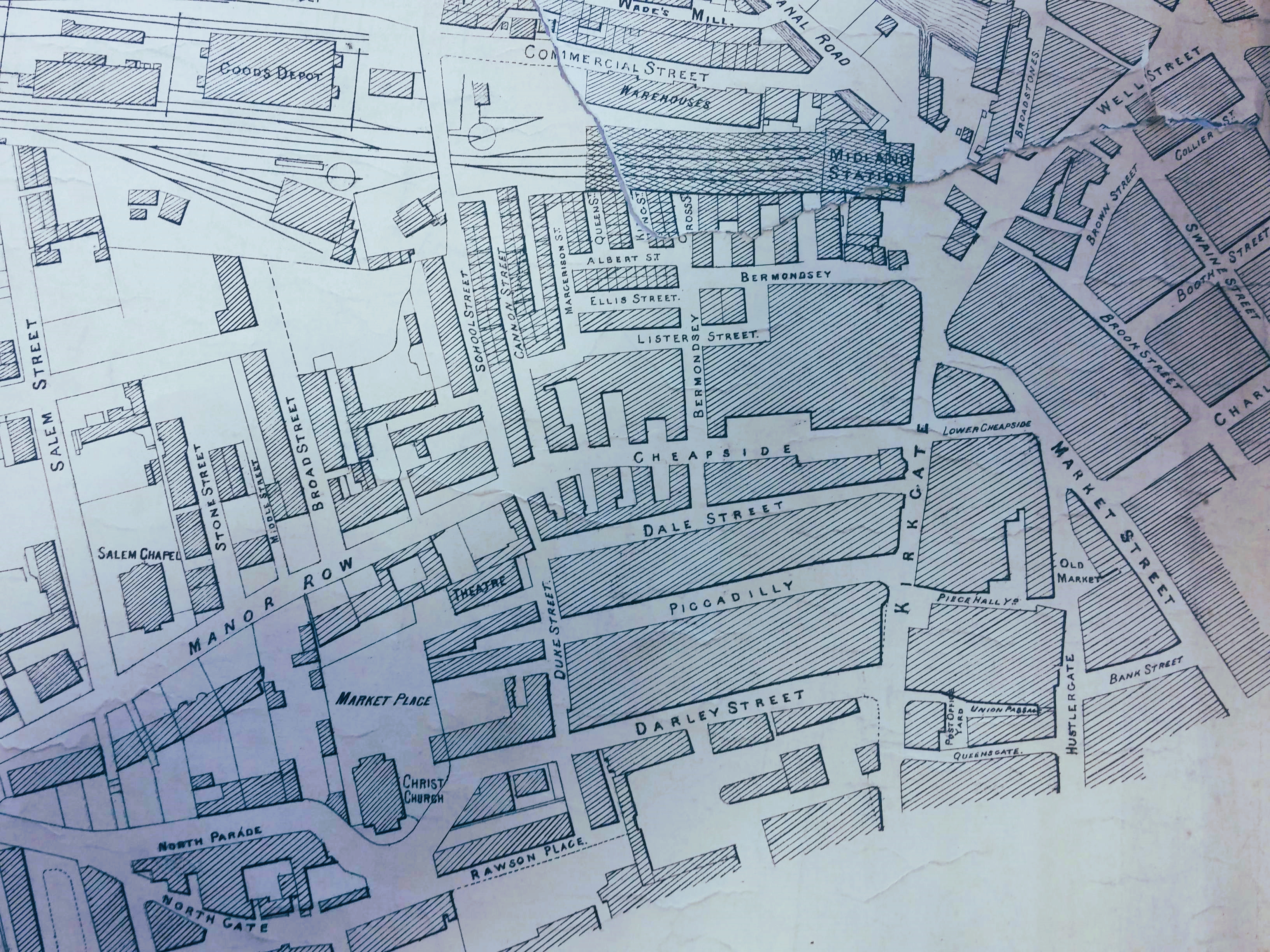
Here I have included three details from a map entitled ‘Plan of part of the Borough of Bradford showing the Midland Railway Station and Approaches, 1863’. John Hart was the surveyor, and the map can be reasonably regarded as showing the situation at the time of the 1861 census, or the Jones Mercantile Bradford Directory, 1863.

In 1847 Bradford had become a Borough, and by the mid-nineteenth century the skeleton of the modern city was in the process of erection. In the 1850s St George’s Hall, Peel Park, and Sir Titus Salt’s Saltaire were all created. The first work on Little Germany was being undertaken in the 1860s but would continue for several decades.
The Bradford canal had opened much earlier in 1774, and ended at a canal basin and a large warehouse. The map shows lime-kilns on the canal side, quite close to the town centre. The Leeds-Bradford Railway, in which George Hudson ‘the Railway King’ was closely involved, had arrived via Shipley in 1846. The route to Keighley was created the following year. To construct the line’s terminus Dunkirk Street was razed to the ground and on 5 March 1846 the Bradford Observer noted the ‘deserted and desolate’ thoroughfare.
On the left of the second detail you can see Trafalgar Street with its well-known brewery. The Trafalgar Steam Brewery had been founded in the 1850s and at this period was associated with the name of Cllr. Charles Waller. The company regularly advertised its porter, mild, and bitter beers in the pages of local newspapers. It survived until the 1930s, but I’m really not sure what they did with the steam.
Two details show Manor Row, which had been constructed in 1820. The map clearly indicates the place where Manor Row and North Parade divide. On this spot one of Bradford’s most iconic buildings, the Yorkshire Penny Bank (1895), was eventually constructed, the architect being James Ledingham. Opposite this junction was the Bradford Grammar School with School (or Grammar School) Street. I believe the history of the school stretches back into the Tudor period but the building in North Parade or Manor Row was constructed in 1820 but there is known to have been an earlier school building near the cathedral. BGS has occupied its current Keighley Road site, once the centre of the Clockhouse estate, since shortly after the Second World War.
If, in your imagination, you walk down Manor Row you next meet Salem Street, with its listed early nineteenth century terraced houses. This was presumably named after the nearby Congregationalist Chapel. ‘Salem’ is a shortened form of Jerusalem and was a popular name for non-Conformist places of worship. This classical revival building was constructed in 1835-6 using ashlar sandstone. It was one of the earliest designs of the Lockwood & Mawson architectural partnership, who later moved on to St George’s Hall and Saltaire. William Cudworth records that Salem’s minister during the mid-19th century was Rev J C Miall. A new chapel was opened in Oak Lane in 1888 after which the Manor Row building was reused as school board offices, and then a school clinic for many years. It still survives as Kenburgh House.
While considering churches the second and third details show Christ Church in Darley Street, which was built as a chapel of ease for the Parish Church and consecrated in 1815. It was close to Bradford market, but I believe that the site was eventually needed for a Darley Street extension. The building was demolished in 1879 and Rawson Square exists at its former site. The church was moved to nearby Eldon Place where it survived until 1940 before demolition.
My limitations concerning Bradford theatre history have been exposed before but there clearly was a Duke Street Theatre in 1863. On this occasion I have retrieved information from Arthur Lloyd’s theatre website. In 1841 the Liver Theatre, Duke Street, probably became Bradford’s first purpose-built theatre. In 1844 it was remodelled and re-opened as Theatre Royal, Duke Street. The fact that it was widely known as the ‘wooden box’ may say something about its construction. In 1864 the Alexandra Theatre had opened in Manningham Lane. Five years later, when the Duke Street Theatre Royal finally fell victim to another series of Bradford’s street improvements, the Alexandra took over the discarded name.
If from Duke Street you continued down Piccadilly and across Kirkgate you would reach Piece Hall Yard. According to the City Heritage blue plaque the Bradford Piece Hall had been constructed in 1773. The development of a building for trading in ‘pieces’ of cloth had been proposed by the hugely influential Quaker merchant John Hustler who died in 1790. I’m not sure when the Piece Hall was demolished, in the late 1850s perhaps. Piece Hall Yard has been, since 1877, the location of the Bradford Club. Today the Club holds an importance for Bradford studies second only to the Local Studies Library itself since it generously allows the Bradford Historical & Antiquarian Society and the Bradford u3a to hold their meetings within its gracious portals.
John Hustler’s name survives in Hustlergate. In map this is recorded as the site of the Old Market but the Gothic revival Wool Exchange, which survives today as a branch of Waterstones, was built here a few years later, between 1864-67. It was another design of Lockwood & Mawson’s. The foundation stone laid by Lord Palmerston, and some magnificent glazed ceramic tiles recording this event, can still be seen in the Market Street pizza restaurant, although the ex-prime minister’s name is misspelled! Bradford was lucky to have recruited him for this operation since he died in 1865.
Naturally there is a great deal of history locked up in street names. Hustlergate must be named after John Hustler, and Market Street must reflect the old market. But look at the streets at the top right of the second map. A water source is the obvious explanation for Well Street. The Swaines and the Booths were wealthy local families and Charles St, Booth St, and Swaine St probably all derived their names from Charles Swaine Booth Sharp (1734-1805) who owned land in the area of Hall Ings and married Hannah Gilpin Sharp, who had inherited Abraham Sharp’s Horton estate via his niece Faith Sawrey. The name Brook St must, I assume, reflect the course of the Bradford Beck. This is seemingly on the surface before 1849, but 1863 the map indicates that it was by then culverted and underground at this point. The names Well St and Market St have survived to the present day.
 Bradford and District Libraries Map Collections