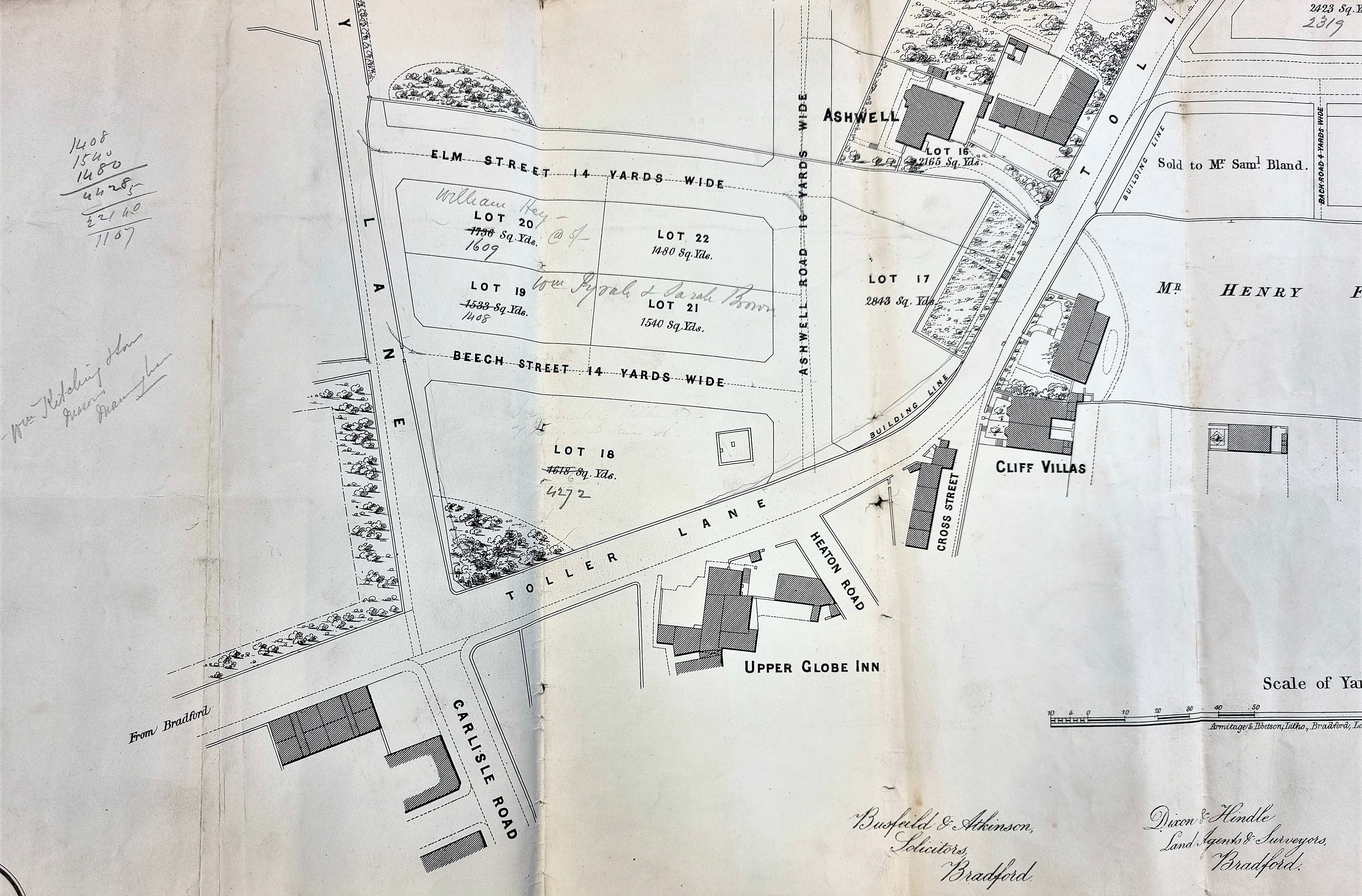
2.192 MAN 1870 DIX
Size: incomplete Material: paper
Scale: 20 yards: 1” Condition: poor
This map is an incomplete sale plan from 1870. Clearly the Manningham Lodge estate, surveyed by Dixon & Hindle, is being sold off by the well-known Bradford firm of auctioneers, J Buckley-Sharp. With an exact date it has been easy to find this 23 Lot sale being advertised in the contemporary Bradford Observer.
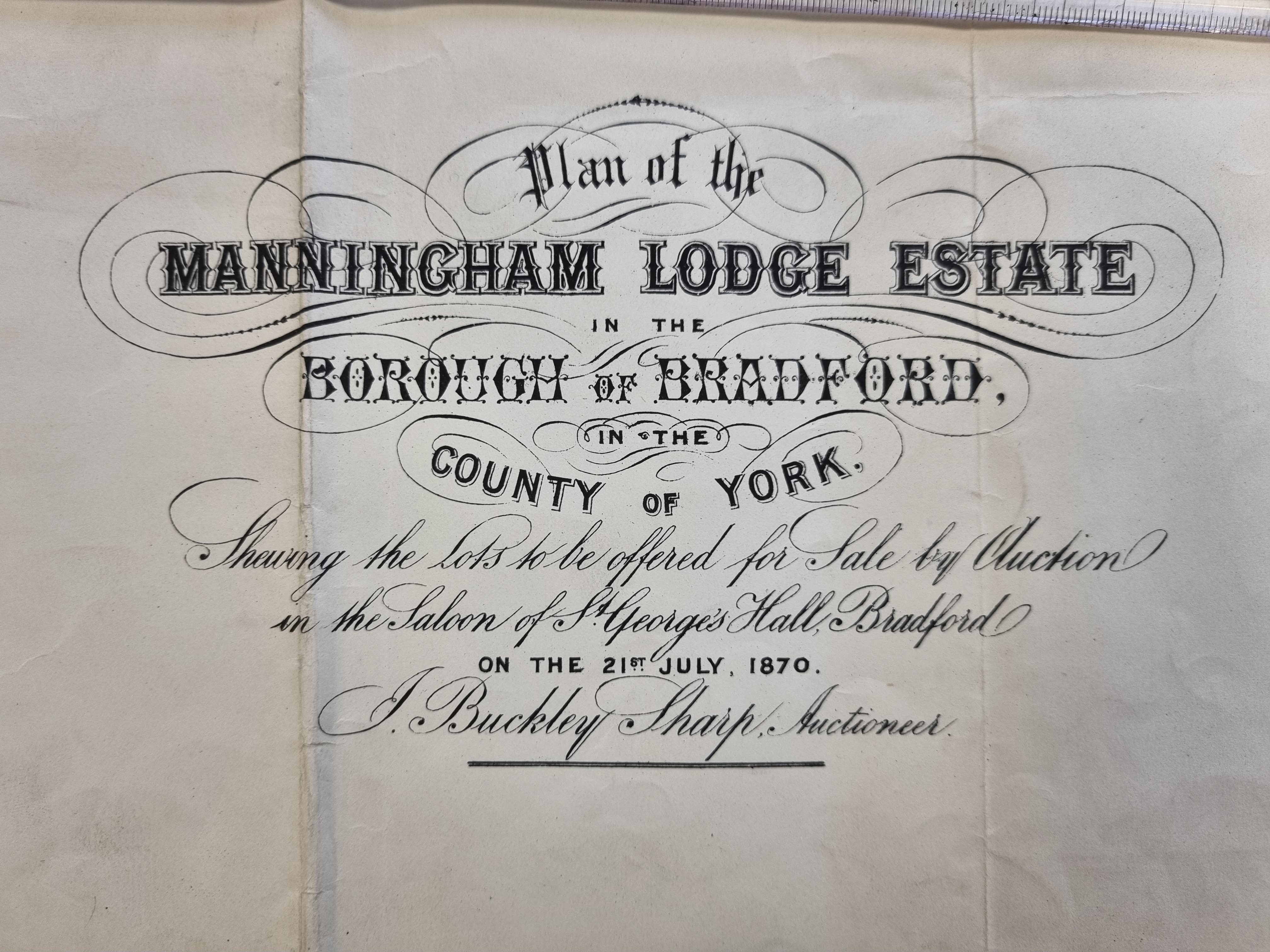
In the Local Studies Library reserve collection was a paper cover giving full details of a land sale involving Globe Fold, White Abbey Road. This was enclosing a section of this earlier map concerning the sale of the Manningham Lodge Estate. A great deal of land, including Cliffe Fields and Ashwell were auctioned in 1870, but not seemingly Manningham Lodge itself.
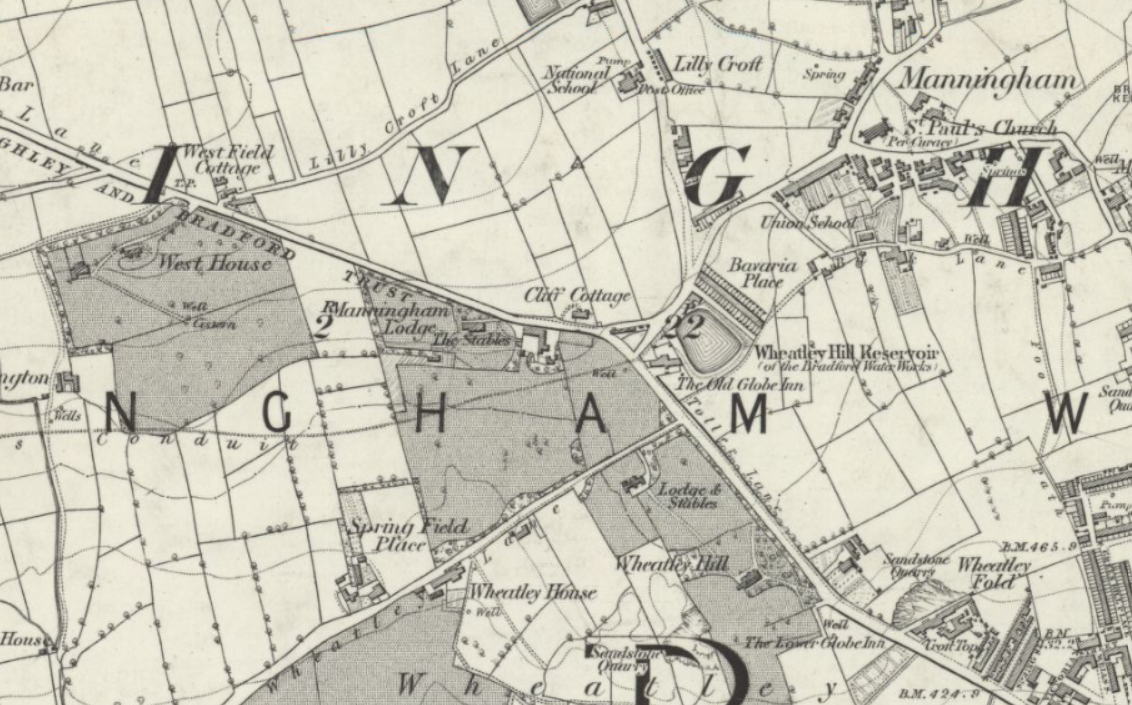
This detail from the first Ordnance Survey map of the area (c.1850) will help you orientate yourself. To make this work the sale plan map has to be rotated 90 degrees to the left. Carlisle Road is present on the sale plan, but had yet to be created in 1850 as a continuation of Wheatley (now Whetley) Lane. Cliff Villas have replaced Cliff Cottage.
In the early and mid-nineteenth century several important local citizens were happy to live on Manningham’s airy uplands. In the far west, Field House (now incorporated into Bradford Royal Infirmary) was occupied by Dr. Scoresby, vicar of Bradford. Nearer to Bradford there was West House the home of Mr. Thomas Hollings, the site of which was later occupied by Woodlands, the residence of Mr. Angus Holden, M.P.
Manningham Lodge itself was first owned and occupied by Mr. Matthew Thompson. As young men Matthew and his brother Benjamin Thompson were sent to learn the Bradford trade, the former being apprenticed to his uncle, Benjamin Peile, a dyer, in Thornton Road. The brothers Thompson acquired considerable wealth, and both invested in real estate. Matthew acquired the Manningham Lodge estate in 1812. He married a daughter of the Rev. William Atkinson, of Thorpe Arch who for the long period of sixty-two years was afternoon lecturer at the Bradford Parish Church. Until 1834, when he retired from business, Thompson was one of the principal men engaged in the worsted industry. He died in September 1847.
Sir Matthew William Thompson, Bart (1820-1891), was the eldest son of Matthew Thompson, and was actually born at Manningham Lodge. He graduated at Trinity College, Cambridge in 1846, and in the following year he was called to the Bar. In 1862, and again in1871-72, he was elected mayor of Bradford. In business he became best known as a railway company director. In 1879 he became chairman of the Midland railway company, and a director and sometime chairman of the Forth Bridge railway company. The bridge was completed in January 1890, and formally opened by the Prince of Wales. On this occasion a baronetcy was conferred upon Thompson. In poor health Thompson resigned the chairmanship of the Midland railway company in 1890, and died the following year in Guiseley.
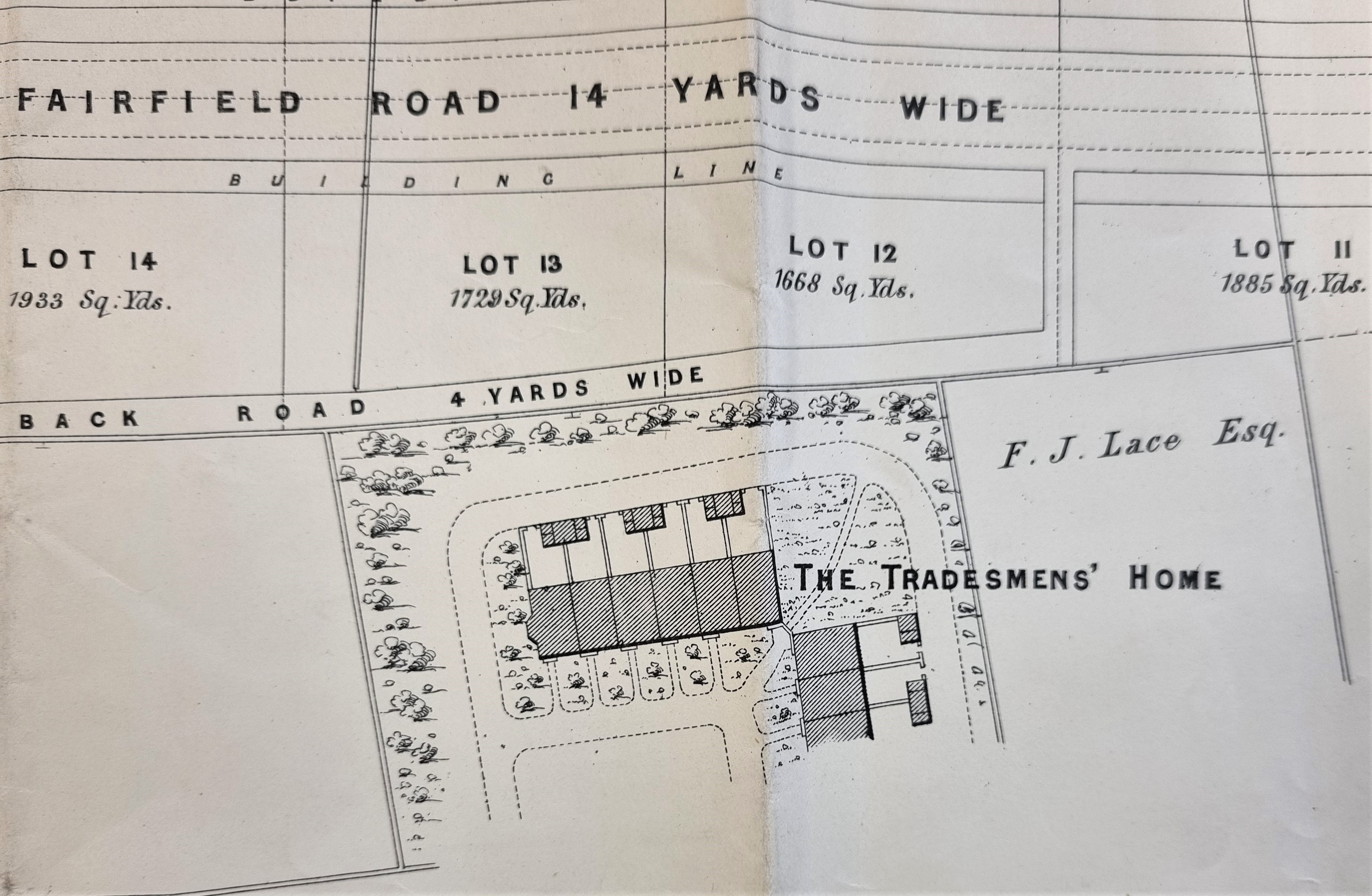
Another institution just touched on by the map are the Bradford Tradesmens’ Homes. The charity known by this name was inaugurated in 1865. The object of its Founders was to erect and maintain at least 30 dwelling houses for those who had at one time occupied a good position in society but through financial reverses were no longer able to support themselves. A site was purchased at Lily Croft, Manningham and in September 1867 the foundation stone was laid by Sir Titus Salt, Bart., who gave the munificent sum of 2,000 guineas and this, with other donations, enabled the original design of three blocks to be completed.
 Bradford and District Libraries Map Collections