
X52 (see 1.05 & 4.039) ILK c1845 LIS
Size: 17” 8 23” Material: Paper
Scale: 5 chains to 1” Condition: Good
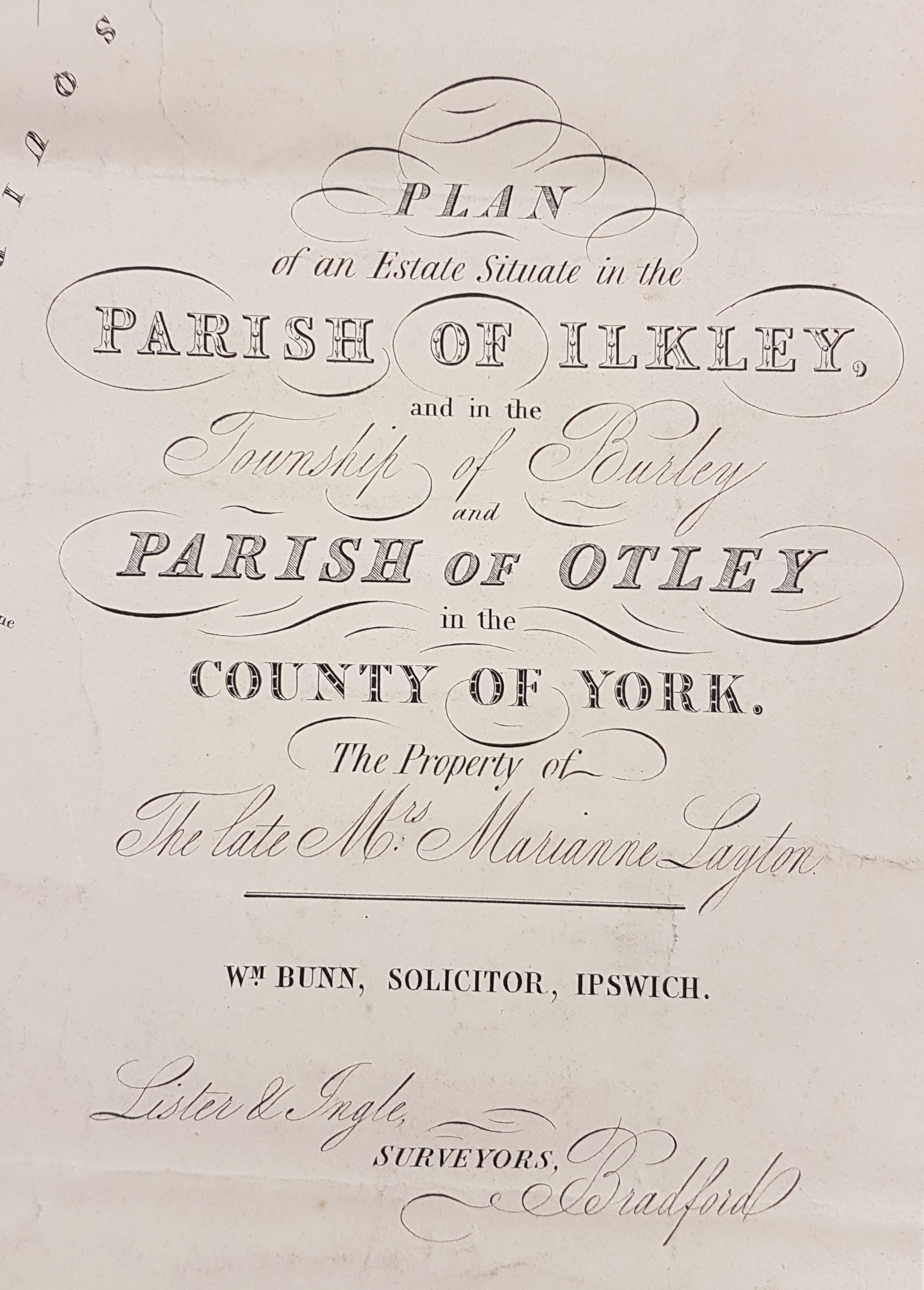
From my notes there seem to be three copies of this plan in the Local Studies Library reserve collection, although it is difficult to check at present because of Covid restrictions. The full title is ‘plan of an estate situate in the parish of Ilkley, and in the township of Burley, and parish of Otley, in the County of York’. It seems highly likely to be a sale plan that once accompanied a sale catalogue. Only the Ilkley property is represented in this image.
Evidently a firm of Ipswich solicitors, called William Bunn, instructed Lister & Ingle to prepare the map, and perhaps also undertake a sale or auction. The map is undated, as is so often the case, but I have established that a Marianne Layton died in Ipswich in 1844. I have assumed that her property was put up for sale soon after. The map includes Rowley Wood, and pre-dates the opening of the Otley-Ilkley railway. I have been told that this commenced in 1863 but the line is present on the first Ordnance Survey map of the area, originally published in 1851.
Where are we exactly? The southward bend in the river Wharfe helps to locate the site. Just off the map to the east was the Ilkley Hydropathic Hotel. Since this opened in 1844 its presence or absence would have been an important piece of dating evidence.
The map is quite detailed and records the field names. Some of these are very ordinary: 10 days work, Cow Leys, Far Pasture and Steep Pasture. The springs in Spring Wood are more likely to be coppiced trees than watercourses. Ing is marshy land, but who the old wife was in ‘Old Wife Close’ I have no idea. I thought some of the interest of this map lay in the names of landowners in surrounding areas. Two are significant Bradford figures: Ann Giles and EC Lister Kaye.
Ann Giles who possessed much property in Great Horton. The means by which she acquired her estate was quite complicated. Hannah Gilpin Sharp (1743-1823) of Horton Hall bequeathed her mansion, with all her land in Bradford, to her nephew, Captain Thomas Gilpin and in ‘default of issue’ to her niece Ann Kitchen. Captain Gilpin died at Madeira in the year 1826 without ever having been married. So, Ann Kitchen came into the property. In 1828 she married a clerk in Somerset House, as her second husband who Cudworth records as Edward Giles, but I believe that Edmund is the correct name. Their son, another Edmund, was baptised the following year. Ann’s husband died in 1832 leaving his infant son as heir to the Horton estates. At the age of 25 this son Edmund eventually went to Australia, being enamoured of sea life, but only lived three days after landing in the colony so all the property was Ann’s again. In 1839 an Act had been passed for disposing of the Giles estate at Horton, owing to the great increase of buildings in the immediate vicinity. Land belonging to ‘Mrs Giles’ are common on maps of Bradford and Horton. Her daughter by her first marriage, Ann Haines, was ultimately to inherit her estate. The two main characters in this account were once commemorated by Ann Place and Edmund Street, off Little Horton Lane.
Mill owner and designer, Ellis Cunliffe Lister (Kaye), was married three times and his surname got increasingly complex as he inherited property through his marital connections. He was the father of textile tycoon Samuel Cunliffe Lister, and made his home in Manningham Hall which was situated in what is now Lister Park. He died in 1853.
 Bradford and District Libraries Map Collections