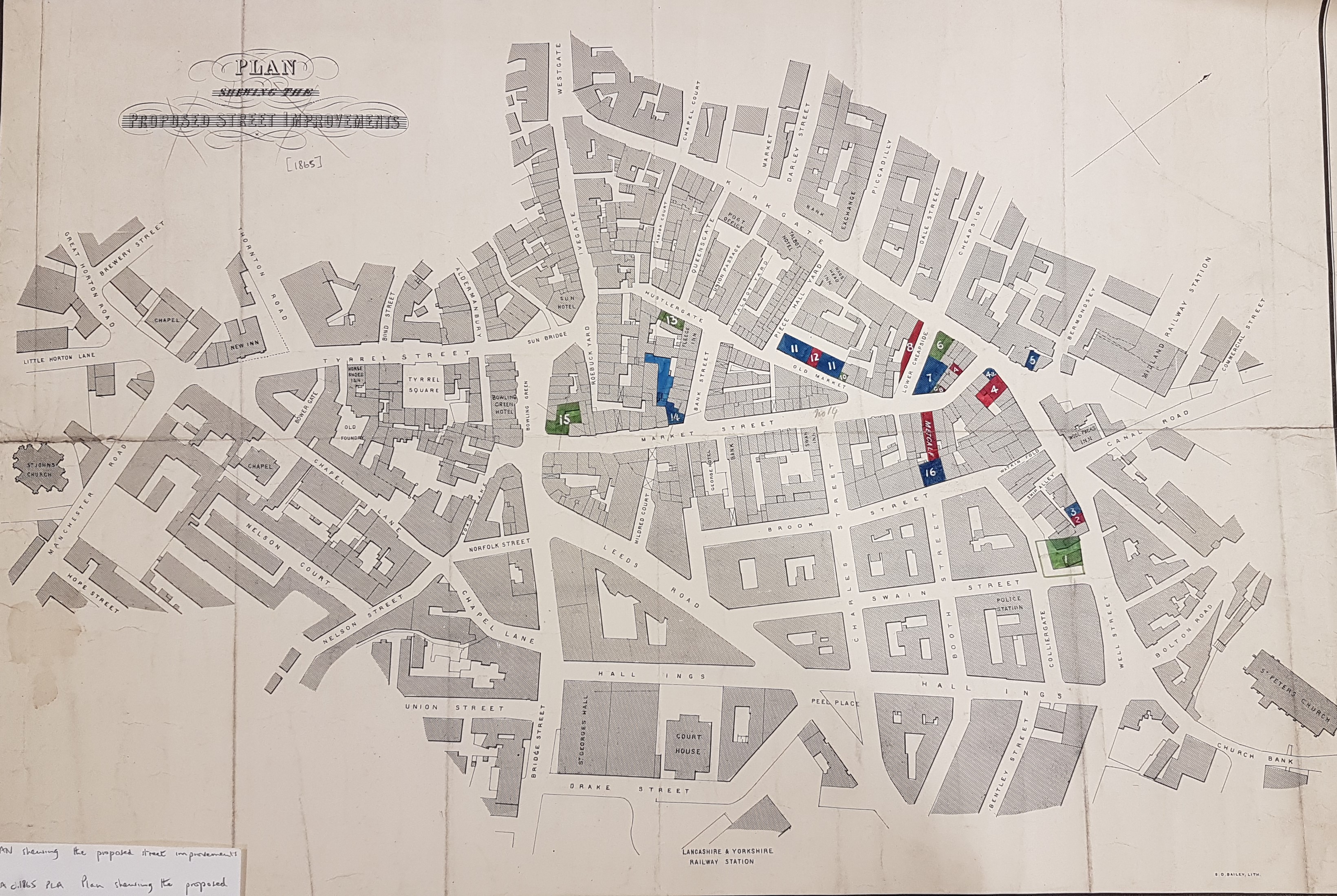
X41 BRA c.1865 PLA
Size: 18” * 27” Material: Paper
Scale: unk Condition: good
The Local Studies Library reserve collection of maps has a series of plans closely resembling this, which seem to deal with street improvements or civic land purchases. A date of c.1865 for this plan (Melcalf v. the Corporation) was suggested by my unknown predecessor who clearly studied it many years ago. The date is not written on the plan itself, but is the suggested date plausible? Certainly it is: St. George’s Hall is present, so the plan is later than 1853, but the present Wool Exchange building has not been constructed, so the plan is earlier than 1867.
I assume that the Bradford borough planning office kept a series of up to date maps of the town centre, on which proposed changes could later be overdrawn. To illustrate this point I’ll include a detail from another town centre corporation plan; it is similar in many respects to the first, except that now the new Wool Exchange is now in position and the name of the ‘complainant’ has changed.

My predecessor names the first axample as ‘Metcalf v. the Corporation: draft plan B’ which suggests he or she had additional information. I had some hope of establishing who Metcalf (or Metcalfe) was, although it seems to have been a rather common surname in mid-nineteenth century Bradford. Several men of this name were contemporary contractors, brick-makers, and masons who were all feasible as small land-owners. But here my research started to unravel. Which spelling of the surname was correct? What was the gender of ‘Metcalf’?
Initially I thought I had found an easy answer. There is a report in the Bradford Observer of July 1864 that seemed to shed some light on the problem. It was clear that Bradford Corporation proposed a number of street improvements, and a commissioner (a Mr Robert Morgan) was appointed to inquire into them. This was seemingly a necessary step to give proper legal authority to the scheme. In the event he was happy with everything except ‘a small wedge at the bottom of Kirkgate owned by Miss Metcalfe’.
Unfortunately she was a Metcalfe, and we really need a Metcalf without the terminal ‘e’. Also ‘a wedge at the bottom of Kirkgate’ does not really fit the plot on which the surname is written on the plan. At this time it was quite usual to refer to a woman of substance, in the newspapers or directories, as Miss X or Mrs Y, without employing a first name. This practice, which seems rather demeaning, is also not very helpful for subsequent historians. Ideally, one of the 46 women with this surname in the 1861 census would be a single adult lady, who is not a textile worker, servant or in a poor house resident. Unfortunately, nobody meeting these criteria appears. The contemporary directories do not provide an exact match either: so there, for the moment, the matter must rest.
All is not lost. I expect our plan of street improvements was produced for very much the same reason as the one drawn up in July 1864, and I certainly do now understand the whole process better. The plan also allows us to wander through the city centre over 150 years ago, visiting the yards and courts of old Bradford. Can you find the famous Bowling Green Inn? Or the police station? And where would you catch a train to Shipley, or end up if you tried to take the journey without a ticket?
 Bradford and District Libraries Map Collections