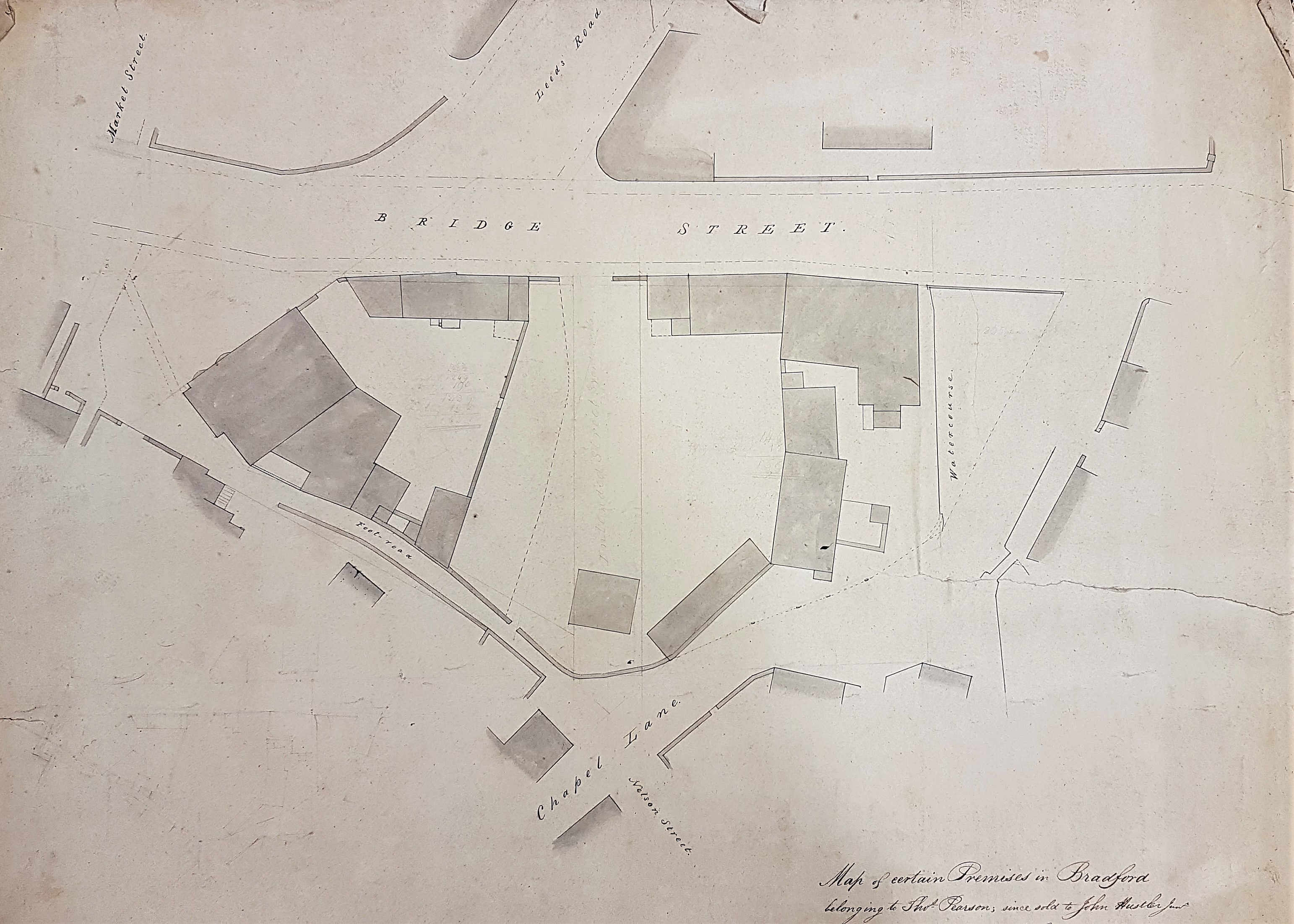
X 37 BRA c.1850 PLA
Material: paper Scale: 1/6” to a yard
Condition: Good
The full title of this plan is ‘Map of certain premises in Bradford belonging to Thos. Pearson, since sold to John Hustler, jnr’. It poses three problems: where is it, which John Hustler owns it, and what date is it?
The location is somewhat different now. The junction of Bridge Street, Leeds Road, Market Street, Chapel Street and Nelson Street is the site of the Bradford City Hall. To the best of my knowledge purchase of land for this iconic building was made in 1869 with construction being completed 1870-73. So, this plan must pre-date the late 1860s. The watercourse included is the Bradford Beck, long since culverted, but visible on the surface at that time.
Which John Hustler was which has caused me problems before. Local historian the late Tony Woods tried to sort this question out for me some years ago. The very famous John Hustler, whose dates were 1715-1790, was the Leeds & Liverpool Canal promotor and company treasurer. The second John Hustler (1768-1842) was his son, who was a prominent Bradford Quaker, a woolstapler, and a partner until his death in John Hustler and Co. Coal Merchants and Proprietors, at Orrell and Liverpool. Finally there was John Hustler of Bolton House (1797-1861) who I think was the nephew of the second, and was a wool merchant in partnership with Benjamin Seebohm. He was also involved in the Orrell coal business.
All this works perfectly well if the middle man was known as ‘senior’, although strictly speaking he wasn’t! A Mary Hustler ‘relict of the late John Hustler’ died at York in 1871. She was 93 so was, presumably, senior’s wife. Then the third John Hustler, formerly of Bolton House, who died in Falmouth in 1861, would be the ‘junior’ mentioned in the present plan. We have another reserve map showing ‘John Hustler’s estates’. It seems that 100 acres of his property were put up for sale in 1851. Two lots were purchased by non-conformist businessmen (Henry Brown, Robert Milligan, Titus Salt, William Rand and Edward Ripley). The land became Undercliffe Cemetery.
For the present I shall date this plan as around 1850.
 Bradford and District Libraries Map Collections