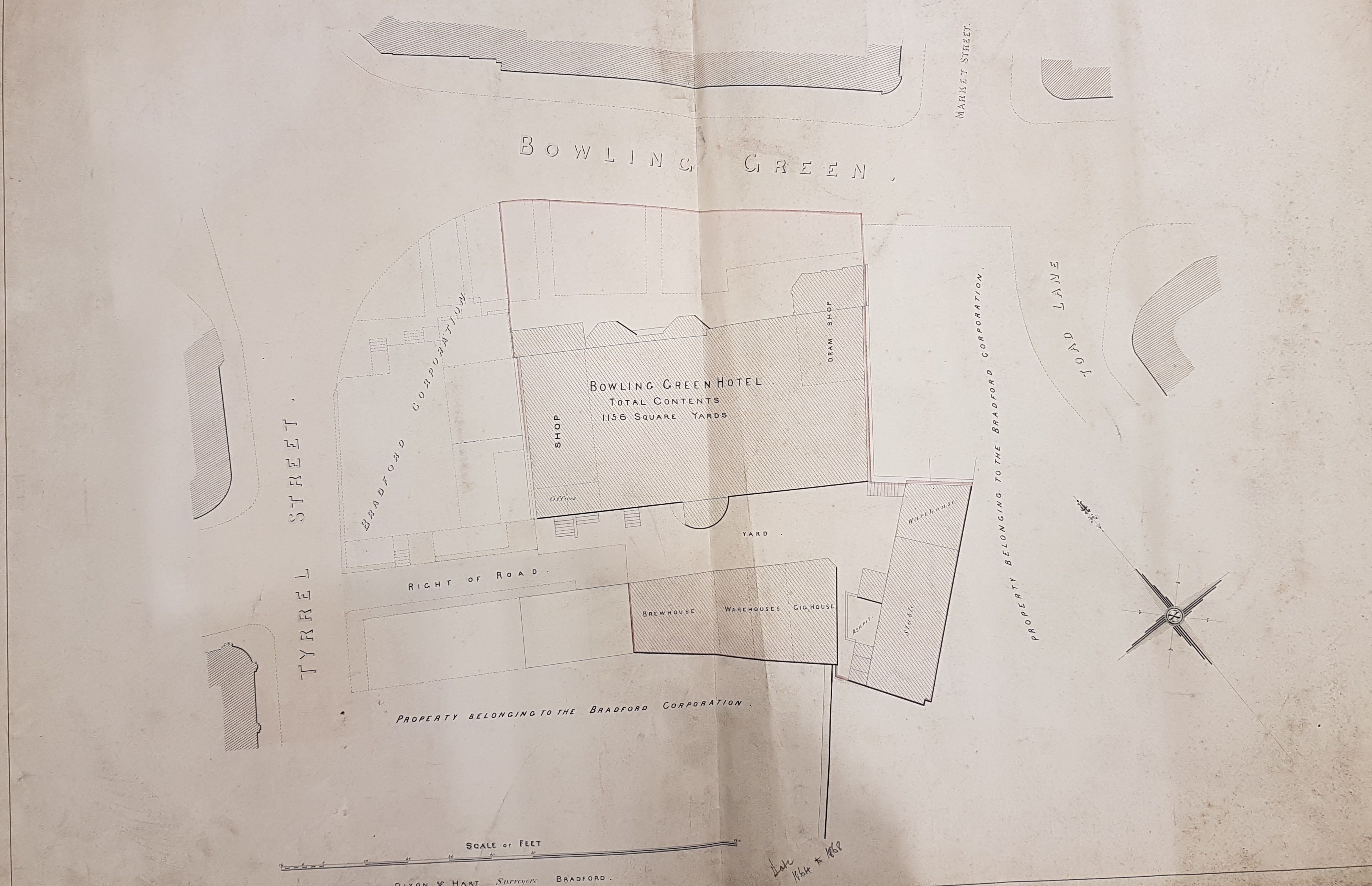
The full title of this plan is ‘Bradford street improvements: The Bowling Green Hotel’. An unknown predecessor of mine, who clearly examined this item many years ago, suggested a date of 1864-1868, and a note to that effect is written on the plan. It was prepared by Dixon and Hart, who were a well-known firm of Bradford surveyors. I am told they were active in the years 1824-1897. This seems a rather long interval, but the Covid regulations are still separating me from the necessary resources needed for checking.
The Bowling Green Inn once stood on Bridge Street. Cudworth mentions that in the 1830s its then owner was a Mrs Susannah Ward, widow of Joseph Ward. Her successor was Joseph Baxter, and then John Lupton was the last man to occupy this position before its demolition. On-line masonic records suggests that the Bowling Green Inn was certainly in existence in the late eighteenth century (c.1794). William Scruton, in Pen & Pencil Pictures of Old Bradford, pushes that date back still further into the seventeenth century, and says that the inn was entirely rebuilt in 1750.
In fact Scruton regarded the Bowling Green as ‘the best inn of the town’. It was used by the Royal Mail for their coaches, and the open space in front of the inn was seemingly once employed for political meetings, and the preaching of John Wesley and George Whitfield, around 1745. Copies of Cudworth’s and Scruton’s books, which mentions many others of Bradford’s former taverns, are available in the Local Studies Library when this is able to re-open.
Parcels of land purchased by Bradford Corporation in the city centre have featured in several other maps in the Reserve Collection. On this occasion you can see that the corporation evidently already owned most of the surrounding land already; it would appear that they are acquiring (possibly by compulsory purchase) the Bowling Green Inn, together with its brewhouse, stable, gig house, and other ancillary buildings.
I have encountered the term ‘gig house’ before, in various parts of the country. Today it would suggest the holding live music performances, or perhaps a place where irregular employees worked. But I assume that it was here you kept your gigs, that is light, two-wheeled, carriages that could be pulled by a single horse.
When was the Bowling Green actually demolished? Scruton clearly places this event well in the past, and his book was originally published in 1889. I rather struggled with an on-line search of the Bradford Observer but the inn was definitely still being treated as a going concern in 1862. The suggested dates for the plan, calculated by my predecessor, could well be right.
 Bradford and District Libraries Map Collections