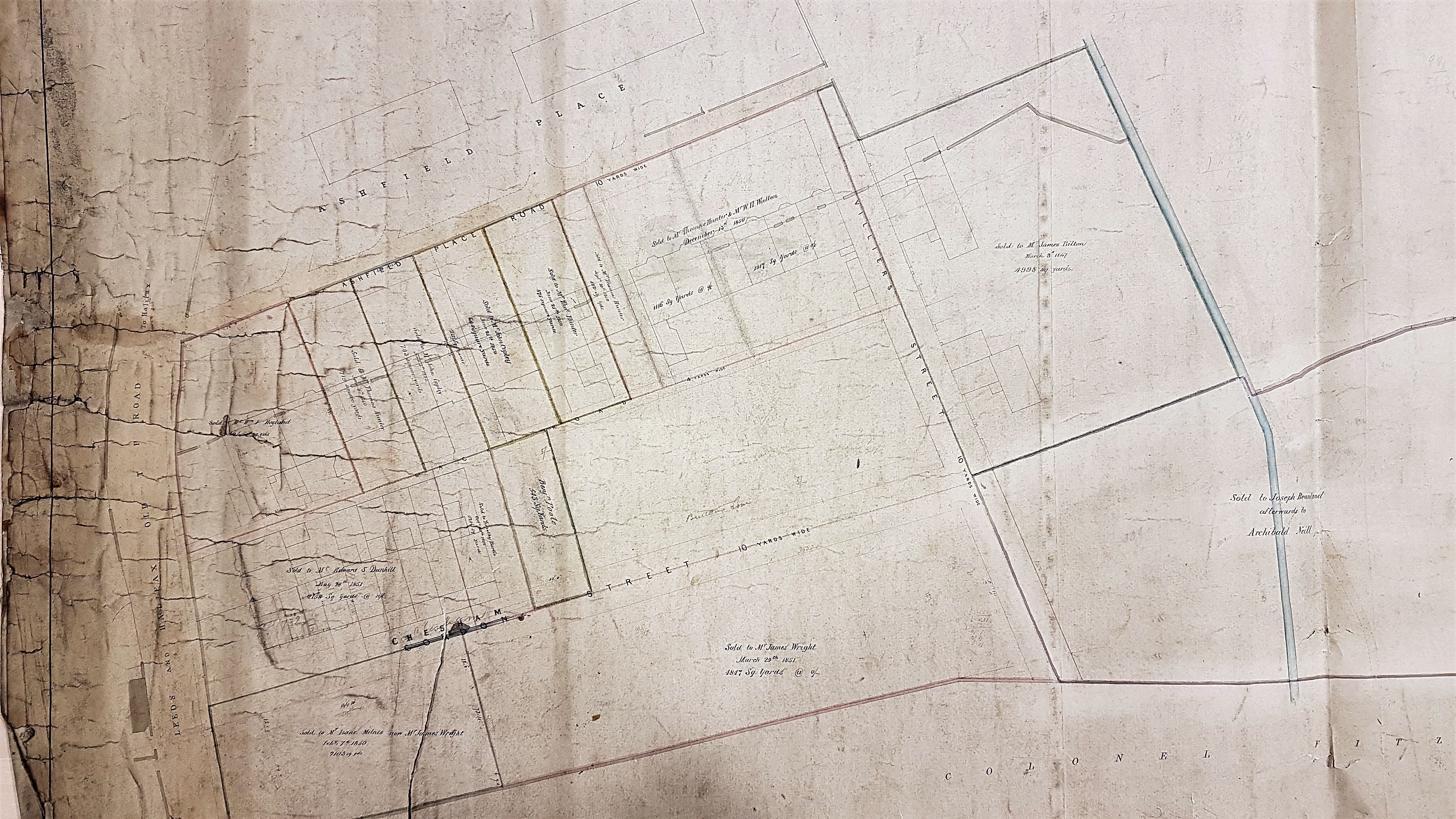
X24 ASH c.1845 PLA
Plan of area bounding Ashfield Place…
Size: 58” * 22”
Material: paper
Date: unk Scale: unk
Condition: good
This plan is identified as relating to ‘Mrs Giles, Great Horton Road’. Although slightly damaged along one edge in the past it shows Leeds & Halifax Old Road and the properties in, and adjacent to, Ashfield Place. It is useful because of the number of important Bradford landowners that ae mentioned. I will describe three in detail: Mrs Giles, Archibald Neill and Colonel Fitzgerald. The map is undated but must be earlier than 1874 when Neill died, and perhaps just before Fitzgerald’s death in 1850 would fit with what we know.
First where are we? It is not easy since almost every road included on the plan has changed its name, or disappeared entirely, in the last 170 years. In the 19th century the Leeds and Halifax Trust turnpike was Little Horton Lane which indicates that the Leeds and Halifax Old Road on the plan must be what we now call Great Horton Road. Fortunately the Ashfield Place that is mentioned is also included on the 1852 OS map.
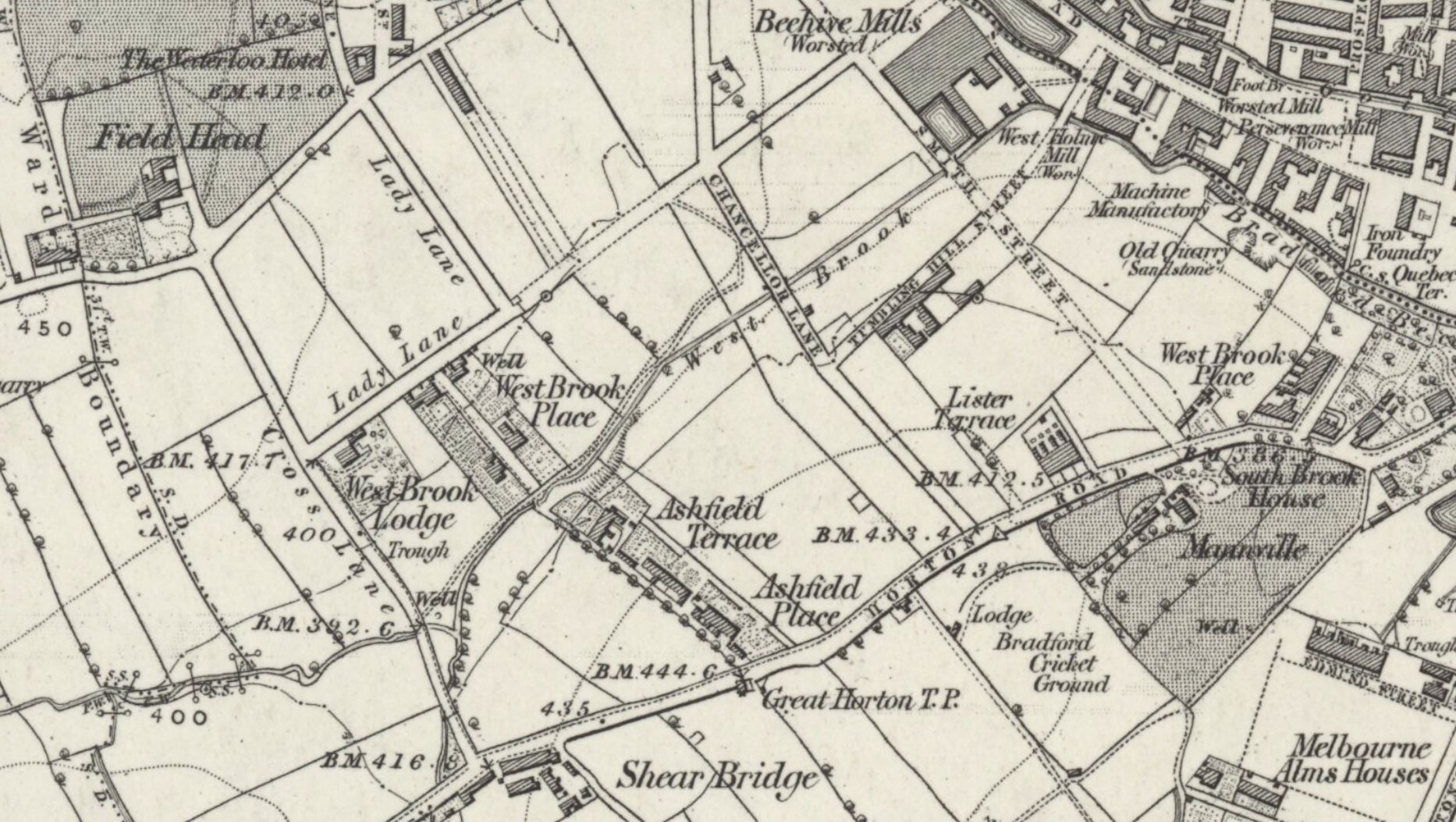
Ashfield Place led off Great Horton Road to the north west at what is now the site of the University of Bradford. The next road in the direction of central Bradford is printed as Chesham Street on our plan but I think ‘Chancellors Street’ is over-written in pencil. Chancellors Street it certainly became, then Richmond Road. It is still Richmond Road and there is also a Chesham building at the University. Both roads join Villiers Street to the north-west, although this is called Lady Lane in the 1852 OS, and Longside Lane both in 1895, and now. The blue line on the plan marks the course of the West Brook.
Mrs Giles was Ann Giles who possessed much property in Great Horton including Haycliffe Hill and Southfield Lane with the fields in between, and the plot on which St Luke’s Hospital was later built. The means by which she acquired her estate was quite complicated. Hannah Gilpin Sharp (1743-1823) of Horton Hall bequeathed her mansion, with all her land in Bradford, to her nephew, Captain Thomas Gilpin, and in ‘default of issue’ to her niece Ann Kitchen. Captain Gilpin died at Madeira in the year 1826 without ever having been married. So, Ann Kitchen came into the property. In 1828 Ann married a clerk in Somerset House, as her second husband, who Cudworth records as Edward Giles, although I believe that Edmund is the correct name. Their son, another Edmund, was baptised the following year. Ann’s husband died in 1832 leaving his infant son as heir to the Horton estates. At the age of 25 this son Edmund eventually went to Australia, being enamoured of sea life, but only lived three days after landing in the colony so all the property was Ann’s again. In 1839 an Act had been passed for disposing of the Giles estate at Horton, owing to the great increase of buildings in the immediate vicinity. Lands belonging to ‘Mrs Giles’ are common on maps of Bradford and Horton. Her daughter by her first marriage, Ann Haines, was ultimately to inherit her estate. The two main characters in this account were once commemorated by Ann Place and Edmund Street, off Little Horton Lane.
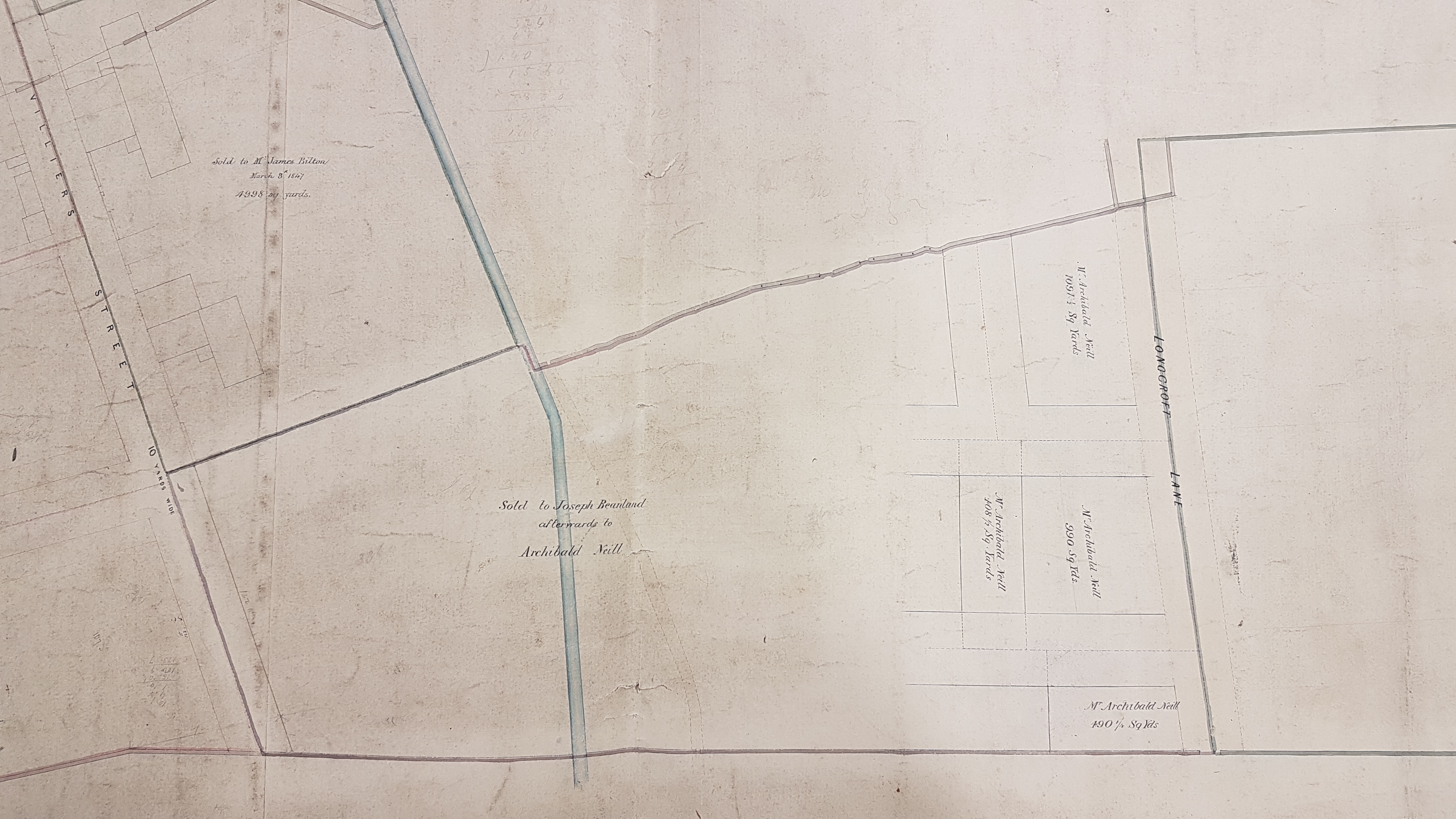
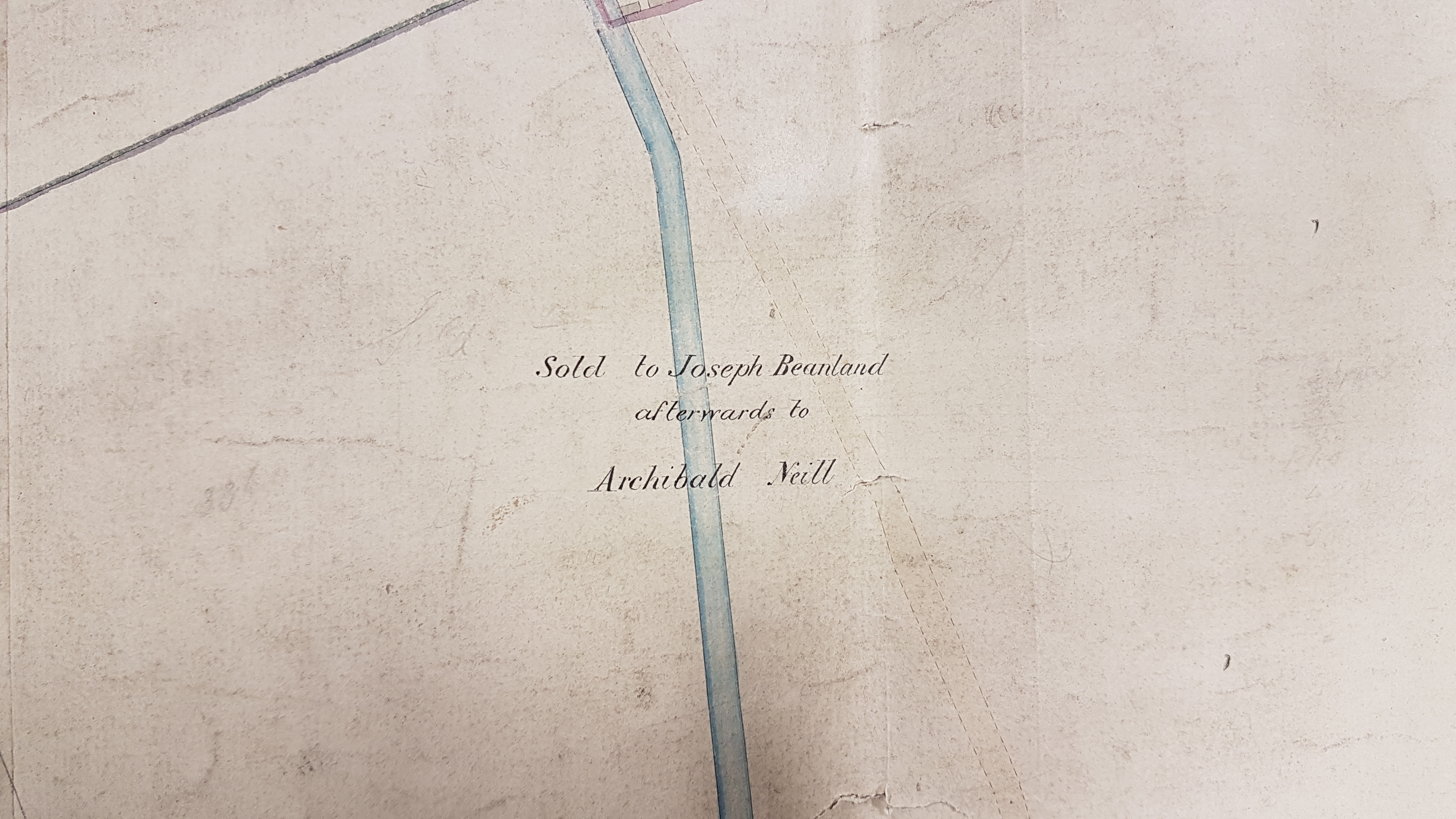
Archibald Neill (1825-1874) was born in Musselburgh and came to Bradford as a young man to work with his brother Robert, who was also a contractor in Manchester. They constructed the station of the Yorkshire & Lancashire Railway. Neill remained in Bradford at York Street and then is listed in 1856 in Westgate. In the Bradford Observer of 18/5/1865, and the 1866 & 1872 Trade Directories, he is a brick-maker in Field Head, Listerhills, which you can see on the OS detail. As a contractor Neill worked on Saltaire and was employed to build Heaton Church, Westgate Station at Wakefield, and the Grand Hotel in Scarborough (than which no faded glory could be more faded). George Sheeran has stated that Archibald Neill was the head of the most important building firm in mid-19th century Bradford. He employed 1000 men and had his own quarries and sawmills. He finally concentrated all his efforts at Field Head. Neill was a liberal, and an Anglican, and was ‘universally respected’ when he died young of a ‘chronic stomach ailment’ and was buried at Undercliffe.
Colonel Fitzgerald has puzzled me before. Who was he? A likely possibility is Thomas George Fitzgerald, of Turlough, Ireland (1778-1850). After 1839 he was a Lt-colonel in the army. Fitzgerald had a strong Bradford connection for in 1809 at St Peter’s Parish Church, he had married Delia (1780-1817), daughter of Joshua Field, of Heaton Hall, and sister of John Wilmer Field. In 1819 he took Elizabeth Crowther (daughter of a Dr James Crowther Leeds), as his second wife. Two daughters died young but they had one son Henry Thomas George Fitzgerald (1820-90) who took over their Irish estates, and was a major in the first Yorkshire rifles. Henry Fitzgerald had been born and baptised in Bradford but probably didn’t live here; his address is usually given at Maperton House, Somerset, which the Fitzgeralds also owned. These men owned a considerable property in the Barkerend district. There was also a Fitzgerald Street off Little Horton Lane.
 Bradford and District Libraries Map Collections
[…] 1852 map showing Ashfield Place from http://www.bradfordlibrariesmap.co.uk […]
LikeLike