X23 BRA c.1860 PLA
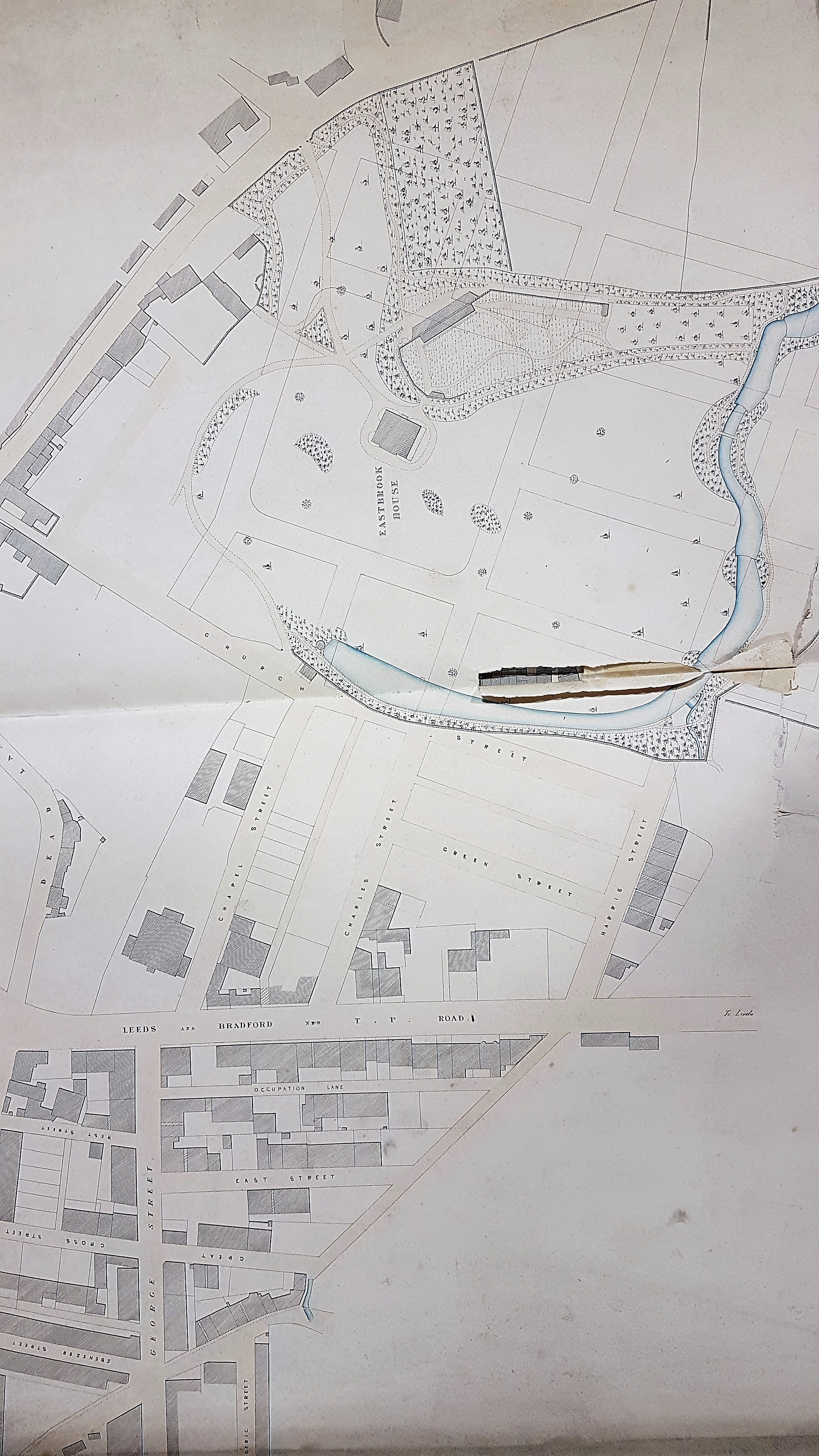
Plan of Harris’s property: Leeds Road & Eastbrook
Size: 27” * 39”
Material: Paper
Date: unk Scale: unk Condition: good
I have rotated this plan by 90 degrees so that it is now orientated N-S. It plan captures the transformation of the original Eastbrook Hall estate to streets and housing. It is undated but must be later than the first OS map of the area (1852). This shows a degree of development quite similar to the plan but although Garnett Street, Charles Street and Harris Street are present in 1852 the OS map shows nothing of the planned street grid crossing the Eastbrook site which is seen here. However our plan need not be much later since although many more roads in this location are included on the 1895 OS map, together with substantial further construction, these roads do not follow the strict grid shown in our plan. In fact this grid has a rather speculative look, so I shall speculate myself and suggest a date around 1860. I’m not sure which of the Harris brothers is the man of the title: there are three possibilities.
During most of the eighteenth century this area was pasture with a few cottages; much of the ownership was vested in the Vicar of Bradford. Some of the land, like so much of the city, was mined for coal. Changes occurred at the end of the century associated with the name Edmund Peckover who was born in 1757 at Fakenham, Norfolk and was descended from an old Quaker family. Whatever the circumstances of his arrival in Bradford Edmund seems to have rapidly evolved into a prosperous merchant and wool stapler with warehouses in Canal Road. Although initially in partnership with John Hustler he later (Cudworth says in 1795) commenced banking on his own behalf. In 1803 he was joined in this enterprise by his cousin, Charles Harris, in the firm of Peckover, Harris & Co. Edmund never married and had no children. The new company evolved into the Bradford Old Bank at Bank Street and then, in 1813, Kirkgate. Edmund’s name is commemorated in Peckover Street in Little Germany. After his death Charles’s two brothers, Henry (1812) and Alfred (1824) became partners at the bank.
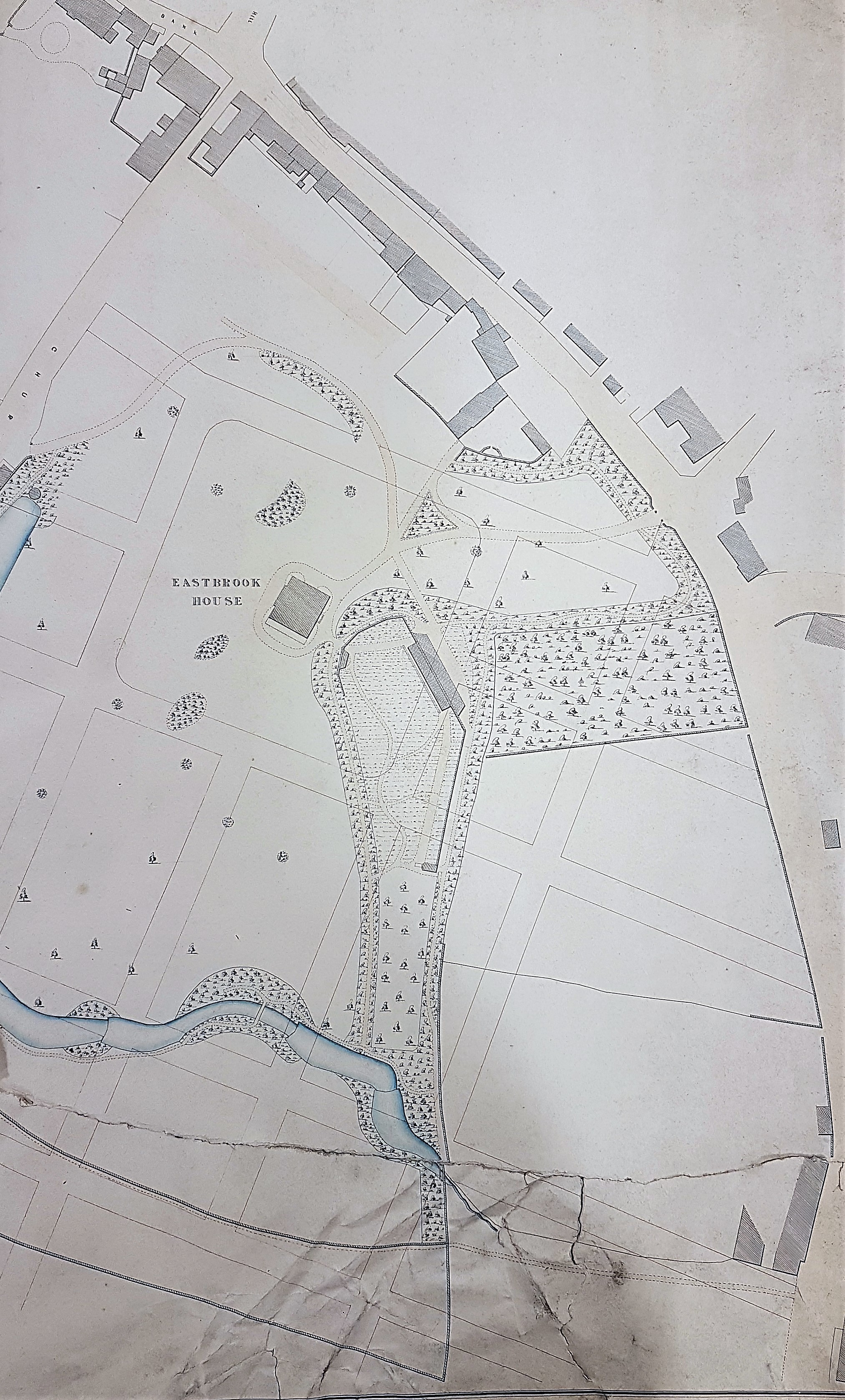
In 1797 Peckover had purchased an estate close the centre of Bradford which had previously been glebe land. He began to construct a town house for himself called Eastbrook House (the East Brook being one of the tributaries of the Bradford Beck). As you can see the house was surrounded by a park and had a lake several hundred yards long. From the eventual lease advertisements (Leeds Mercury 1811) we know that the estate consisted of an orchard, gardens and 20 acres of meadow. The house had a dining room, breakfast room, drawing room, six good ‘lodging rooms and dressing rooms’, with attics, cellars and adequate accommodation for servants including a butler’s pantry. It was furnished by Gillows of Lancaster & London, who were famous furniture making firm.
The further development of the estate only began after Edmund Peckover’s death. His partner Charles Harris seems to have attempted to lease the house but eventually he evidently decided to live there himself, although at his retirement (1840) he moved to Fulford Grange, York where he died in 1847. The original Eastbrook Methodist Hall was built in 1825 on land purchased from Harris although this was replaced in 1903 by the more familiar Edwardian building. In 1832 a Quaker School was built nearby in Chapel Street on land given by Harris. Despite the sales and gifts of land it can be seen from the first OS map, surveyed around the time of Charles Harris’s death, that the estate was left largely intact. Charles Harris’s brother Henry is well known to those of us who live in Heaton since for a long period he leased Heaton Hall and was known for philanthropic work there. The third brother, Alfred Harris, took the lead in creating Bradford Fever Hospital off Leeds Road, and laid its foundation stone (1867). Is anything left of Eastbrook House? A remnant does remain in the shape of three arched windows and a little tower once part of the south-east wall.
 Bradford and District Libraries Map Collections
Thanks for this fascinating delve into Eastbrook history. I often refer to Eastbrook House in my talks – this blog article reveals so much I didn’t know – like how big the lake was, the interior etc. So much Bradfordian don’t know about Bratfurd…
LikeLiked by 1 person