X22 ELD c.1850 LIS
Size: 14” * 18”
Material: Paper
Scale: 5 chains to 1 inch Condition: Good
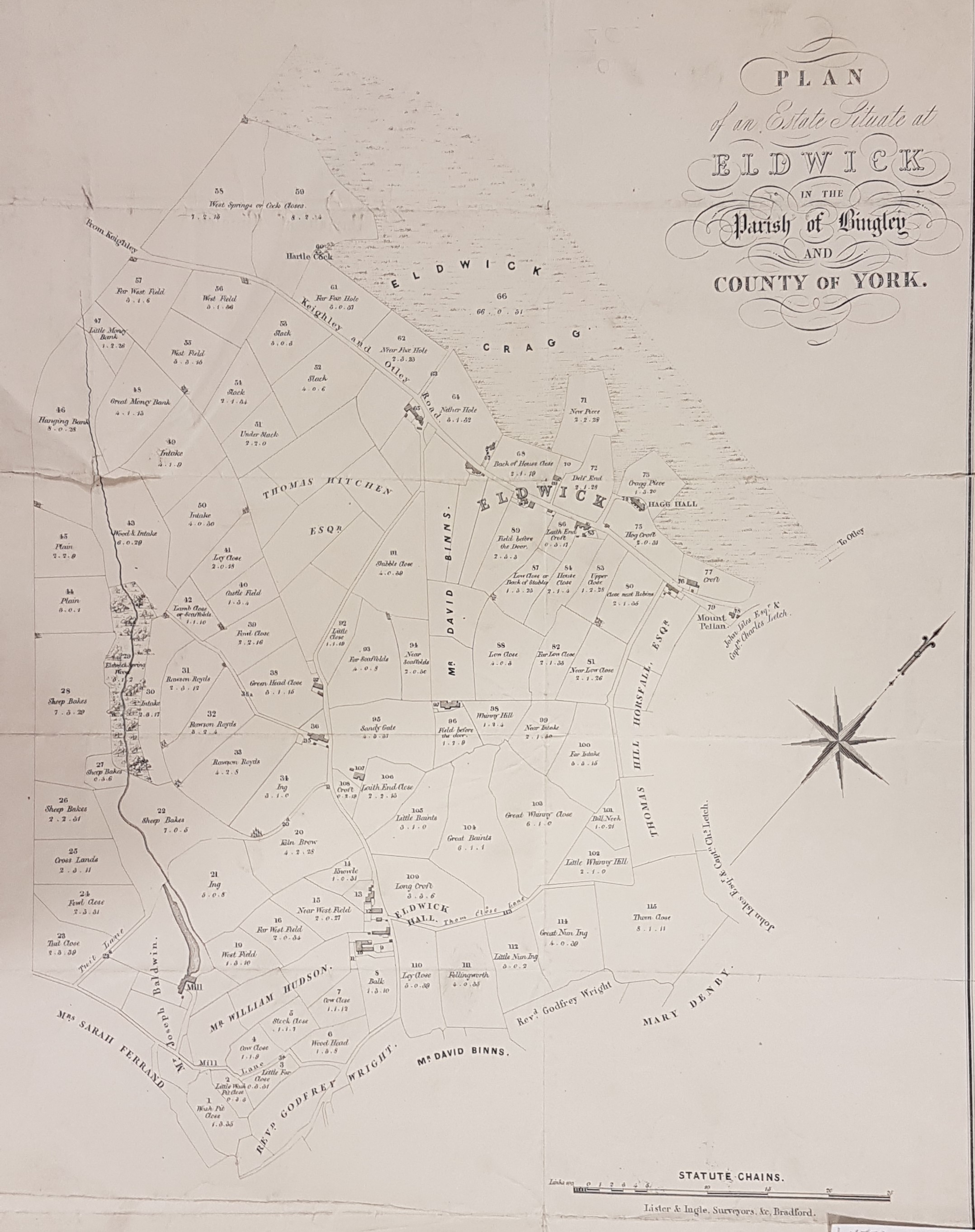
This map is a undated plan by the well-known surveyors, Lister & Ingle, of the whole of Eldwick. It displays field names and numbers. Sarah Ferrand and the Rev. Godfrey Wright are among the landowners which helps with estimating its age. The map must pre-date the deaths of Wright in 1862 and Sarah Ferrand, who died in 1854. Other landowners include Thomas Kitchen and Thomas Hill Horsfall (1802-1855). Land tax records confirm both men as Bingley landowners in the mid-nineteenth century.
Thomas Hill Horsfall has featured in these accounts once before. Victorian local historian William Cudworth records that he was the owner of Whetley Hill in Bradford in the 1830s. While resident he kept a pack of foxhounds that hunted all around Bradford, he was consequently known as ‘Hunting’ Tom Horsfall. Eventually Horsfall sold his house to John Priestman and moved to Thirsk, around 1838 I estimate. He was visiting his cousin John Horsfall of Bolton Royds, Manningham at the time of the 1851 census. A relative was John Garnett Horsfall who had introduced steam power looms to Bradford, which led to a riot at his mill at North Wing (1826).
So, where are we? Well, we are quite far north. In the middle of the map find ‘ELDWICK’: near it is Hagg Hall (Hog Hall on the first OS map). Move west along the road to Keighley (the Keighley & Otley Road) and you will come to a T junction. Here, in the first Ordnance Survey map (1852) the building is identified as the Fleece Inn (now Dick Hudson’s), but on our map it is unnamed (number 65). Further west there is no reservoir drawn, so we must have the map date approximately right. You can see that north of the road there is a strip of cultivated land and then you are in Eldwick Cragg. The OS surveyors call this Weecher Flat and consider it part of Bingley Moor. On the extreme left of the map is Eldwick Beck. Return to Dick Hudson’s and go south following the line of the road. Our map provides the field names, but is not the equal of the OS map in identifying quarrying sites or naming settlements. Eventually you pass a field called Kiln Brow and arrive at Eldwick Hall (a grade II listed seventeenth century building), and the nearby Eldwick Mill. Assuming our map was intended to include all the buildings in the area (and it might not have been of course) then it is probably earlier than the first OS map which, for example includes a terrace called ‘New Row’ immediately south of the mill.
 Bradford and District Libraries Map Collections