
Nobody can use this map blog for very long without appreciating that the Rev. Godfrey Wright is an obsession of mine. It is strange that until I started work on the Local Studies Library map and plan collection, three years ago, I had never heard of him. I now realise that the LSL has literally dozens of map records of various pieces of his property – property devoted to industry, dwellings, mining and agriculture. To give one example Godfrey Wright owned the land on which St George’s Hall and Little Germany were subsequently built.
Rev. Godfrey Charles Wright (1780-1862), of Hooton Pagnall, Doncaster, is an almost entirely forgotten figure but was once the major Bradford landowner. He possessed estates in what would later become the city centre, but also at Horton, Manningham, Baildon, Otley, and elsewhere. The first of his appearances in the local press that I can trace is from 1819, when he subscribes two guineas to Leeds General Infirmary. At that date he is already being referred to by his clerical title. Godfrey Wright does not seem to have lived in Bradford for any prolonged period, if at all. His wife died in 1821 and certainly by 1822 he was resident at Bilham House, Hooton Pagnell, where he remained for the next 40 years. In later census reports he described himself as a ‘clergyman without cure of souls’, and usually had an indoor and outdoor staff of a dozen or more. He was still living at Hooton Pagnall (with 10 servants) at the time of the 1861 census, and he died the following year. He was described after his death as a staunch Conservative and left £80,000 to his heirs in 1862 which equates, according to the National Archives currency converter, to £3,452,800 at 2005 values. It is very natural to wonder how an unpreferred Clerk in Holy Orders acquired all this wealth and property. Victorian Bradford historian William Cudworth believed that Godfrey Wright’s prosperity resulted from a relationship to, and inheritance from, three important local families: the Swaines, the Fields, and the Booths.

This rather lovely plan from the reserve collection reveals the extent of Godfrey Wright’s property in Bradford, Horton and Manningham. The plots are numbered: the key on the map itself provides the plot areas but little other information aside from comments like ‘house’, ‘cottage’ or ‘divided into three’. Assuming every number indicates a piece of property, owned somewhere, the total come to 903! Industry doesn’t feature much although there are examples of textile mills, limekilns, coal staithes, and a delph (quarry) at the end of Manningham Lane.
The plan is undated but when is it likely to have been drawn up? The ‘old church’ on the plan is the medieval Parish Church (now Cathedral): the ‘new church’ must be Christ Church (long demolished) which John James records was erected in 1815. The road labelled as ‘Leeds new road’ is now Leeds Road, which dates the map to later than c.1825-30 during which period the new turnpike to Leeds was constructed by the Leeds & Halifax Turnpike Trust. The overall arrangement is similar to the earlier 1802 Bradford map and it is hard to believe that the original map-maker did not have access to this same map when he drew up the present plan. The 1834 Bradford map is on a smaller scale so direct comparisons are difficult but by that time there had certainly been considerable urban development which does not feature here.

Stylistically the plan would fit the early nineteenth century but if so there have been many more recent additions to it reflecting, for example, the arrival of the railway in the mid-1840s. At the end of School Street there is a space designated ‘Goods Station’ and above it a ‘railroad street’. There is a ‘Great Northern Station’ indicated in pencil off Wakefield Road. Initially I assumed, being uninformed about early railways, that this was a piece of speculation but in fact Adolphus Street station was built by GNR at exactly this location. It provided a direct line to Leeds but the terminus seems to have been an unpopular distance from the town centre and closed to passengers as early as 1867. When a loop line from Drake Street (Exchange) Station, via St Dunstan’s and Hammerton Street, was created in the same year this captured most of the passenger traffic.
Some indicated plots have comments like ‘land sold’ or ‘partly built’ written in pencil. In one plot I can definitely read the date 1860. Details of the plan reveal several other interesting features. The Bradford Beck is open throughout its length. There is a coal stay (staithe) close to the Parish Church which we know was supplied by the Low Moor Iron Company, probably from the Black Bed coal seam. A second staithe is pencilled in along Leeds Road. I know it existed from other maps but may not be visible to you in these images. It was supplied by a tramway from Bowling Iron Works. A network of streets is also faintly pencilled in around this area: I can recognise Mount Street, Victoria Street, Albert Street and Melbourne Street.
There are canal-side limekilns and some attempt is already being made to straighten the course of the beck. The Rouse and Leeming Mills are in existence and nearby Canal Road is sketchily drawn. Vicar Lane has its original name of Dead Lane. There is a Bowling Green at the junction of Ivegate and Bridge Street. On the left hand side of the map a mill race is drawn which was taken off the Beck to supply the Soke Mill. Unusually the dialect word, goit, is not used which made me wonder if the map surveyor was not local, but more probably he simply copied the word race from the 1802 map. There is a long islet in the beck adjacent to field 532. Did this really exist I wonder?
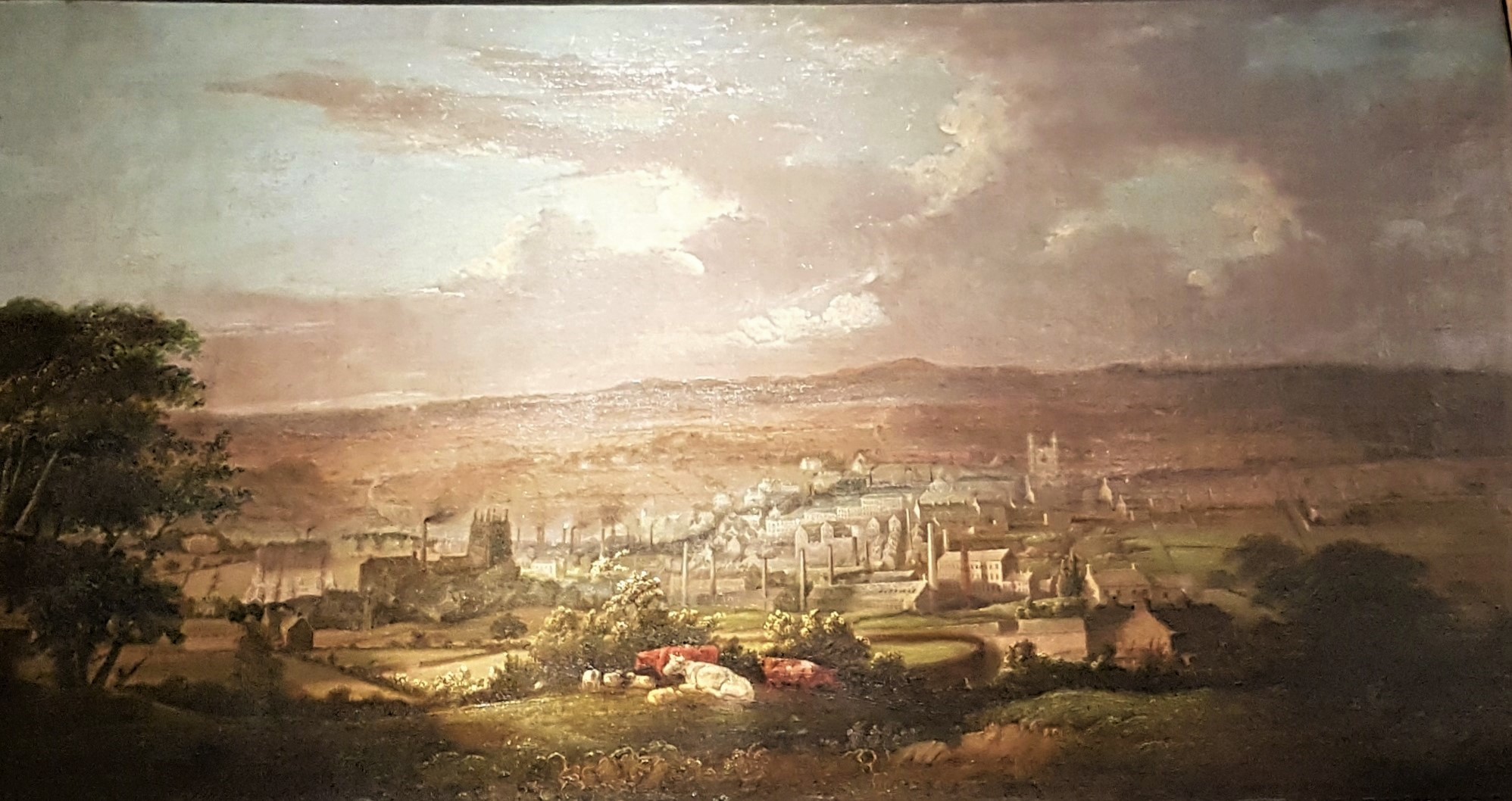
There is an oil painting in Cartwright Hall gallery which shows Bradford in the early nineteenth century. I think that it is reasonable to assume that the town looked like this when the original plan was drawn up, even if the same plan was subsequently used and written on for the next 30 years: probably in fact until the end of the owner’s life. I’ve often looked at the scene depicted in the painting without appreciating, until recently, that Godfrey Wright owned most of it!
 Bradford and District Libraries Map Collections