3.045 WAP c1850 PLA BHM 1187 B14
Shaws Building Land, Wapping
Cloth backed paper Scale: 80 ft per 3 inches Size: 93*80 cm Condition: good
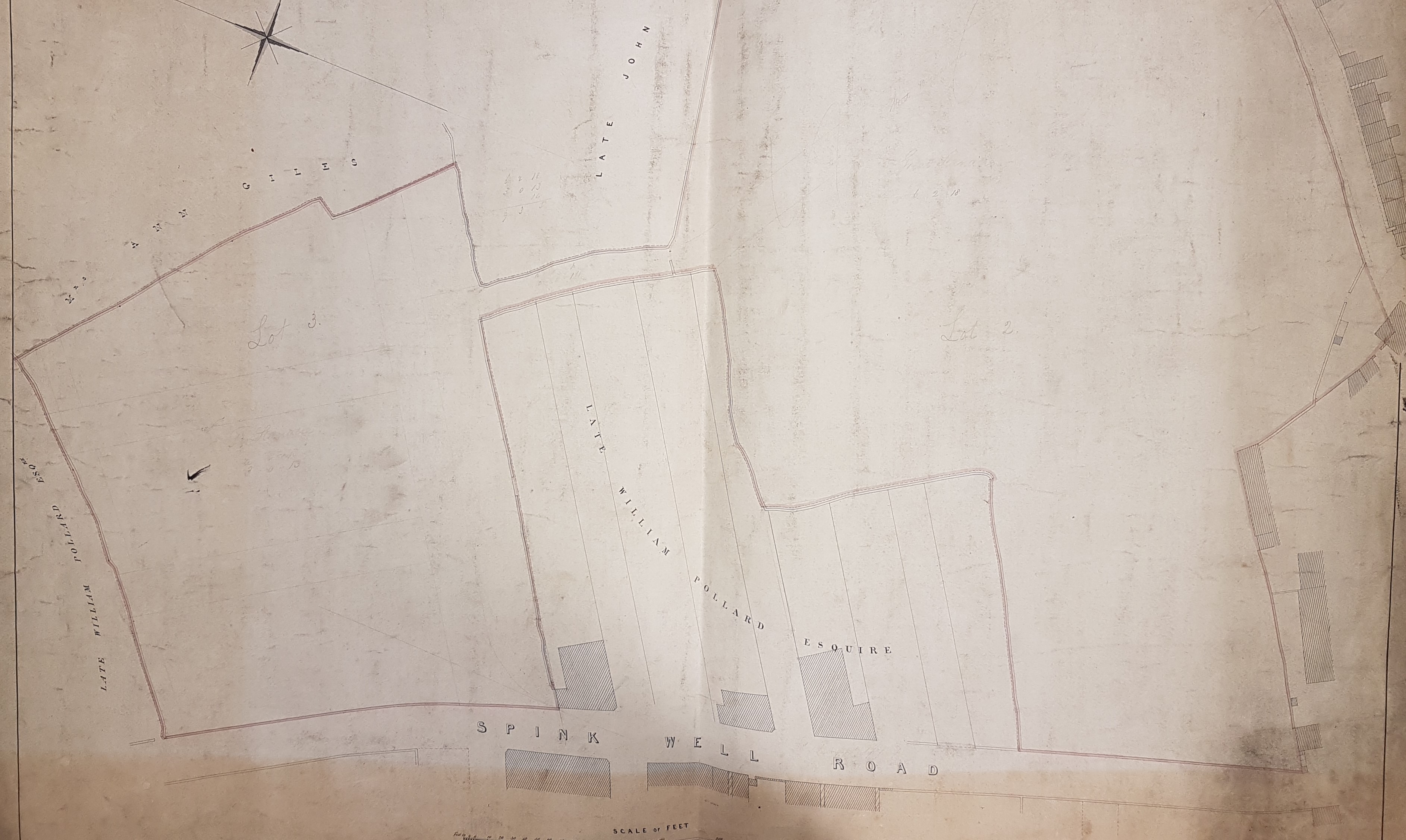
I think I need to start with an apology for trying to interest you in an undated and unlabelled plan which consists largely of empty space! The sheet is annotated on the reverse ‘A19a Shaws Building Land Wapping’. The plan, as I say, is largely empty and presumably defines the property of a Mr Shaw, with a frontage on Spink Well Road (more usually called Wapping Road) and North Wing (drawn but not labelled). The plot concerned is quite near the city centre, south east of the Spinkwell stone quarries which famously provided the masonry for Manchester City Hall.
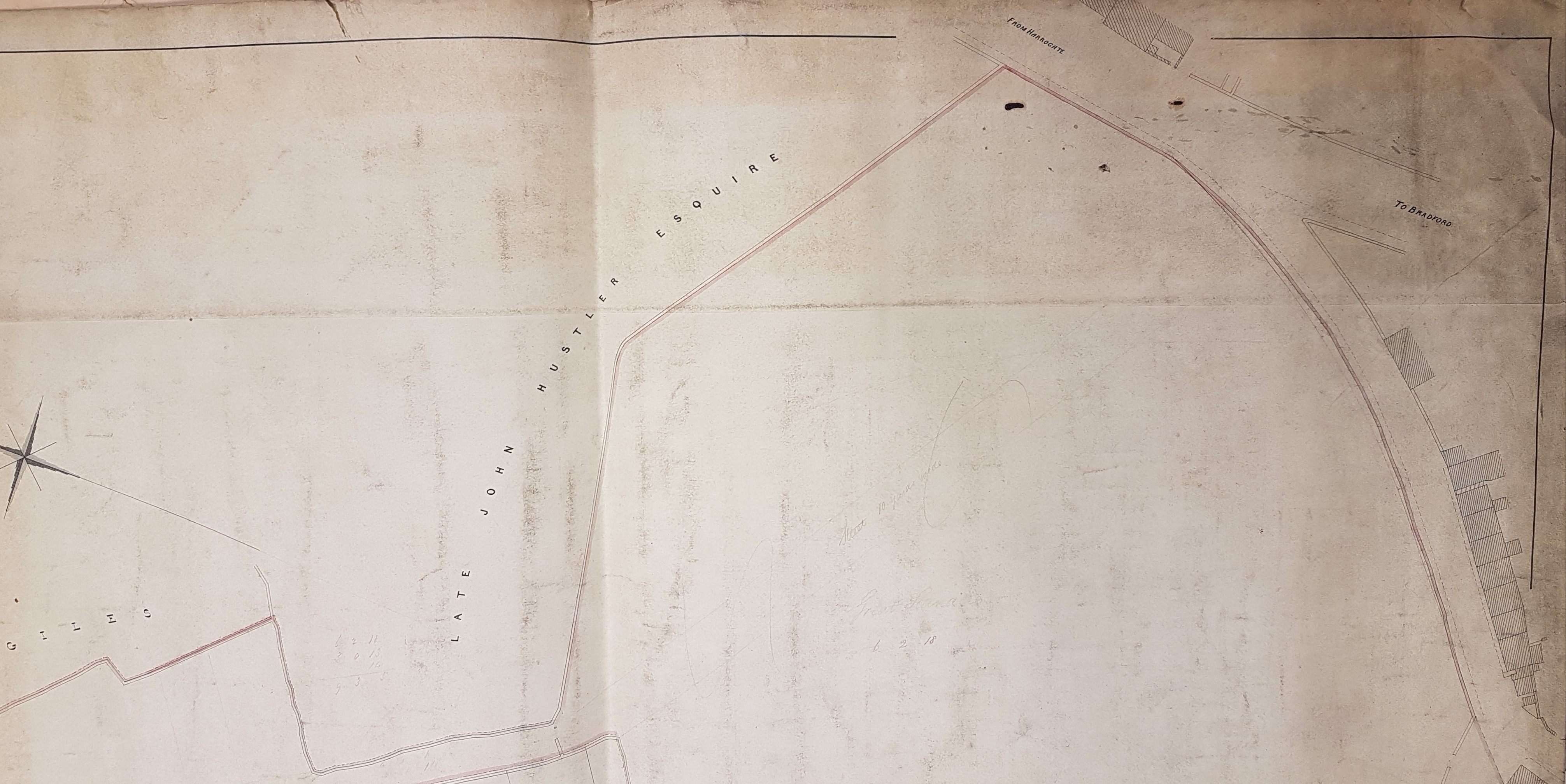
The two field boundaries connected by a ‘corridor’ fits the first OS map, c1850, but within 20 years the area was to be the site of a brick works. Aside from Mr Shaw three other land-owners’ names are included: Mrs Ann Giles, the late John Hustler Esq., and the late William Pollard.
I had noticed the name ‘Mrs Giles’ as a landowner on many of our plans but this plan was the first occasion on which I had seen her full name included. This was a huge help in identification. In other material from the Local Studies Library reserve collection she is associated with Great Horton in the mid-nineteenth century. She sold the land called ‘Horton Park’ which was the future site of Bradford Union Workhouse and then St Luke’s Hospital. She has property in Horton near Haycliffe Hill and Southfield Lane (Salt Pie) with fields in between. Mrs Ann Giles’s trustees were selling land by 1871 which I assume indicates that she had by then died. The means by which Mrs Giles acquired her estate was quite complicated. Hannah Gilpin Sharp (1743-1823) of Horton Hall bequeathed her mansion, with all her land in Bradford, to her nephew, Captain Thomas Gilpin and his male heirs, and in ‘default of issue’ to her niece Ann Kitchen. Captain Gilpin, after enjoying the estates for only three years, died at Madeira in 1826 without ever having been married, so Ann Kitchen came into the property. In 1828 she married a clerk in Somerset House, as her second husband, and now became Mrs Giles. Cudworth records him as Edward Giles, but I believe that Edmund was the correct name. After the couple were united at St Pancras Old Church he would have acquired control of all her property. Their son, another Edmund, was baptised the following year. Ann Giles lived in Tavistock Place and her husband died in 1832 leaving this infant son as heir to the estate. In 1839 an Act had been passed for disposing of the Giles estate at Horton, owing to the great increase of buildings in the immediate vicinity. So this is why lands belonging to ‘Mrs Giles’ are common on maps of Bradford and Horton. Ann was still alive in the 1851 census when she and young Edmund were staying with her daughter by her first marriage, Ann Haines. At the age of 25, in the early 1850s presumably, Edmund went to Australia being enamoured of sea life, but only lived three days after landing in the colony. Ann Haines ultimately inherited the estate.
To the best of my belief there were three men called John Hustler. The senior (1715-1790) was the famous Quaker businessman and Leeds & Liverpool Canal promoter, his son (1768-1842 was also a prominent local Quaker, his grandson (1797-1861) was a wool merchant in partnership with Benjamin Seebohm. The ‘late John Hustler’ on the map is probably the second of these men. Mary Hustler, ‘relict of the late John Hustler’, died at York in 1871 at the age of 93! The other possibility is the third John Hustler, formerly of Bolton House, who died in Falmouth in 1861.
I know very little about ‘the late William Pollard’ although this surname is sometimes linked to Spinkwell quarry. There are brass memorials in Bradford Cathedral which states that there was a William Pollard who married Beatrix and died in 1840 aged 72, suggesting a birth around 1770. In 1841 Mrs Pollard of Scar Hall is winning horticultural prizes and Beatrix is recorded, aged 85, at Scar Hall in the census of that year. In the cathedral there is also a memorial to William Pollard of Crow Trees near Bingley, son of William Pollard of Scar Hall. He died in 1819 aged 31 suggesting a birth around 1780. So these two men can’t be father and son then. Scar Hall, at Scar Hill, was at the crossroads in Bradford Moor where the appropriately named Pollard Lane joined Killinghall Road. It is well shown in the 25 inch 1893 OS map and must now be at the site of Bradford Moor Golf Club. I can tell you that the Wapping brick works built on this site are shown on the topographical drawing accompanying William Cudworth’s Worstedopolis close to what became Oxford Place. In a Bradford Observer report of 23 July 1855 a Henry Hutton of Bolton Outlanes is recorded as brick-maker & farmer with a brickyard in Spinkwell Road, but he was only the first in a series of local brick-makers based at this location.

So, who was Mr Shaw? Well I have to leave readers something to do for themselves.
 Bradford and District Libraries Map Collections