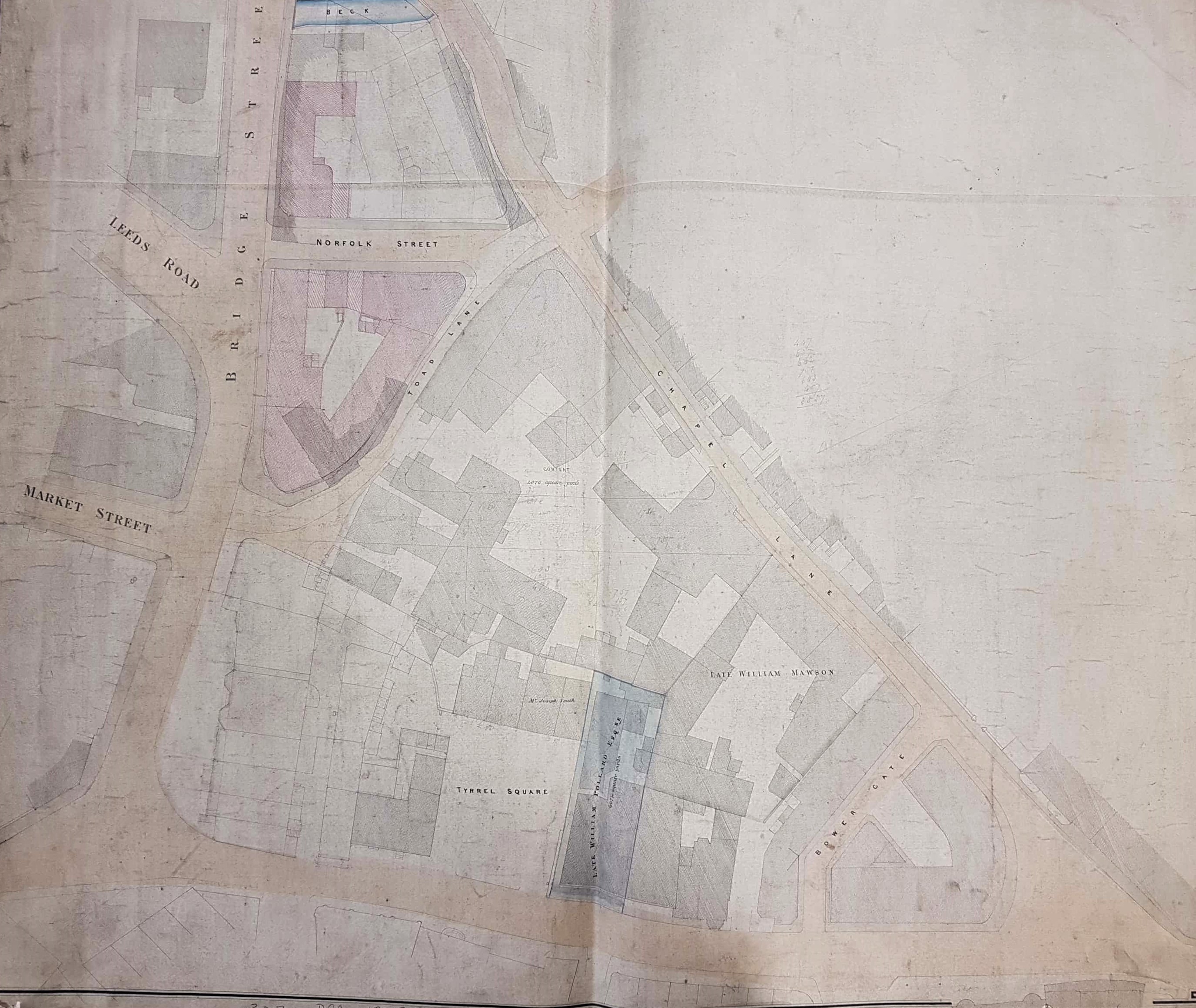
A recent item on the Roebuck Inn convinced me that I don’t know the arrangement of mid-nineteenth century Bradford as well as I probably should. Here I shall use two plans from this period to explore the issue further. As you will see both are connected with the surname Atkinson. The first plan is labelled on the back ‘Mr Atkinson’s property, Tyrell Street’, which is the presumably the pink coloured areas. The plan covers less than a quarter of the area surveyed in the second plan, but in much greater detail.
3.007 BRA c1845 PLA BHM 1171 B14.
Linen backed paper Scale: unk Size: 91*81 cm Condition: fair
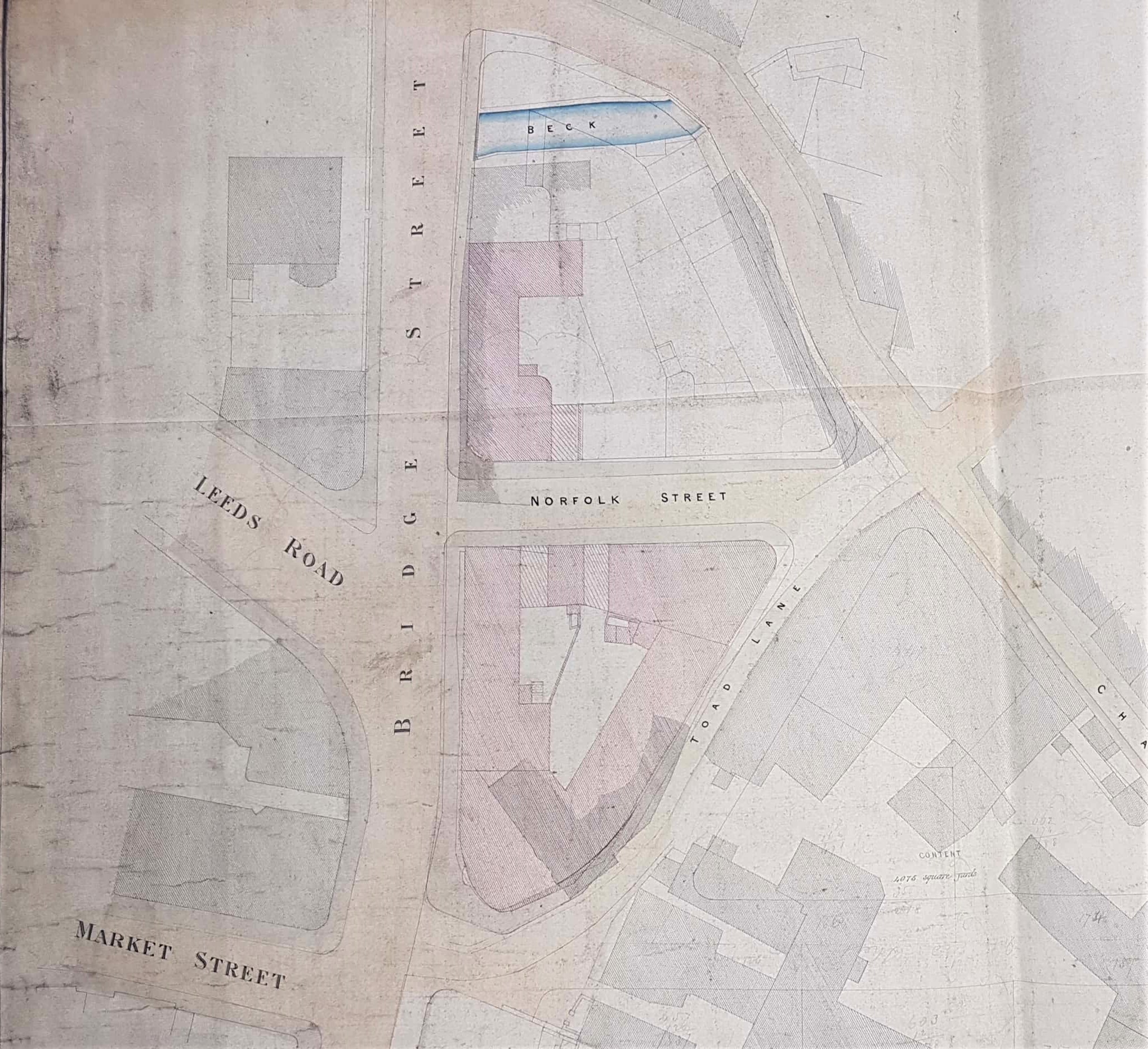
When I first looked at this undated plan I felt that the road and building arrangements resembled the 1849 tithe map. Another clue to the date is a piece of property coloured blue is labelled as belonging to the late William Pollard. If this man is William Pollard of Scar Hill he was certainly alive in 1842 when he drew up a will, so I estimated a provisional date of 1845.
Secondly a plan of Bradford Centre, showing proposed street improvements, c.1860:
3.042 BRA c1860 PLA BHM 770 B11.
Paper Scale: unk Size: 75*55 cm Condition: fair
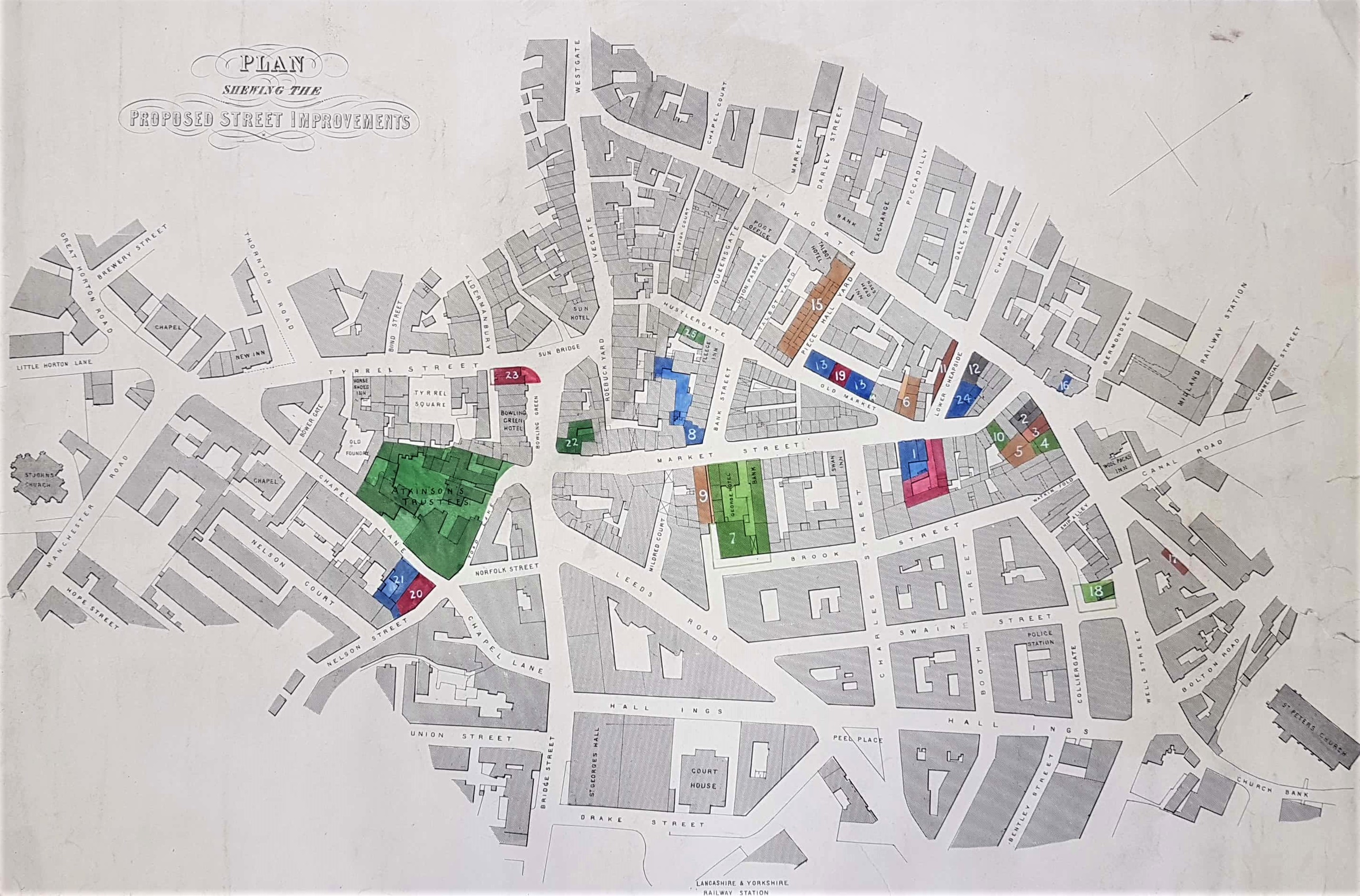
This is clearly a town centre street improvement plan. North-west is at the top. Coloured plots numbered 1-23 are scattered over the area surveyed. The plan is not provided with a year of publication, but it evidently pre-dates the construction of the new Wool Exchange in 1867. On the other hand St. George’s Hall is present which places it later than 1852. Possibly an interval of 15-20 years separates the two plans I am showing.
The relative ages of the plans would seem to be confirmed by the situation of Mr Atkinson. In the first plan he owns property in Tyrell Street, but in the second the council are dealing with ‘Atkinson’s Trustees’ who own an adjacent piece of property. ‘Trustees’ suggest that he has died and men have been appointed to represent the interests of his descendants. Additional confirmation is provided by a small section of the Bradford Beck between Chapel Lane and Bridge Street. This is to be found on the surface in the first plan but has clearly been culverted by the time of the second.
Undertaking a little more research for this article I came across reports in the Bradford Observer (1864) which describe an action by ‘the trustees of the Rev. Mr Atkinson’ to improve an offer of compensation for an area known as the Old Foundry which blocked the proposed extension of Market Street from Bridge Street to Manchester Road. The property block was considered to be the only one in that part of the town which hadn’t been converted ‘to mercantile purposes’. Clearly the corporation wished to acquire the whole block, which was more than strictly necessary for road improvements. The average yearly rental for the last 5 years had been £400. A great deal of detailed evidence was given and in the end Mr Picton, the umpire, awarded the trustees the sum of £17,448.
So who was Rev. Mr. Atkinson? Further delving in the newspapers suggested that in life Rev. Atkinson held the post of lectureship at St Peter’s parish church. I cannot be absolutely certain but I believe he was Rev. William Atkinson MA (1757-1846), sometime fellow of Jesus College Cambridge, who my fellow library volunteer Bob Duckett has already researched. If so William Atkinson used the nom de plume ‘The Old Inquirer’ in many pieces of his writing. He was the youngest of four talented brothers from Thorp Arch near Wetherby one of whom was Vicar of Leeds. Having taken holy orders, William Atkinson became lecturer at Bradford parish church from 1784 till his death aged 89 in 1846: a period of 62 years. He was only required to be in attendance to preach a sermon on Sunday afternoons: idiosyncratically he used to keep his written sermons in two barrels. He did have other duties occasionally, for example in 1824 he married Rev. Henry Heap, the vicar of Bradford. He was a giant of a man who lectured in a gown. He was accustomed to walk from his home in Thorp Arch on Saturdays and walk back on Mondays, staying over in Bradford for his Sunday lectures. When resident in Bradford he reportedly had a room in Beecroft’s Wood Yard which disappeared during Corporation improvements of Townend and Tyrrell Street. Possibly this is how he came to own property in the area. The few contemporary published references to him don’t seem to agree on his marital status. One article states that Elizabeth Sarah Atkinson was his daughter and she in turn was the mother of manufacturer Sir Matthew Thompson. Another authority states that this formidable man was a bachelor which does seem plausible. The large number of Atkinsons in Thorp Arch makes this question impossible for my limited family history skills to resolve.
During his 62 years in post Rev. Atkinson wrote letters, essays and poems. Bob lists his literary interests as: the exportation of wool, tithes, political reform, dissenters from the Church of England, the Pope, press bias, agriculture and even banking. William Atkinson is unique among my map-based historical characters in having a Wikepedia and a DNB entry: some reminiscences of him were also published in the Bradford Observer on 22 July 1869. If you’d like to learn more, and see his picture, please follow this link:
 Bradford and District Libraries Map Collections