
3.039 BRA c1865 DIX BHM 756 B11
Bradford city centre, Roe Buck Inn
Dixon & Hart, surveyors
Paper Scale: 40 ft per 5 inches Size: 77*50 cm Condition: fair
I am sometimes asked if it would be possible to illustrate a map or plan with a contemporary photograph or drawing. This is an excellent idea in principle but to avoid misleading the reader I would have to be absolutely certain that that I knew where the surveyed site actually was. This is not always straightforward as this plan illustrates. The title ‘Dyson and others v Corporation: Claimants Plan’ would seem to indicate that Dyson is a representative land-owner objecting to some plan of the corporation’s, or perhaps the compensation he has been offered to allow such a plan to take effect. I have not been able to positively identify Mr Dyson: there are just too many contemporaries with this surname, and none are obvious candidates. The Roebuck Inn is marked on the plan as you see. Presumably its demolition was to allow the improvement of the junction between Ivegate and Market Street and possibly, as we shall see, some bigger construction plan. The junction certainly was improved: it currently boasts an ornate steel barrier and, unless I am totally mistaken, the site of the Roebuck was occupied after 1870 by the corner of the large Brown & Muffs building.
With the date 1870 carved into the new building it is easy to be certain about the date of the Roebuck’s end. A Mr Samuel Thomas, the man who had been the licencee, died there in 1869 at the age of 59. Later that year the trustees offered it for sale by auction, under ‘a deed of assignment’, through auctioneers Whalley & Co. The Roebuck was mentioned again the following year in connection with a legal case in which the owners of the nearby Hope & Anchor, at the corner of Market Street and Bank Street, objected to the valuation placed on it by the Town Clerk. The inn is not present in a Bradford Directory of 1872. It looks from a sale notice in the Bradford Observer from 1870 as if the land was now in possession of the council who were selling off ‘builders’ materials’ in Roebuck Yard, and at other neighbouring premises. It was required that the land be cleared in 14 days.

But how old was the Inn? The Local Studies Library reserve collection has many other plans of Bradford city centre. This detail of a block plan shows a very different topography from the present day and makes the mid-nineteenth century arrangements clearer. The block plan is undated and looks reasonably modern in style but the New Wool Exchange is not yet constructed so it predates 1864-67, although possibly not by much. It is certainly apparent that Ivegate does not reach Market Street but Roebuck Yard is interposed between them. The fact that Roebuck Yard is a recognised name suggests that the inn has been in position for some time, but is it ‘our’ Roebuck, which would have been at 2, Ivegate? We should now consider this illustration from Cudworth:
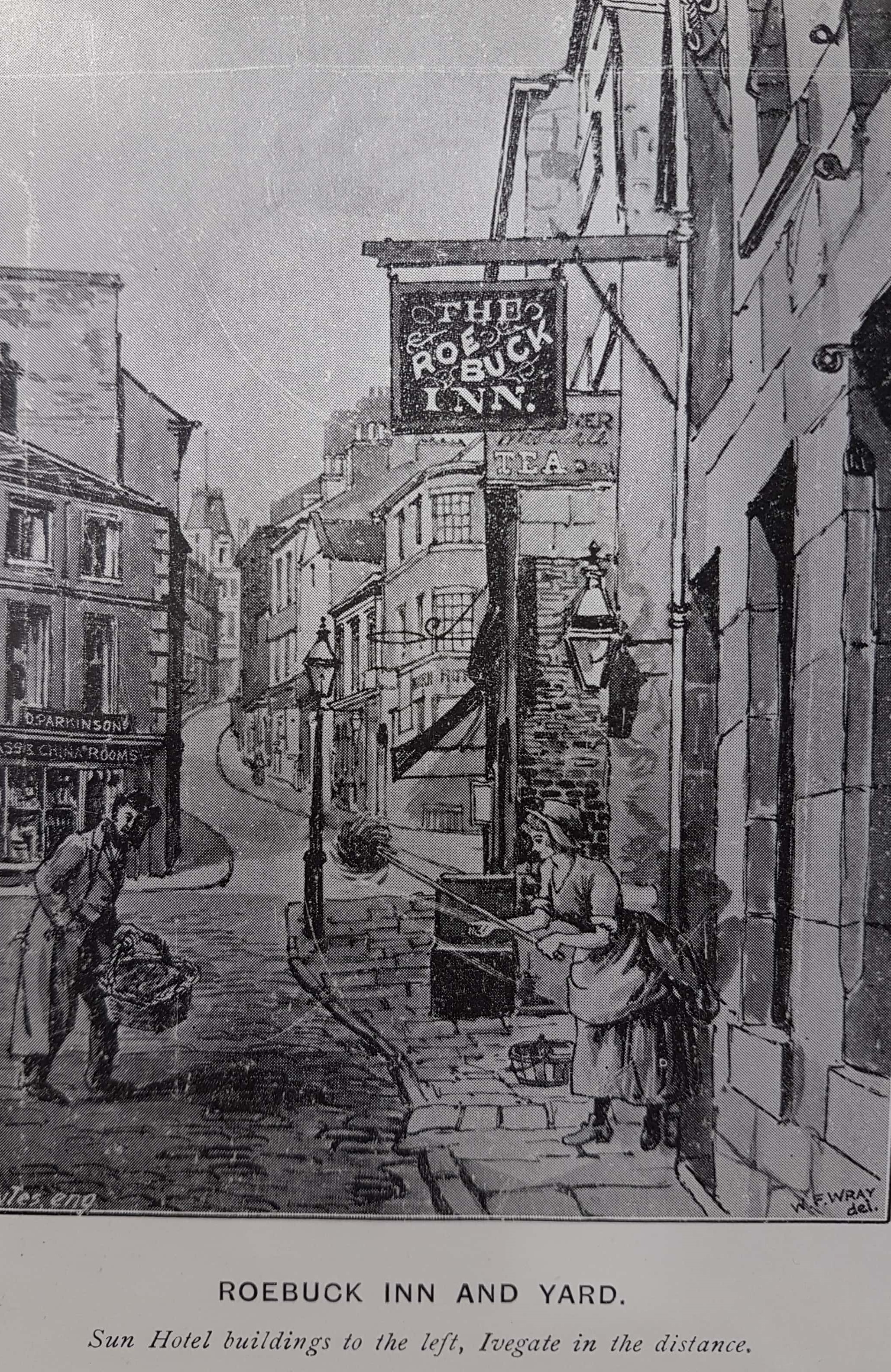
I would assume that this is an artist’s impression but even an illustrator is hardly likely to be mistaken about the Sun Inn being on the left as the rubric claims. This fits our block map detail perfectly. The explanation must be that the Roebuck changed its location. The Roe Buck, or Roebuck, was a reasonably common name for a public house in this area: there were Roebucks in Wyke and Leeds. More importantly there was there was a Roebuck Tavern at 45 Ivegate which features in the 1822 Pigot Directory. This position fits the illustration much better. Possibly a new Roebuck was constructed, or an old building adapted, only to be swept away within a few years when Ivegate was finally joined to Market Street.
Does any of this really matter? Perhaps it does. The Inn was famous in an earlier generation for its militant role within Bradford Chartism when its landlord was Peter Bussey. After the physical force Chartists failed in the late 1830s Bussey fled to the United States. I’m told he did eventually return to Yorkshire and resumed his trade as innkeeper. Ironically he might well have been alive, albeit at the end of his life, when this plan was drawn-up by the well-known surveyors Dixon & Hart. He died in 1869 and is buried in Farsley. So if, in this bicentenary anniversary of the Peterloo massacre, you wish to stand at the spot where your fellow Bradfordians, long dead, expressed the same aspirations – make sure you pick the right Roebuck!
After this article was published in its original form I received some most helpful comments from Kieran Wilkinson, a photographer and local historian, who has put me right on several previous occasions. He believes that my explanation requiring the Roebuck to be physically relocated is over-complicated: simple re-numbering of the properties on Ivegate is more plausible. He has researched another inn, The Old Crown, which also appears to change address in Ivegate. It therefore seems clear that, at some point in time, the odd and even numbered sides of the street swapped around: additionally a map of 1860 names ‘Roebuck Yard’ as Ivegate. Kieran even explained that the Cudworth illustration I used probably employed a photograph as a starting point and he provided me with a copy. Finally he has found a press cutting from 1843 which refers to the hostelry as ‘The Roebuck Inn, Sun Bridge’ which would certainly place it at the bottom of Ivegate, and so plausibly at the location we see on the above maps.
Most interestingly a second cutting from 1843 gives the owner as one Jonas Sunderland, a farmer of Heaton. He seems to have purchased the Roebuck from the executors of a late owner, Samuel Yates. The Sunderland family are known. A John Sunderland was the first occupier of ‘The Turf’ owned by Benjamin Marriner at the bottom of Emm Lane, Heaton. In the 1841 census Jonas Sunderland is a 30-year old publican and Cudworth links him with Carr Syke Farm, Frizinghall. The Turf was constructed by the Clarke family of Heaton, quarry owners, in 1825 along the new Bradford-Keigley turnpike. It was totally rebuilt in 1894. The Turf survived much longer than the Roebuck, although it is currently being converted into a restaurant. Both historic Bradford inns have followed so many others into oblivion.
 Bradford and District Libraries Map Collections