2.85 H ECC 1890 PLA BHM 1758 B27
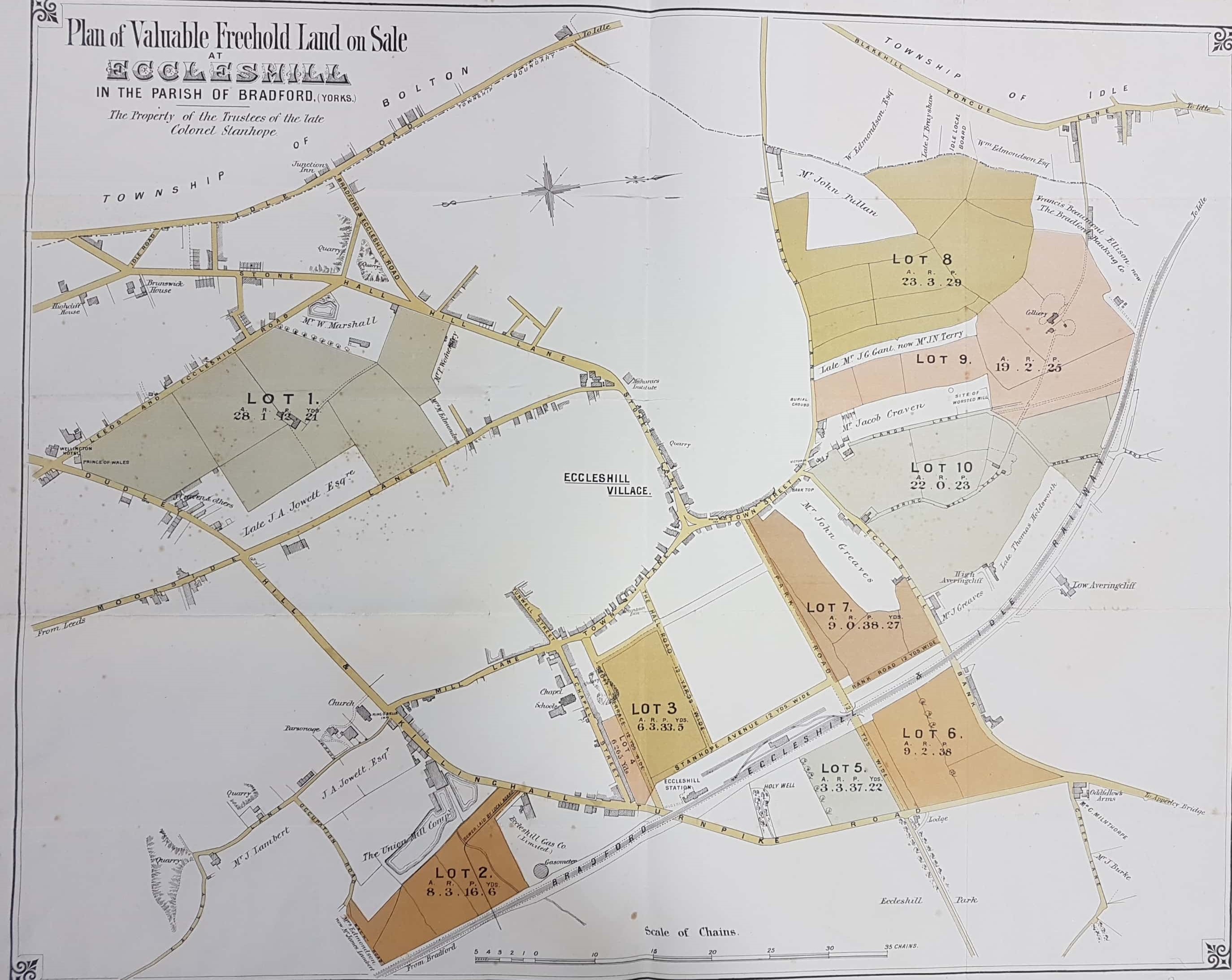
Freehold land sale Eccleshill, trustees for the late Colonel Stanhope
A. M. Pretty, printer (Manchester)
Paper Scale: 5 chains per inch Size: 65 * 50cm Condition: Good
The ancient township of Eccleshill is well represented in the Local Studies Library reserve map collection. The whole of Eccleshill was once mined for coal, with mining features being commonly seen on mid-nineteenth century maps of the district. The seams that could be exploited included the Hard and Soft Beds which were widely mined all over the north Bradford area. Above these in the geological sequence was the important vein of sandstone called the Elland Flags, which was extensively quarried in Eccleshill and Idle. Half a dozen quarries are included on the map. William Cudworth, in his account of Eccleshill, mentions the Better Bed, and also an associated fire-clay and brick making industry based at Manor Potteries in Eccleshill. The brick works is not named as such on this plan its owner, Mr W Marshall, is named (with a collection of quarries) just below Stone Hall Road.
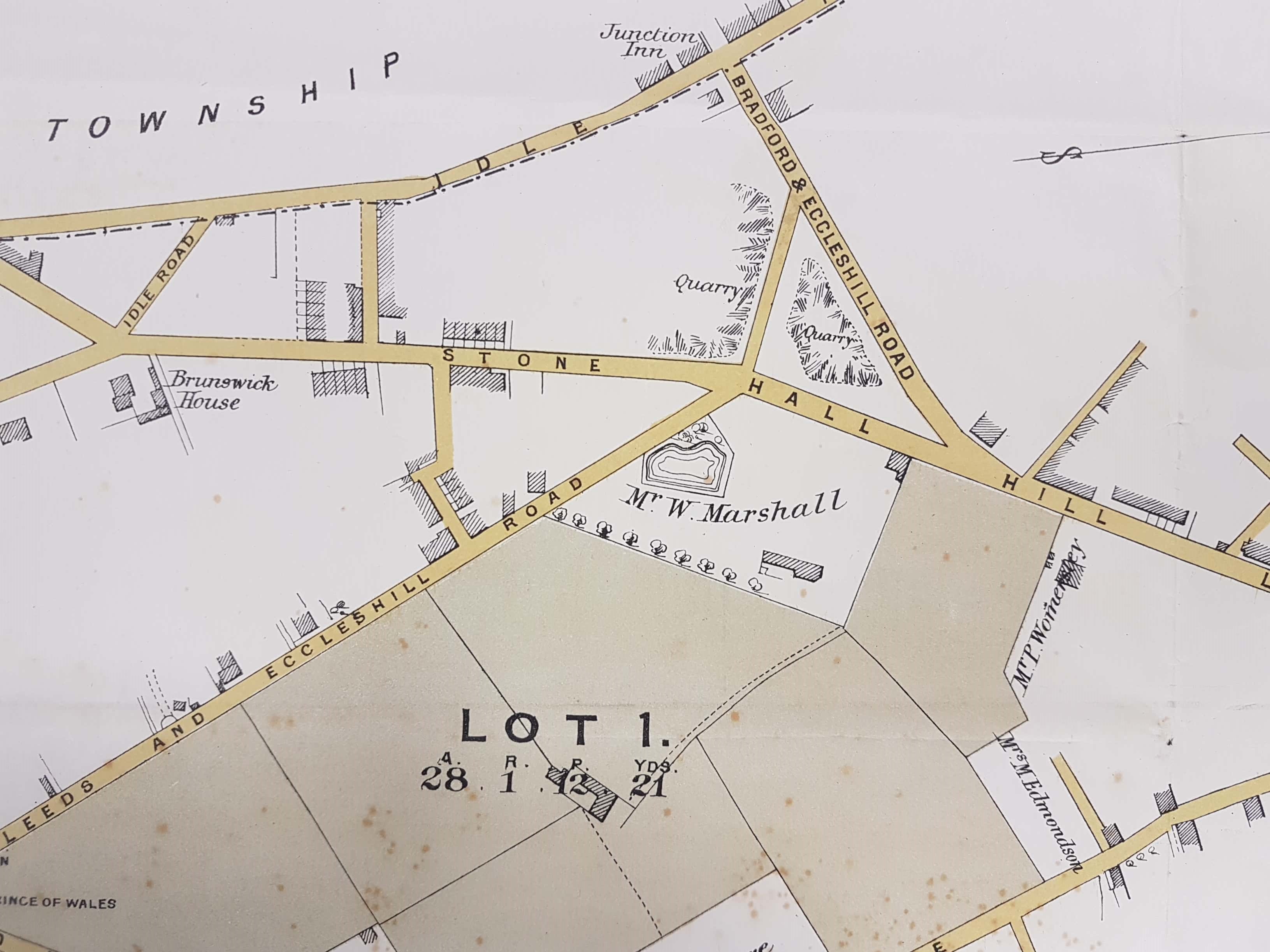
This brings us to the date of this undated plan. Manor Potteries brick works would probably have had Marshall’s name attached to it only after 1866, but what are the dates of the Colonel Stanhope whose trustees are selling the land? When Walter Stott Stanhope of Eccleshill Hall (1757-1844) died, aged 88, the estate passed to his nephew George Stott Stanhope, Lt-Colonel in the Indian Army. He soon built a larger house for himself. In the 1871 census George Stott Stanhope and his wife Mary (with various adult children) were living at The Park, Eccleshill. I assume that the ‘Colonel Stanhope’ who had trustees is this Col. George Stott Stanhope, who died in 1872. A few years after his death the original Eccleshill Hall was demolished.
Another land-owner recorded on the plan is James Atkinson-Jowett (1817-1886) who was once the owner of the Clockhouse Estate in Heaton. The Clockhouse name survives as one of the Bradford Boys’ Grammar School buildings. James Atkinson-Jowett was the son of Nathan Atkinson-Jowett. Both men changed their surname from plain Atkinson in the 1860s in order to claim the large Jowett property inheritance. I assume he inherited when his father Nathan died in 1861 but here he is once referred to as ‘Late J A Jowett Esq’ which must make the map date later than 1886. In fact it has been possible to identity the sale itself, in the Leeds Mercury, as one which took place at Leuchter’s Restaurant, Bradford on 10 July 1890. The printed list of lots for sale exactly matches this plan. Mr J Hindle was the land surveyor and the solicitors were a Manchester firm which presumably explains their use of a Manchester printer.
In examining the plan further please note that west is at the top. Among the other features recorded are the Union Mill, the Eccleshill Gas Works, and the Mechanics Institute. A planned street grid has been superimposed on an older street plan, and the sale notice in the newspaper rather harps on road frontages. There is little doubt that the desirability and profitability of house-building (rather than quarrying, mining or brick making) was the factor than led the trustees to wind up their responsibility with a land sale. As evidence for this only a single Eccleshill colliery is still included, in the top right corner. Immediately above this colliery is the name Francis Beaumont Ellison.

The patch of land is clearly marked ‘Francis Beaumont Ellison, now Bradford Banking Corporation’. Ellison once owned a fire-brick works. The earliest reference to his works I can find is a successful planning application to the Eccleshill Local Board in 1875 (Bradford Observer 18/2/1875). Ellison describes himself as a mining engineer and his earlier employment was at Whitwell Main Colliery (owned by his father) where he was ‘cerificated engineer’ in 1873. By 1881 he employed 81 men and boys at West Yorkshire Colliery Fire Brick & Santary Tube Works. His premises, at Springfield (Averingcliffe), seem to border the parishes of Eccleshill and Idle but were unrelated to Manor Potteries. His home address is given as Greenville, Idle. I think he almost certainly purchased his land from Col. Stanhope’s Eccleshill Estate in 1879, although it was later sold or mortgaged to the Bradford Banking Co. as the plan shows. The fire-brick works disappear with the 1887 trade directory. F B Ellison probably died in 1936 in Ulverston.
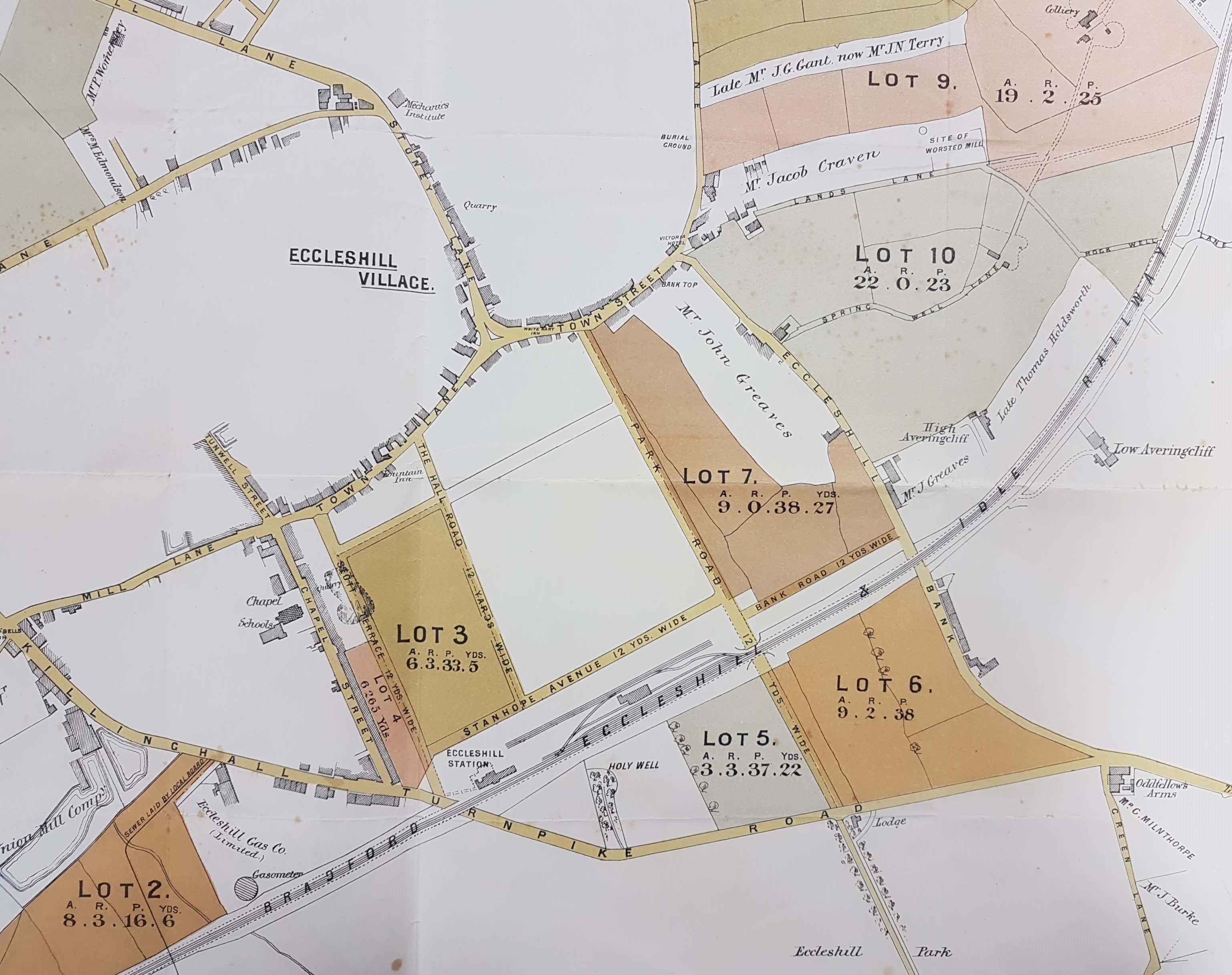
Finally the ‘Holy Well’. Anyone interested in this subject must consult Val Shepherd’s Historic Wells in and around Bradford (1994, Heart of Albion Press). Eccleshill’s well was situated at the end of Holy Well Grove. It is recorded in Tudor times but became neglected by the time of this plan and must now be underground.
 Bradford and District Libraries Map Collections