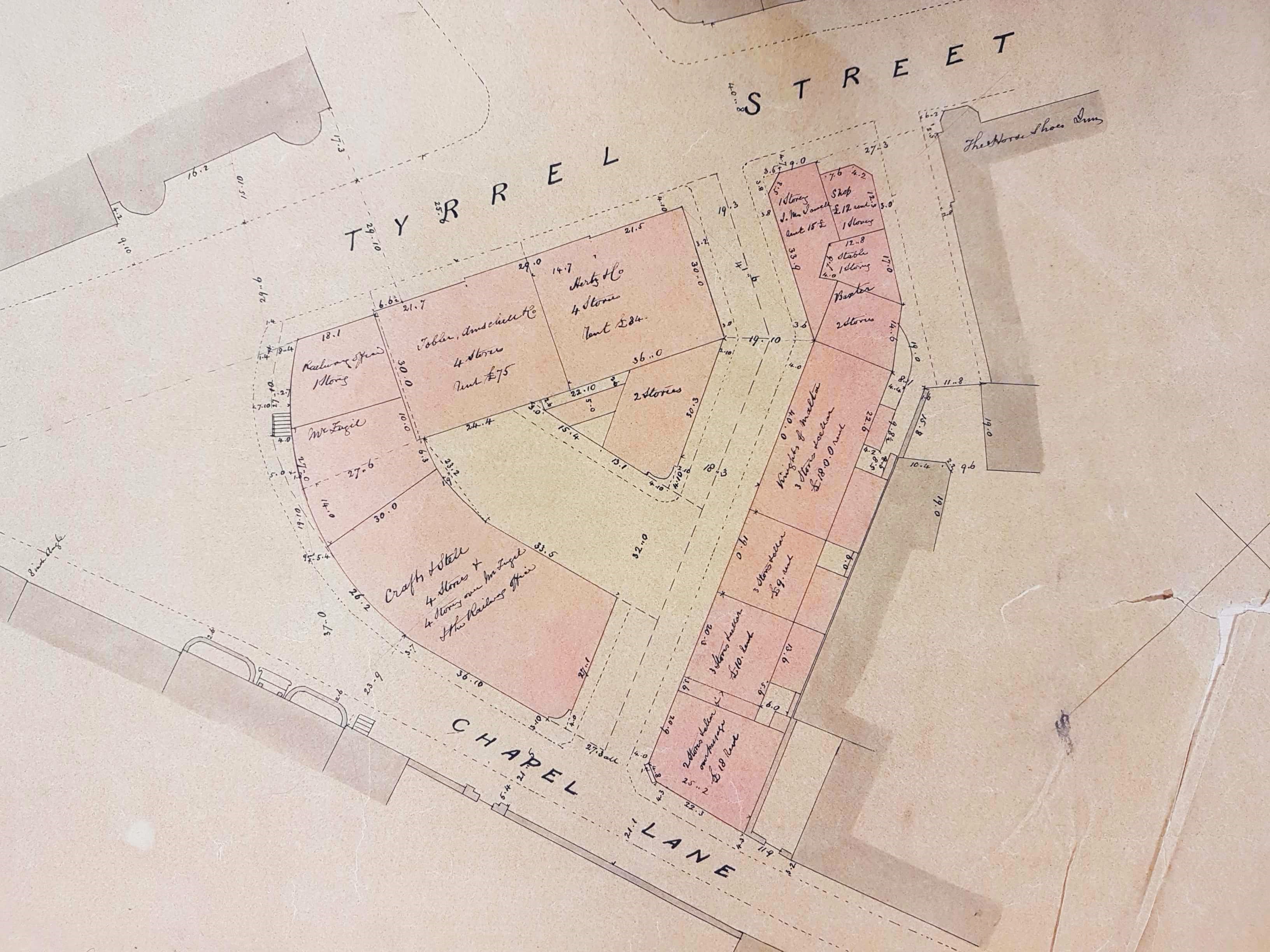
Bradford City centre, c.1852 (undated)
2.80 BRA c1852 PLA BHM 913 B12
Junction of Tyrell Street & Chapel Lane
Material: tracing paper Scale: 10 yards to 1.5 inches
Size: 60*38 cm Condition: Poor
In the 170 years since Bradford became a borough in 1847, its centre has changed almost beyond recognition. Many new buildings have been erected and old ones demolished. The Bradford Beck has progressively vanished underground into culverts. New roads have been created (Sunbridge Road being a good example), while others have been repositioned, lengthened, or have disappeared entirely. Change has been a continuous process but it was accelerated in the 1960s when there was a wholesale city centre redevelopment associated with the name of SG Wardley, then the city surveyor and engineer. In this mid-nineteenth century plan we are almost at the beginning of this process. It is easy to see the acute angle made by the Turls (Tyrrel Street) and Chapel Lane. The size of the roadways, and land occupation in this central triangle, have been very carefully plotted.
What year is represented by the plan? There is a ‘railway office’ so it must be later than 1846. In 1847 the Poor Law Commissioners considered Chapel Lane a possible site for a ‘vagrants’ yard’, and in 1855 a ton and a half of ‘vile bones’ were removed from the premises of one John Boyd, who the Lund’s 1856 Directory of Bradford lists as a ‘rag dealer’. The same source gives Rev. JH Ryland as the non-resident minister at the Unitarian chapel that gave Chapel Street its name. There is also an architects’ partnership (Stott & Illingworth) and a painter (John Edwards), but otherwise the Chapel Lane residents are all tradesmen: plumbers, hair dressers, boot-makers, saddlers, pawnbrokers and so forth.
The current undated plan must, I feel, be some years later in date. The new unnamed cut-through joining Chapel Lane and Tyrrel Street is Bower Gate. The overall topography closely resembles the 1861 OS map. I hoped to make the dating of this plan more secure by identifying the property occupants in various Bradford trade directories. I consulted three of these, for 1856, 1863, and 1871. I thought that the The Ancient (or Noble) Order of the Knights of Malta would be the easiest occupant to identify but they don’t appear in any of the directories. They clearly were a provident, or friendly, society like the Druids, Buffaloes, Oddfellows, Foresters, Orange Order, and Order of the Golden Fleece. Newspaper evidence shows that in the 1840s they were active in Bingley and Great Horton. They had lodges like the Freemasons and frequently gave dinners for long serving officers or other friendly societies. There must have been many knights since 100 attended a funeral of a member at Shelf, but I can’t yet place them in Bower Gate in the 1850s.
The next most prominent occupant is the Horse Shoes Inn at the top right of the plan. The occupant was once John Sugden, Tyrrel Street who’s inn is to be found in both the 1856 and 1863 directories but not in that of 1871. Hertz & Co. were stuff merchants. I can place them in Bradford in the same directories, but not at this address. Crafts & Stell were Manchester merchants: reports in the Bradford Observer from the 1850s have them taking their employees to a ‘sumptuous dinner’ at the Devonshire Arms, Bolton Abbey, and fielding a not very successful cricket team. So far I cannot locate an address for the company. Most helpfully Tobler & Amschel were stuff merchants who are present in the 1856 directory but dissolve their partnership soon after (in 1858) which provides a latest date for the plan. Essentially we have a plan that must date to the years 1846-58, and I have chosen the midpoint of c.1852.
The next development was to represent a huge change. Bradford Borough Council decided that a purpose built Town Hall was required to support the rapidly growing urban area. A number of sites were considered but finally a competition was launched to design a hall to be built on the Chapel Lane site. The winning design was opened by the Mayor, Matthew Thompson, in 1873. The architects were the famous partnership of Lockwood & Mawson who had already designed the Wool Exchange (1867). The contractor was John Ives of Shipley. In his book Bradford in History Horace Hird described the whole process and provided illustrations of the runners-up. It seems that all the considered designs were for Gothic buildings including a tower. The Unitarian Chapel and Chapel Lane itself were left alone during this development, but Bradford became a city in 1897 and the increase in council business required further extensions to be built.
Since I first wrote this description of the plan I have been enormously aided (not for the first time) by the researches of Kieran Wilkinson, local historian and photographer. He found press cuttings confirming that the premises fronting Tyrrell Street & Chapel Lane were known as Bower’s buildings and were actually owned by Abraham Bower of Elmcrofts, Ripon. The construction was undertaken in 1842, and by 1850 Hertz & Co, Tobler Amschel, Crafts and Stell and the Railway offices were occupied. Craft & Stell were possibly still there in 1856. An 1850 cutting refers to the ‘late offices’ of the Railway company. This probably means that the plan cannot be any later than 1850 since an 1850 directory shows the Lancashire and Yorkshire Railway Company situated elsewhere. The block was demolished in 1868 so it plainly had a short life. Abraham Bower JP (1803-1884) was born in Bradford and died in Ripon. He was the son of John Bower of Townend whose monument is in the Cathedral. In the 1840s he was contributing to ‘unemployed poor charities’ in Bradford and to the new Infirmary, and also supporting the idea of a railway link to Leeds. Even then he gives his address as Middlethorpe Hall, York. By the 1851 census, contemporary with the map, he describes himself as a ‘landed proprietor’ and lives in Ripon with his wife Cornelia (daughter of Rear Admiral Henry Gage Morris), two young daughters and a cook, gardener, maidservant, and nurses. On his death he left a personal estate of nearly £20,000. His wife Cornelia Bower was the sister of an eminent clergyman-naturalist Francis Orpen Morris. The son of Abraham and Cornelia was Prof. Frederick Orpen Bower FRS, who held the chair in Botany at Glasgow; a long way from Bower’s Buildings.
 Bradford and District Libraries Map Collections