
Peel Park Plan in 1854 surveyed by Thomas Dixon
2.98 PEE 1854 DIX Dup B-12-866
Material: tracing paper Scale: 30 yds to 1 in Size: 70 * 70 cm Condition: very poor
Peel Park is located in the Bolton and Undercliffe areas of the city. It is Grade II* listed, 56 acres in extent, and was named after Sir Robert Peel (1788-1850). It was opened to the public in 1853, so this plan may well have been the first one produced. The LSL reserve collection has a second example (10.003), also in poor condition, marked as a ‘collection duplicate’ and ‘Town Clerk’s copy’. Peel Park is significant since it was such an early example of a public park. Joseph Paxton’s design at Birkenhead is generally accepted as the first in England, being opened in 1847. The group that financed our park initially retained control and weren’t, for financial reasons, able to present it to the Borough of Bradford until 1863. We have a third plan (10.004) from 1884 which is a beautifully surveyed and drawn plan of part of the park and intended for local authority use. The first OS map of the area was released a year before Peel Park was opened but was based on a survey undertaken in the late 1840s. Its not hard to locate the position of the future public space. I have tried to establish who owned the land on which the park was constructed. Horace Hird has an account of its early days in his Bradford in History (1968, p.140-41): he describes land purchase of 47 acres from the trustees of lawyer Richard Tolson and also a 17 acre purchase from Richard Shaw. Having said all this I am not completely sure for what purpose the present map was produced. In 1854 the Bradford Observer explained that a lithographic plan was to be sold shortly showing the Park ‘as it will appear when is completed’. This is important since not all the features drawn seem to have, in reality, existed. Hird also explained that various unwanted properties, acquired with the estates, were sold off by the Organising Committee to raise money. One possibility is that this plan was intended to encourage builders and developers to take advantage of this new civic adornment, and its positive effect on property prices.
Sir Robert Peel is famous as being the Prime Minister whose government legislated against child labour in mines and factories. As Home Secretary he created the police force, and he is regarded as being the first leader of a modern conservative party. He and his supporters later joined with Liberals and Radicals in 1846 in order to reform the existing, and harsh, Corn Laws. This reform was unpopular with cereal growing landowners but resulted in the import of much cheaper grain supplies which benefited the poor. He may have hoped that this legislation might improve the position of those affected by the catastrophic potato famine in Ireland, but if so it failed. I’m not sure what combination of these achievements endeared him to the prominent citizens of Bradford when they met to plan a memorial within a few weeks of his death.
Peel had suffered a serious horse-riding accident which was reported in the Bradford Observer on 4 July 1850. Announcement of his death followed later the same day and his ‘matchless skill’ as a statesman was described. He was buried on 11 July at Drayton Bassett, his family having declined a public funeral. On 15 August the Bradford Observer described a public meeting held at the Temperance Hall, Chapel Street to plan a suitable memorial. Sir Titus Salt, then a council alderman, offered £1000 if the borough would raise £9000. Salt had previously made such an offer to develop a park, in vain, when he was mayor. He renewed the suggestion in the light of Peel’s death and it does not appear that any alternative memorial was seriously considered. The firm of Milligan Forbes & Co. donated a similar sum. Henry Ripley, who couldn’t be present, certainly suggested a statue and park. With loans and a government grant adequate funds were assembled. The public also contributed and a gala was held in the park with this in mind in 1853. The gala proved to be the first of many.

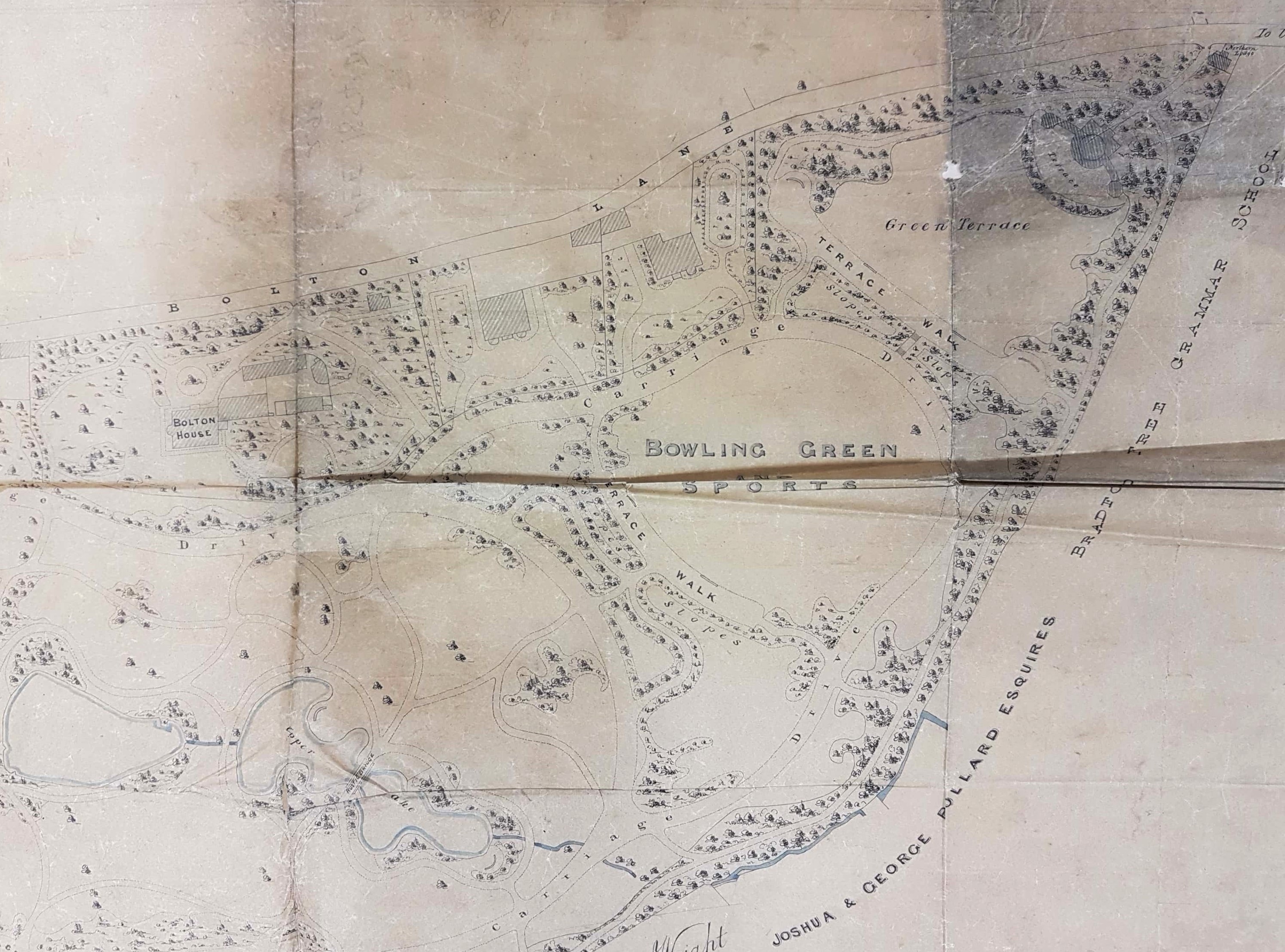
I found it more difficult to find my way round this map than originally envisaged. Items have been added to and removed from the park, several road have been reconstructed or have had their names changed. A common way of approaching the Peel Park today is up Queens Road but this had not been developed in 1854, The Queens Road bridge, which carries the traffic from Manningham over Canal Road towards Bolton, Eccleshill and Idle, was certainly in place when the 1889 OS map of the area was surveyed and the LSL reserve collection has a map from 1880 which seems to have been part of the preparatory planning for this structure. In any event Queens Road would today deliver you near the top left of the first detail of the plan, roughly opposite the three lakes. The first OS map suggests that the central lake is natural. Turning left at the end of Queens Road would take you along the Bradford & Eccleshill turnpike towards Greengates. A left and sharp right turn here today takes you along the northern edge of the park along Lister Lane and Valley View Grove. Clearly this was named Bolton Lane in the original map as can be seen in both details. Bolton House is easily visible here.
Solicitor Samuel Hailstone (1768-1851) had purchased the Bolton House estate around 1826 although he never resided there. William Cudworth records that earlier than this Bolton House was associated with the Hustler family, John the great canal promoter, and his son and grandson William and John junior. I assume the Hustlers leased the property since the estate was owned by the Lister family. However the Organising Committee acquired the house they sold it, together with the adjoining land, for a substantial sum to help fund the development of the park.
Returning to the end of Queens Road and now turning right you would now be in Bolton Road which takes you round the southern edge of the park where ‘Cliffe Lane’ is marked on the map. As you can see you drive past a series of spacious villas accessed from a carriage road. These are not present in either of the first two OS maps which suggests they were just a gleam in a surveyor’s eye rather than completed structures. Just past the southern lodge you could turn sharp left up the eastern border of the park along Back Road (now Cliffe Road). At the bottom centre is Harrogate Road. This is clearly modern Otley Road which continues to follow a course round the east of Eccleshill.

Note the Undercliffe Hotel and the land owned by Daniel Riddiough. Though now forgotten he was a remarkable man. At various times he was a brick-maker, a joiner and a builder, which is presumably how he also became involved in the ownership of a quarry. Daniel Riddiough was born in Colne, Lancs. His name appears (as Daniel Riddiough, Undercliffe) in the Leeds Mercury 28 Aug 1852 applying for a licence at the Brewster sessions. By 1872 he is described in the same publication as a brewer of Otley Road offering beer-houses to let. This must indicate that he owned what was called the Peel Park Brewery, Otley Road built in 1853. Apparently he sold this concern in 1872, and then bought it back after the new owners went bankrupt in 1882. During this period he must have retained control of some properties since in 1876 one of his pubs, the Alpaca Inn, Edward Street was subject to a compulsory purchase order by the Lancashire & Yorkshire Railway. It appears that in 1891 he sold out his brewery and 17 pubs to Hammonds Bradford Brewery Co Ltd. His brick works were at Cliffe Lane, Bolton Road. Daniel Riddiough himself died in 1911 at the age of 88. On the plan the small circle may represent a brick kiln but if so its presence would have been temporary since Riddiough built a brewery on this site and moved his brick-works further down Cliffe Lane. Above his property was land owned by the Airedale Land Society and by the time of the second OS map (1889) housing had appeared along Sydenham Place at this location.

Many changes have occurred since 1853. Portions of the park were reserved for cricket and bowls. Later on tennis courts and football pitches arrived. Statues were erected and the right hand most lake, the Upper Lake, seems to have disappeared within a few decades. Our plan suggests that there once was a northern lodge, a green terrace and a pavilion designed by Lockwood and Mawson. One version of the plan displays a drawing of the structure. On the OS maps this area is at the junction of two sheets but as far as I can see the pavilion is not present. Perhaps it was never erected in order to save expenditure. Does anybody know for certain?
 Bradford and District Libraries Map Collections