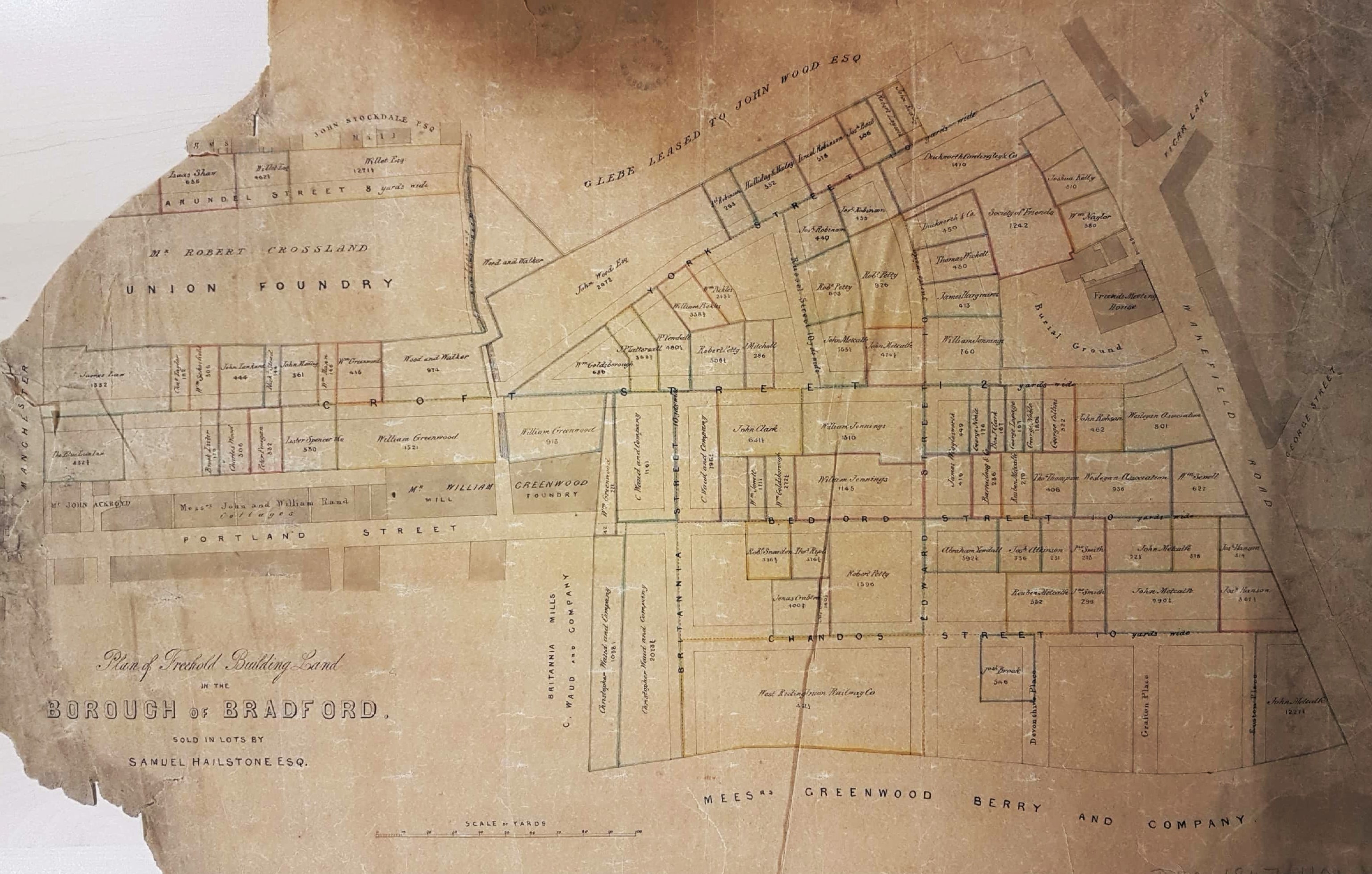
Freehold Building Land in the Borough of Bradford, c.1847
2.75 BRA 1847 HAI BHM 914 B12
Tracing paper Scale: 20 yards per inch Size 60*40 cm Condition: Poor
This plan shows land east of Wakefield Road and the Friends Meeting House including: Croft Street, Bedford Street and Chandos Street. Manchester Road is included in a damaged section on the extreme left. The land has been divided up, seemingly for auction to purchasers.

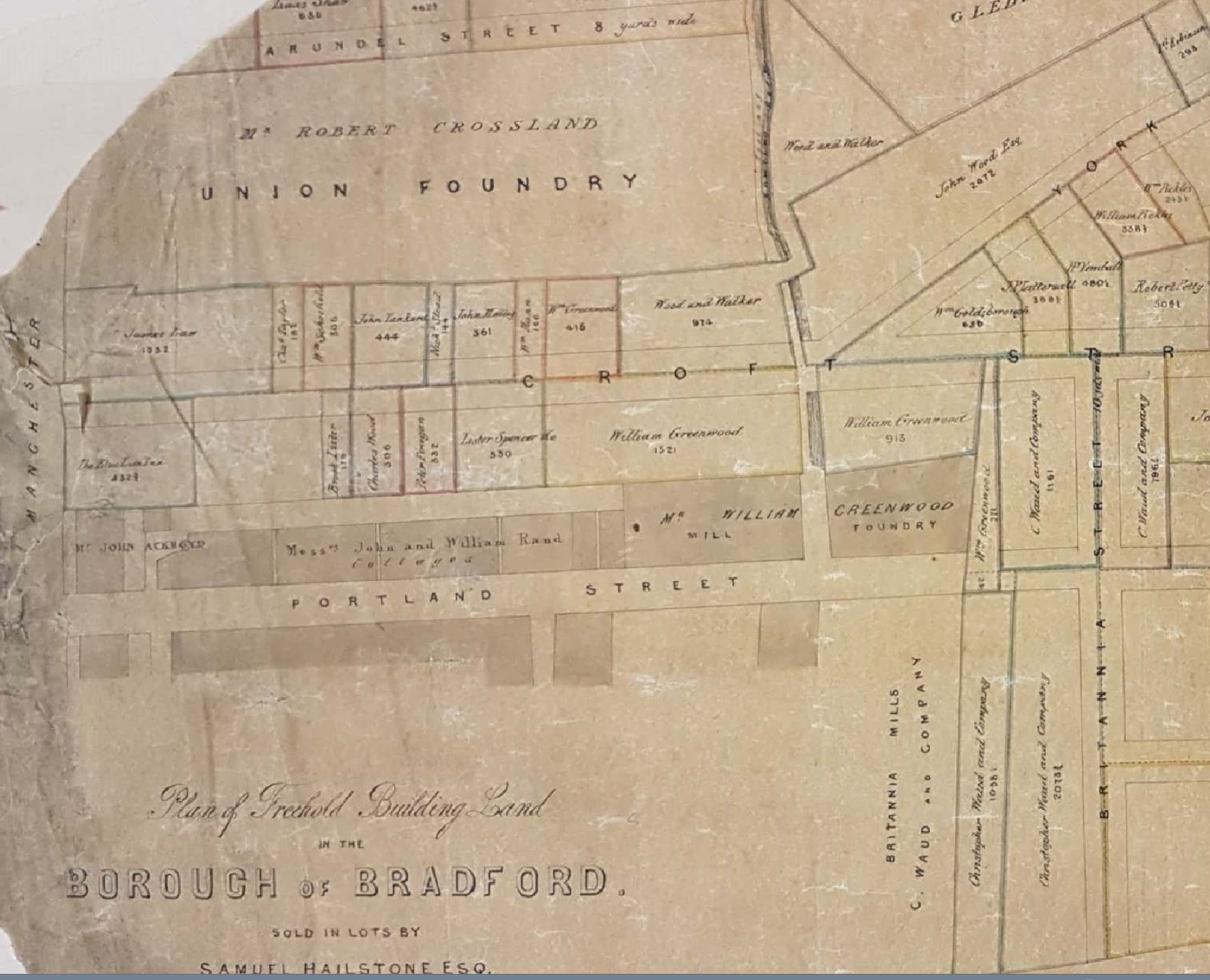
The plan is marked ‘Borough of Bradford’ which didn’t exist as an entity until 1847. Railways are not hinted at except that to the south some land is owned by the West Riding Union Railway Co (which would just have had independent existence by 1847). After 1850 there would have been the tunnel of the Lancashire & Yorkshire Railway under these streets. I have tried to identify the sale in question, without success so far, but in 26 September 1850 the Bradford Observer gave notice of a similar sale by the Lancashire & Yorkshire Railway. This included properties on Edward Street and Croft Street, roads which are included on this plan, and other properties which were identified as ‘recently acquired from Samuel Hailstone’. I have surmised that the arrival of the railway line from Halifax in 1850 resulted in many property sales and purchases. The company would have needed to acquire land along the route, and for its station. Other land-owners might well have taken the opportunity to sell land that the arrival of the railway had made more valuable for industry. Finally the railway company would have sold off recent purchases which, in the end, were surplus to its requirements.
As I work on the reserve map collection the same local land-owners appear regularly. Examples are: Rev. Godfrey Wright, Mrs Giles and Miss Dawson. Godfrey Wright owned a great deal of property around Bradford, but seemingly lived near Doncaster. ‘Mrs Giles’ was clearly a member of a family who owned much of Horton, and she or her trustees sold the land on which the Bradford workhouse (later St Luke’s Hospital) was built. ‘Miss Dawson’ was probably Eliza Dawson, grand-daughter of Joseph Dawson, partner in the Low Moor Iron Company. The name of Samuel Hailstone (1767-1851) also occurs regularly. He date of death helps make the case for a plan date of c.1847 more compelling. His importance to Bradford, and his fame as a Yorkshire naturalist, will ensure that his memory stays green. Hailstone was a well known Bradford solicitor, and was clerk to the Leeds & Liverpool Canal. He was that rare combination, a lawyer and a botanist. His brother John Hailstone MA FRS took holy orders and became a professor of geology at Cambridge. Samuel himself was born in Hoxton, London but his family soon moved to York. In time he became articled to John Hardy, a Bradford solicitor, and Hardy & Hailstone eventually became partners. John Hardy was elected an MP and was the father of another politician, Gathorne Gathorne-Hardy, who was created Earl of Cranbrook. I understand that Samuel and John Hardy were the moving spirits behind the 1803 Bradford Improvement Act. More than forty years before Bradford became a borough this act established commissioners with a variety of local government powers such as street cleaning, lighting, and water provision.
Samuel continued to practice as a solicitor and was later in partnership with the Thomas Mason who became a director of the Bolling Iron Company and lived at Bolling Hall. Hailstone was a classic example of a wealthy and highly successful professional man. His politics were Liberal and, slightly unusually for non-conformist Bradford, he was an Anglican. He purchased the Bolton House estate, which later evolved into Peel Park, although he never resided there. I get the impression that Yorkshire botany and geology were Samuel’s main interests. A collection of more than 2000 plant specimens was passed to the Yorkshire Museum at his death. But despite these studies he was active in issues affecting his chosen town. He helped found the Bradford Literary & Philosophical Society and also the Mechanics Institute. He served as a major in the Bradford Volunteer Infantry and was clerk to the Trustees of the Leeds and Halifax Turnpike Road. On the plan is Croft Street which took its name from Croft House which is where Samuel lived in his early years. In 1808, quite late in life, Samuel married Ann Jones, the daughter of a Bradford surgeon, and the couple had several children. Samuel died at Horton Hall, Bradford in 1851. In his census return for that year he indicates that he is living alone, except for a house-keeper and five servants. The Hailstones were a very high achieving family. One son, Samuel jnr., was also a noted amateur naturalist and a collector of crustacea. He pre-deceased his father in 1841. There were two surviving sons, Rev John Hailstone (1810-1871), the vicar of Bottisham, Cambridgeshire, and Edward Hailstone FSA (1818-1890). Edward took over the Bradford legal practice but is more famous for a huge assembly of books and documents relating to Yorkshire history, especially those of the Sharp family who were the previous owners of Horton Hall. This was the project of his retirement when he lived at Walton Hall, near Wakefield. At his death the collection was left to the archives of York Minster where it can still be consulted today.
 Bradford and District Libraries Map Collections