
2.48 BRA c.1869 PLA BHM 1700 B27
Proposed site of theatre c.1869
Paper Scale: unk 60*47cm Condition: fair
The maps and plans in the LSL reserve collection haven’t been examined for some years, so there is always the exciting possibility of some of some genuinely new information being discovered. As an example this plan provides a fresh insight into the history of Bradford’s nineteenth century theatres and music halls, which doesn’t seem to have been recorded elsewhere. I must say at once that I needed a huge amount of help in interpreting the plan which is very far removed from the area of industrial history where I feel most confident.
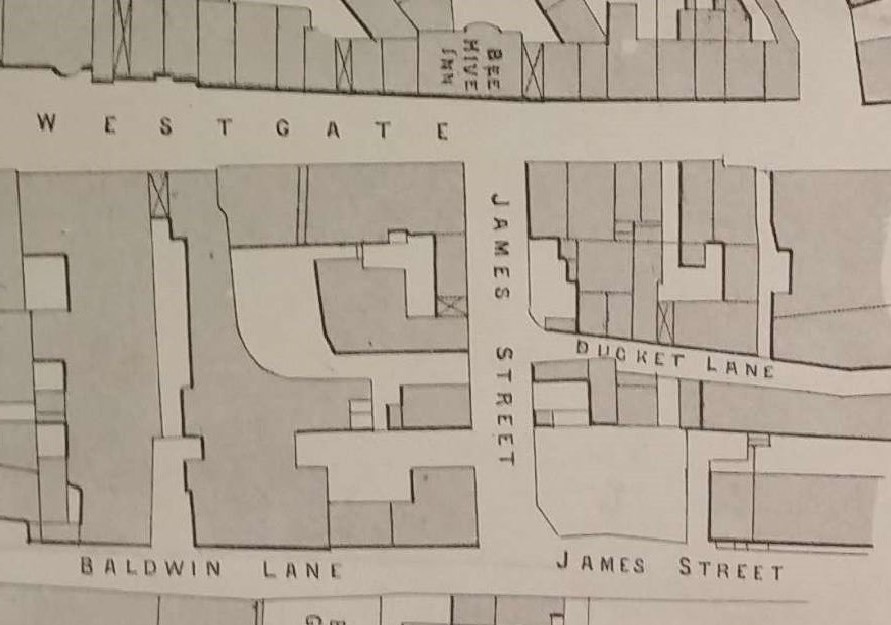
The plan in question clearly shows a theatre, or perhaps a music hall, prior to its planned enlargement. I found that the process of trying to identify the building’s actual name proved unexpectedly difficult, although I learned a good deal about Bradford theatre-land in the process. I never even attempted to unravel the ownership of the nearby slaughter house! Plans may, of course, be drawn up for buildings that are never finally constructed. But in this case the words ‘line showing size of present theatre’ are included, so some place of entertainment must surely have been on the site even if the enlargement contemplated was never undertaken. In attempting to understand this plan it is essential to appreciate the exact location. This is evidently between Duckett Lane (previously Back Lane) and James Street whose names survive to the present day. This is what the site off Godwin Street looks like today.

The site, which appears to be conveniently empty, is well displayed in another approximately contemporary map. The word ‘approximately’ is intended to convey a warning. Many of our maps are undated. Estimating their age to a decade, or even a five year period, by studying the dates of nearby buildings or known land-owners is not too difficult; but trying to accurately date some short-lived enterprise is still very challenging. The empty space at the site of interest may indicate a date prior to the theatre’s construction, or some years after its demolition. We know that theatrical premises were often constructed of wood so that erection, and demolition, would have been speedy processes.
‘Cross Street’ in the second plan has been considered as part of James Street, and must have been as incorporated into Godwin Street when this thoroughfare was developed in the early 1870s. Please note the street called Baldwin Lane which will feature in later discussion. The 1861 White’s Directory of Bradford does not contain Duckett Lane but includes James Street. Unfortunately no places of entertainment are listed here although an Ezra Hoyle is a beer-seller in ‘Cross James Street’. Hoyle is still there in the 1863 Directory. In the 1861 census his residence is described as the ‘Bay Horse Inn’.
In these directories there doesn’t seem to be a category for theatres, music halls or similar places of entertainment. This is still true in the 1872 directory but this at least this source lists a Henry Pullan, Brunswick Street, individually as a music hall proprietor. His theatre is elsewhere described as a ‘large wooden building…erected in 1869’. The Theatre Royal in North Parade is also described which seemingly cost £8000 to build and was leased by Mr Charles Rice. By the time of the PO Directory of 1879 things are much better. We now have the Theatre Royal, Manningham Lane and the Princes Theatre, Horton Lane (with the Star Music Hall in its basement) and finally a new Music Hall in Brunswick Place, owned by Henry Pullan and managed by CR Pullan, his son. None of this is the slightest help with the original plan however. The same directory itemises business premises in James Street and Godwin Street but there are still no theatres included.
Unhelpfully the original plan is undated, but it incorporates a list of distances from the New Wool Exchange. It mentions St George’s Hall (opened 1853) and the New Exchange assembly rooms (foundation stone laid 1864), so presumably it was drawn up after 1865. The signature of the surveyor who drew up the plan is illegible although his address is 31, Kirkgate. In 1863 there was an architect, Thomas Campbell Hope, at 31 Kirkgate who advertises frequently in the Bradford Observer.
Before trying any further to identify the building concerned I tried to learn a little about the overall theatre history of Bradford. In Charles Dickens’s rather neglected novel Hard Times Mr Sleary, a circus manager, says: ‘People must be amused…they can’t be always a working, nor yet they can’t be always a learning’. So, how were they amused in Bradford? It seems that in the late eighteenth and early nineteenth centuries itinerant entertainers visited public houses, and there were also visits from fairs and circuses. Permanent theatre building had commenced by the 1840s. In 1849 Henry Pullan, who I have already mentioned, is known to have built the Coliseum Theatre in Westgate. Pullan had previously managed the Bermondsey Saloon in Cannon Street, a noted place of entertainment. His Coliseum was unusual in that it was not directly linked to a public house. The Coliseum was not Bradford’s first theatre which is said to have been owned by an L.S. Thompson in a converted barn on Southgate (now Sackville Street) around 1810-25. This hosted travelling theatre troops. A few years later, in 1841, the New Theatre opened at the city end of Thornton Road using the upper room in an existing Oddfellows Hall which itself had been opened in 1839. The Oddfellows were a friendly society who had 39 branches in Bradford and surrounding areas. I understand that the New Theatre was intended to hold ‘superior performances’. In the same year the Liver Theatre, Duke Street, became Bradford’s first purpose built theatrical premises. In 1844 it was remodelled and re-opened as Theatre Royal, Duke Street. There is another undated map, possibly of 1863, in the reserve collection which at least identifies its position, a position which is still commemorated by a wall plaque.

The fact that this theatre was widely known as the ‘wooden box’ may say something about the standards of its construction but in illustrations it looks stable enough. In 1864 the Alexandra Theatre had opened in Manningham Lane and in 1869, when the original Theatre Royal finally fell victim to a series of street improvements, the Alexandra took over its discarded name. The second Theatre Royal’s moment of fame occurred in 1905 when the great actor Sir Henry Irving gave his final performance as Thomas Becket on its stage. Shortly afterwards he collapsed and died in Bradford’s Midland Hotel.
By the time of the 1869 Directory we know that Mr Pullan had moved to a theatre called Pullan’s ‘New’ Music Hall, Brunswick Place (now Rawson Street, by the multi-storey car park). This had the amazing number of 4,000 seats; the modern Alhambra has less than half that number. Pullan’s new music hall remained in existence in the years 1869-89, at the end of which time it burned down. The vacant site left after the fire eventually evolved into the John Street open market. In 1876 the Prince’s Theatre was built above Star Music Hall in Victoria Square. The proprietor of this curious double establishment was entrepreneur William Morgan who started his career as a Bradford hand wool-comber and concluded it as mayor of Scarborough. I think its site is the garden that is now in front of the Media Museum. Both theatres were fire damaged and restored in 1878. The Star had an important role during the great Manningham Mills strike of 1890/91 when one of Henry Pullan’s sons placed his premises at the disposal of the strike committee during the early days of the dispute. The Star Music Hall was renamed as Palace Theatre in 1890s and finally demolished in the 1960s. In 1899 the Empire Theatre was built at the end of Great Horton Road. All three theatres were just across the road from the present Alhambra which was built in 1914 and is associated with the name of Bradford’s pantomime king, Francis Laidler. In 1930 the New Victoria was opened on an adjacent site but this was eventually converted to the iconic Odeon Cinema. Finally I should mention that in 1837 the Jowett Temperance Hall had been built and this was also converted into a cinema as early as 1910. This building was also destroyed by fire and was rebuilt in 1937 as the Bradford Playhouse, Chapel Street. If you would like a more detailed, and very well written, introduction to the subject of Bradford theatres there is a website:
http://www.arthurlloyd.co.uk/BradfordTheatresIndex.htm
One source for the information on this site is the long account of local theatres given in William Scruton’s Pen & Pencil Pictures of Old Bradford. Scruton provides many details of the largely forgotten actors who performed in Bradford. More recently the development of the early theatre was described by David Russell in The Pursuit of Leisure (in Victorian Bradford, 1982).
So, returning to the original question, which was the theatre illustrated in the plan, which was presumably drawn sometime in the years 1864-69? It initially seemed plausible that it represented an intention to enlarge the old Coliseum theatre, ‘off Westgate’, around 1868 although in the end a wholly new building was constructed on a nearby site. When I proposed this theory as a LSL ‘map of the week’ local historian and photographer Kieran Wilkinson disagreed. He was sure that this location was never the site of the Coliseum and I am now fully persuaded that he is absolutely correct. What follows is entirely based on his researches.
In the Bradford Observer 19 April 1860 there was a small advertisement: ‘To let with immediate possession Eagle Balls Music Saloon, James Street, Westgate. Enquire of the proprietor’. The name seems quite strange, could Eagle Halls have been intended? I think it is certain that was an Eagle Saloon or Music Saloon at this site which (as many did) also operated as a musical theatre. We know that one one occasion an engagement for a comic singer was being advertised. There might well have been a plan to enlarge it in the mid 1860s even if this enlargement never actually took place. Kevin Wilkinson has located the name of this proprietor in a cutting from The Era, 24 May 1857, which calls him F. C. Rushworth. The 1857 PO Directory names Frederick Collier Rushworth, as a beer retailer, of Baldwin Lane, James Street. How his property is both on James Street and Baldwin Lane is not entirely clear unless he operated on both sides of the road. Further information about Rushworth is not hard to come by. The London Gazette reports that in 1855 Frederick Collier Rushworth, late of Victoria St Bradford, was out of business and in the gaol at York as an insolvent debtor. He was described as previously of the ‘Eagle Ale Vaults’, now in lodgings. As Frederick Collyer (sic) Rushworth married at St Peter’s PC on 11 January 1853 when he gave his profession as woolstapler; his bride was called Hannah Smithies. Frederick was the son of Joseph Taylor Rushworth, also a woolstapler, who certainly lived in Victoria Street, North Parade Bradford, with Diana his wife, in the 1851 census. They are at the same address a decade later although ‘woodstapler’ has become the far less affluent ‘woolsorter’. Frederick Collyer is not living with his parents on these occasions, nor in the 1841 census. His insolvency announcement suggests he may have been a warehouseman in this period. By 1861 Frederic (sic) and Hannah Rushworth were in Liverpool where Frederick was working as a hotel manager. He had been born in 1824 and gives Bingley as his place of birth. There the trail ends at present, although Liverpool is a good place to be if you wish to test your managerial skills in the New World.
Although we don’t know any more about how the Eagle Music Saloon operated we do know a good deal about contemporary music halls from Mr Pullan’s efforts to obtain an alcohol licence for his Brunswick Place theatre. The Bradford Observer in September 1869 reports he was making application at the Brewster Sessions. The account refers to his managing a similar house in Bradford satisfactorily. In the new house there would be no stage plays, nor obscene songs. ‘Coarse and obscene ballads’ are mentioned in other accounts of contemporary music halls. Entry charges of 3/6 and 1/- would be made. Performances were from 7.30 pm to 10 pm, and never on Sundays. Alcohol would be served only in a bar specifically provided for that purpose. Mr Pullan stated that he had returned to Bradford in 1864 after seven years in Manchester and at present he ‘kept a concert hall in Westgate’ which must be the original Coliseum. He obtained his license and by November 1869 the local paper reported that Mr Pullan’s newly erected music hall in Brunswick Place had been well-attended. He was engaging ‘a superior class of artiste’ which included the famous Mr George Leybourne.
Pullan’s old Coliseum survived, being later renamed as St James’s Hall and then The Protestant Working Men’s Hall. It was finally demolished in 1892. Today at the site in James Street the Commercial Inn and other Victorian masonry buildings can be found. While undertaking his researches Kevin has pushed back the history of Bradford theatres into the late eighteenth century, and discovered the names of other forgotten establishments. Possibly the time is coming for a wholly new history to be written.
 Bradford and District Libraries Map Collections
I have an interest in Henry Pullan and have been trying to locate the site of the Coliseum which is given as, 7 Westgate in the 1851 census. Henry was working for his mother in law, Martha Dunn, and is listed as a Clerk, while Mary is listed as Beerseller. If the numbers up Westgate have stayed in the same order, the building opposite the Kirkgate Centre has a date of 1887 and was built after the area was cleared, so number 7 would have been in or around this block. I would be interested to see detailed a map like the ones above.
LikeLiked by 1 person
Sorry for the long delay in replying to your comment. I’m glad the map was of interest. Before I briefly researched it I hadn’t appreciated that the exact location of former Bradford theatres was often in doubt. Thanks.
LikeLike